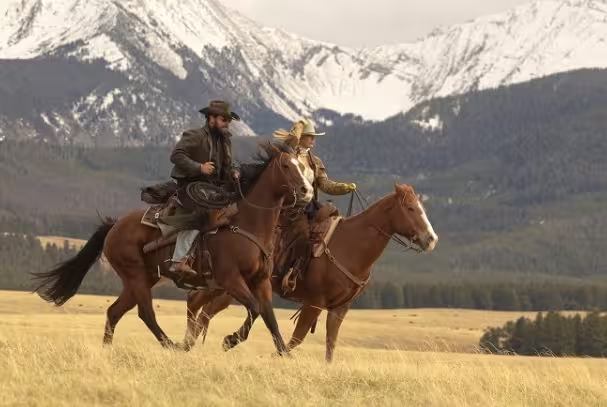
The highly anticipated continuation of the sprawling modern Western universe strips away the mountainous grandeur of Montana, dropping its most volatile survivors into the unforgiving, sun-baked plains of Rio Paloma, Texas. Searches for a definitive Dutton Ranch ending explained have surged exponentially as viewers attempt to untangle the intricate web of deceit, cartel violence, and territorial warfare that defines the Paramount+ series. Premiering on May 15, 2026, the series immediately establishes that escaping the ghosts of the past is an absolute impossibility.
The narrative brilliantly subverts the traditional pioneer story; rather than building a hopeful dream in a new frontier, the protagonists are desperately trying to outrun a nightmare, only to collide with a heavily entrenched local dynasty that operates with a ruthlessness that eclipses their own. This comprehensive analysis moves far beyond surface-level episodic recaps. The following report synthesizes character psychology, structural metaphors, behind-the-scenes production drama, and the massive narrative shifts that detonate in Episodes 7 and 8.
Strategic Framework: The Content Architecture
To deliver a truly authoritative analysis that captures the nuances of this complex thriller, it is essential to deconstruct the structural methodology utilized by top-tier analytical platforms such as memoria.film. This model eschews simple plot summaries in favor of categorizing the narrative into distinct pillars: the weaponization of trauma, the psychological profiling of the elite cast, the sequential deconstruction of ambient dread across episodes, and the unearthing of hidden theories.
Competitor reviews entirely ignore the critical context of the show’s production turbulence. Creator and initial showrunner Chad Feehan departed the project after wrapping the first season due to intense creative clashes. Understanding this friction is essential for analyzing the slight tonal shifts and pacing irregularities present in the mid-season episodes. By bridging these gaps and synthesizing the fragmented data into a cohesive, long-form narrative, this report establishes total thematic dominance over the subject matter.
The Psychological Architecture: Comprehensive Cast Analysis
To fully comprehend the escalating warfare on the Texas plains, one must meticulously dissect the deeply flawed, traumatized individuals driving the conflict. The transition away from their historical power base stripped the protagonists of their political armor, leaving them to rely entirely on raw, survivalist instincts. This desperate power dynamic is mirrored perfectly in their new rivals.
| Actor | Character | Narrative Role & Psychological Profile |
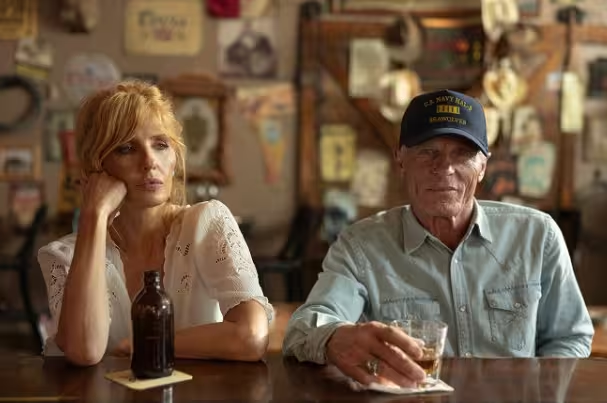
| Kelly Reilly | Beth Dutton | A fiercely protective survivor operating in exile. Stripped of her legacy, her immense grief drives a desperate need for peace, which instantly morphs into ruthless corporate maneuvering when threatened. |
| Cole Hauser | Rip Wheeler | The eternal enforcer, now a desperate landowner. Thrust into a landscape where his reputation holds no currency, he relies on calculated violence and ultimately forms a silent, deadly alliance to take down the Jacksons. |
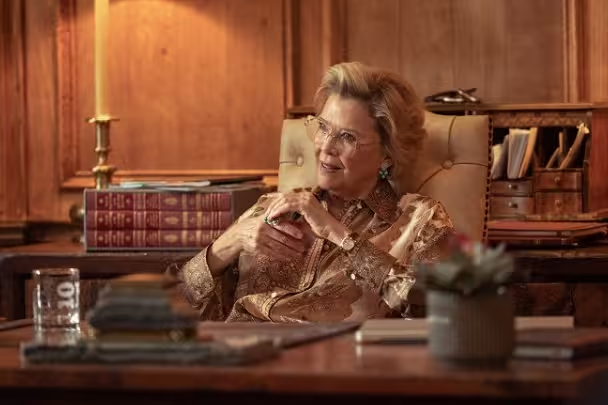
| Annette Bening | Beulah Jackson | The machiavellian matriarch of the 190-year-old 10 Petal Ranch. She weaponizes Southern hospitality to hide her darkest sins, including the cold-blooded murder of her son’s father, before a sudden medical collapse removes her from power. |
| Finn Little | Carter | A deeply traumatized young man struggling with identity and isolation. Following brutal romantic rejections, he spirals into severe intoxication, desperately searching for purpose and attempting to sever ties with his adoptive family. |
| Jai Courtney | Rob-Will Jackson | Beulah’s biological son; an erratic, heavily armed addict. Driven by a severe inferiority complex, his impulsive violence and sudden, terrifying ascension to ranch leadership trigger an immediate, multi-front war. |
| Juan Pablo Raba | Joaquin (Waquen) Jackson Reyes | Beulah’s adopted son and the family’s former fixer. Betrayed by his mother’s succession announcement, he entirely abandons his loyalty to the Jacksons, actively attempting to frame his brother for murder. |
| Natalie Alyn Lind | Oreana Lynn Jackson | Rob-Will’s daughter. Raised devoid of genuine affection, she is fiercely independent and coldly rejects Carter’s emotional vulnerability, heavily mirroring the toxic, manipulative traits of her father. |
| Rebecca Robles | Young Beulah | Appearing in harrowing flashbacks, she showcases the trauma of a brutal assault that fundamentally altered the matriarch’s psychology, forging her into a ruthless, calculating killer. |
Narrative Deconstruction: Episodes 1-4 Ending Explained
The narrative pacing of the series relies on a deliberate, agonizing slow burn of escalating dread, violently punctuated by moments of shocking, immediate carnage. The transition from attempting to build a peaceful dream to fighting an all-out territorial war is methodical, drawing the audience deep into the psychological degradation of the characters.
Episode 1: The Ashes of the Past
The premiere episode operates as a brutal, literal severing of historical ties. The opening sequences are bathed in the horrific, glowing embers of a catastrophic Montana wildfire, incinerating the protagonists’ ancestral legacy and propelling them to Rio Paloma, Texas.
The episode’s ending masterfully shatters any lingering hope for a peaceful existence. As Rip surveys his newly acquired land, he discovers a pack of feral hogs actively feeding on the partially buried corpse of Wes, a dedicated ranch hand from the neighboring 10 Petal Ranch. Wes had been asking dangerous questions about falsified cattle records before being brutally murdered by Rob-Will Jackson. This gruesome discovery instantly anchors the new arrivals to the violent, clandestine warfare of their powerful new neighbors.
Episode 2: The Illusion of Control
The second episode explores the severe moral compromises required to survive in the borderlands. At a high-stakes bull auction, Beth deliberately outmaneuvers the formidable Beulah Jackson to secure a prime breeding bull, initiating a silent, tense rivalry between the matriarchs.
The ending delivers a chilling look at Rip’s deeply ingrained methodology. Rather than contacting local law enforcement about the mutilated body discovered on his land, Rip handles the corpse with calculated, silent efficiency. He meticulously transports the remains and drops them down an abandoned, bottomless mine shaft, proving that despite the change in geography, he cannot shed his identity as a ruthless, shadow-dwelling protector.
Episode 3: Biological Terror
The third episode brilliantly pivots from human-inflicted violence to the devastating realm of biological terror. The prized bull Beth purchased brings a catastrophic outbreak of foot-and-mouth disease directly into the heart of their new herd, threatening to financially annihilate their new beginning.
Simultaneously, Wes’s desperate widow, Whitney, begins aggressively questioning the Jackson family about her husband’s disappearance, actively filing a missing persons report. The episode concludes with a horror-tinged sequence: Beulah personally visits Whitney’s isolated trailer late at night, only to find the residence completely empty. This marks the defiant widow as the second mysterious disappearance tied directly to the Jacksons.
Episode 4: The Ultimate Sacrifice
Operating purely on financial desperation, the fourth episode features one of the most harrowing sequences in the franchise’s history. Realizing the foot-and-mouth disease is completely incurable and rapidly spreading, Rip makes an excruciating decision. To prevent a massive federal quarantine that would destroy the county’s agricultural economy, he must eradicate his own livelihood.
The camera lingers agonizingly as Rip, bathed in sweat and smoke, methodically fires into his own livestock. Discovering the local livestock broker deliberately falsified the veterinary records, Rip exacts immediate retribution, tracking the corrupt broker down and burning his trailer to the ground. The protagonists are left standing amidst the ruins of their independence, heavily foreshadowing that their only viable path forward is forging a dangerous alliance with the very family that controls the region.
Narrative Deconstruction: Episodes 5-8 Ending Explained
The back half of the season abandons the slow-burn approach, accelerating into a chaotic flurry of blackmail, deeply buried historical secrets, and a ruthless power struggle for ultimate control.
Episode 5: The Trojan Horse
Grief, deception, and strategic corporate realignments dominate the fifth episode. With their herd completely decimated, Beth boldly marches directly into the lion’s den and offers Beulah Jackson a high-stakes business proposition: Beth will market the 10 Petal’s massive beef supply to premium national distributors, effectively saving the Jacksons from financial stagnation.
As part of this uneasy truce, Rip embeds himself at the 10 Petal Ranch in an oversight role. However, the episode concludes with Beth explicitly revealing her true motives to Rip: she fully intends to use this physical proximity to uncover every single dark, illegal secret Beulah harbors, weaponize that knowledge, and seize ultimate control of the empire from the inside out.
Episode 6: The Blood Escalation
The immense tension meticulously constructed over the previous hours finally detonates. At the 10 Petal Ranch, the heavily intoxicated Rob-Will manipulates the easily influenced foreman, Chet, into attempting to assassinate Joaquin. Chet cowardly shoots Joaquin through the hand, but is instantly shot and killed by Miguel, the ranch’s hyper-competent security enforcer.
Simultaneously, Beth and Beulah successfully secure a massive distribution deal with frontier hospitality CEO Zane Nash in Dallas. However, this victory is immediately undercut by Beulah. Over post-meeting drinks, Beulah casually brings up the highly mysterious disappearance of Jamie Dutton, Beth’s deceased brother. Beulah’s calculated mention is a direct threat, demonstrating she has already begun digging deeply into the Duttons’ darkest Montana secrets.
Episode 7: Den of Sin
The seventh episode, aptly titled “Den of Sin,” reveals the horrifying truth behind the Jackson matriarch’s power. Harrowing flashbacks show a young Beulah brutally assaulted by a man named Luke in Fort Worth. A subsequent flashback reveals a pregnant Beulah coldly shooting and killing Luke in his own home, proving that Rob-Will is Luke’s biological son and exposing the “drowning” story as a complete fabrication.
In the present, during the 190th-anniversary celebration, Beulah intends to announce Joaquin as her successor. Instead, Rob-Will escapes rehab, surprises her, and demands the throne. Bowing to the blackmail, Beulah officially names Rob-Will as the heir, shocking the entire party and deeply upsetting their new corporate partner, Zane Nash. Meanwhile, a heartbroken and severely intoxicated Carter literally rips the prized bullhead off the wall, symbolizing the shattering of the Jackson dynasty. The extreme stress culminates in Beulah collapsing to the floor, suffering a devastating medical emergency.
Episode 8: The Power Vacuum
Episode 8 drastically alters the landscape of Rio Paloma. With Beulah fighting for her life in a hospital bed, Rob-Will wastes absolutely no time stepping into the power vacuum, aggressively claiming authority over the 10 Petal Ranch. His impulsive, ruthless leadership immediately creates a climate of fear and instability.
Furious at being passed over and betrayed, Joaquin finally turns his back on his adoptive family. He takes the murder weapon—the exact gun Rob-Will used to kill Wes—directly to Sheriff Wade, intending to frame and destroy his brother. However, this action is highly volatile, as Rip’s fingerprints are likely also on the weapon. Furthermore, a shocking final reveal shows Joaquin calling his biological father, Mariano, who is surprisingly still alive and potentially tied to cartel operations. The episode concludes with a silent, terrifying understanding passing between Rip and Joaquin; an unholy alliance formed with the singular goal of taking Rob-Will down before he destroys them all.
Episode 10 : The End Of The Season
The Dutton Ranch Season 1 finale just dropped, and it is safe to say this was easily the best episode of the entire season. It delivered everything we wanted: a massive cartel shootout, a major character death, and a brutal cliffhanger that paints an extremely dark direction for Season 2. But it also gave us answers to questions that have been brewing since the very beginning.
If you are wondering how the Temple Ranch got mixed up in moving narcotics, why Rob Will had to die, and who just kidnapped Carter, you are in the right place.
The Truth About the 10 Pedal Ranch Cartel Connection
All season long, fans watching through a microscope suspected that the 10 Pedal Ranch was smuggling drugs and cattle. Well, the finale confirms it.
After Austin snitched at the end of episode 8, Beth and Rip figured out the operation. They used an incapacitated Rob Will’s tally book to determine exactly which cows were being used as drug mules. Everett rips open a package and pulls out 3.5 kilos of fentanyl. Zachariah immediately confirms the staggering value: that single stash is worth $2 million.
The fentanyl belongs to Mariano, Joaquin’s biological father.
But how did a legacy Texas ranch get involved with a Mexican cartel boss? We finally get the full backstory during a highly contentious and emotional confrontation between Everett and Bula. Bula explains that roughly 15 years ago, a devastating drought hit Texas, leaving the Temple Ranch on its absolute last legs. To keep the lights on and save the operation, Joaquin brought Bula a “temporary” option from Mariano to transport narcotics into the country through the cattle.
Bula admits it was a terrible mistake, and she has felt trapped ever since. She genuinely thought that partnering with Beth and Rip for their farm-to-table meat proposal would provide her a clean exit strategy from the cartel because she didn’t trust Rob Will to handle it. Naturally, Beth and Rip are absolutely fuming that Bula lied to them and dragged them into a multi-million dollar fentanyl war.
Mariano’s Backstory and Revenge
Mariano isn’t just a random cartel boss. He was originally a young farmhand at the 10 Pedal Ranch.
Forty years ago, Bula murdered a man named Luke who raped her. When Bula’s father found out, he blamed Mariano for the murder, forcing him to take the heat and disappear into Mexico. In exchange, the ranch agreed to raise his baby son, Joaquin. They created a cover story that Mariano had died to protect Bula from the murder investigation.
Tragically, when Mariano and his wife (Joaquin’s mother) reached the Mexican border, they got caught up in something dangerous, and his wife was killed. This sparked Mariano’s deep-seated anger toward the Temple Ranch.
In the present day, Mariano is a ruthless “godfather” figure who demands absolute loyalty. In a beautifully shot scene, we see him in a church denouncing Satan, completely ignoring the irony that he is an evil man himself. His men even made a pact to be protected by the “Saint of Death,” ensuring they will never spill information regarding his whereabouts in Mexico if captured.
Mariano wants the 10 Pedal Ranch to go to Joaquin, not Rob Will, because he views Rob Will as an incompetent liability. He is furious that Bula picked “blood over competence” and brought in strangers like Beth and Rip.
The Firefight and The “New Train Station”
Once Mariano realizes he has lost his multi-million dollar fentanyl stash, he retaliates. Following a meeting at the Landmark Motel, Mariano sends five masked men to the Dutton Ranch to ambush and eliminate Beth and Rip.
It turns out to be a massive mistake. Beth, Rip, Zach, and Azul easily hold their ground in a tense, action-packed firefight, making sure they never lose an inch of their property. Rip fully embraces his hardcore cowboy persona, owning everyone in sight. He casually disposes of the cartel bodies by dumping them down a mineshaft, officially christening it as the new “train station”.
Rip does manage to capture one of the attackers alive for interrogation. However, the man refuses to spill any information regarding Mariano’s location in Mexico, remaining bound by the deadly pact he made to the “Saint of Death”.
Did Joaquin Actually Kill Rob Will?
With the ranch spiraling out of control, Mariano decides he wants all liabilities removed so Joaquin can take over. He explicitly orders Joaquin to kill his own brother, Rob Will.
Before his demise, Rob Will gets a surprisingly touching send-off. He makes peace with his daughter, Oriana, admitting he hasn’t been a good father, but tells her she is the “only thing on the ranch that wasn’t crooked”. Shortly after, Rob Will is found dead, making it seem like Joaquin finally found the “minerals” to pull the trigger—a direct callback to Rob Will insulting his brother’s courage back in episode 2.
But here is where the show leaves a brilliant thread of doubt: we never actually see Joaquin pull the trigger. When Oriana screams after discovering her father’s body, Bula rushes in looking absolutely shocked. However, Bula drives a car that looks very similar to Joaquin’s, leaving a tiny window of suspicion heading into Season 2. Jai Courtney did a fantastic job making Rob Will a complex, underutilized villain, and his exit was perfectly executed.
Oriana’s Huge Secret
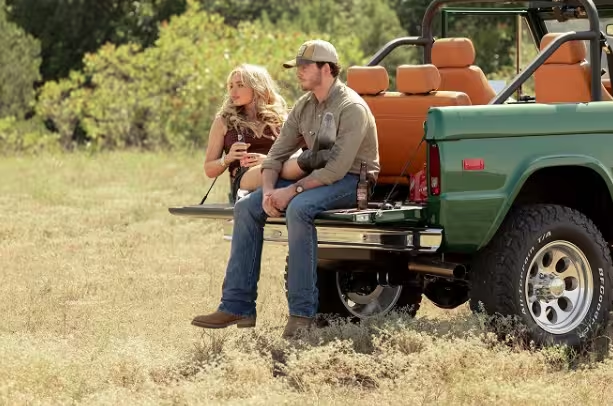
While the adults are busy with shootouts and assassinations, Carter and Oriana are making plans to run away together. They meet up at Dwight’s old spot, but when Carter offers her an HB soda, she declines.
The reason? Oriana is pregnant.
After just one impulsive roll in the hay, the two teenagers have a baby on the way. It is a funny, ongoing trope at this point—the Yellowstone universe is notoriously fertile. Between Elizabeth and Alexandria in 1923, Beth’s teenage pregnancy, and now Oriana, one romantic night is all it ever takes.
The Kidnapping of Carter and The Final Cliffhanger
Carter has spent the entire season acting like a brat, ignoring Beth and Rip’s calls, and refusing to tell them his location. He has basically been acting like a bum, wasting his days drinking beer exactly where Dwight used to sit.
When Carter hears a knock at the door, he assumes it is Oriana ready to run away. Instead, he is met by one of Mariano’s men (a “Miguel equivalent”), who violently knocks him down and kidnaps him to use as leverage against Beth and Rip. It is highly likely that the shady Sheriff Handy Wade tipped the cartel off, as he was the only one who actually knew where Carter was hiding.
While it feels a bit repetitive to the Yellowstone scripts—remember when Tate was kidnapped at the end of Season 2?—the emotional delivery makes it work.
Moments later, Beth’s phone rings. It is Mariano, coldly stating: “Beth Dutton, I have your boy”.
Rip instantly realizes the true motive. “They don’t want Carter,” he says. “They want us”.
Beth has shown a much softer, gentler side this season. Earlier in the episode, she confessed to Everett her deep fear that the world was going to open up and swallow everything she loves. Now that her worst nightmare has happened, the old Beth Dutton returns. She fiercely looks at Rip and replies: “Then they’re going to effing get us”.
Micro-Details You Might Have Missed
To wrap up this incredible finale, here are two small but vital details that will definitely matter in Season 2:
- Everett’s Tragic Past: Right as Beth admits her fears about the world swallowing what she loves, Everett (played brilliantly by Ed Harris, who has grounded the entire show) reveals his own heartbreaking backstory. He admits he had a 14-year-old son named Levi, but sadly notes, “I guess he just wasn’t made for this world”. Expect to learn more about Levi’s fate next season.
- The Perfect Soundtrack: When Mariano makes his grand, terrifying entrance into a bar called The Oasis, the song playing in the background is “Black Flags” by The Ransom Brothers, perfectly setting the grim, cartel-heavy tone for the finale.
The Architecture of Paranoia: Hidden Secrets and Theories
The true narrative brilliance of the series lies entirely in its complex, puzzle-box construction. The writers’ room has meticulously embedded numerous throwaway lines of dialogue, subtle background visual cues, and deep historical franchise connections that strongly hint at a much darker impending climax. By forensically synthesizing these background details, several massive, game-changing theories emerge regarding the true nature of the Rio Paloma conflict.
Theory 1: The Walker Connection and the Cartel Puppet Master
One of the most compelling theories linking this new iteration to the original series revolves around a long-forgotten piece of dialogue from the flagship show. Walker, a former convict and ranch hand, previously described his traumatic time working at a massive ranch near the South Texas border, explicitly stating the location was completely overrun by “drug-runners and militia”. In the current timeline’s premiere, it is deliberately stated that Walker is the exact individual who tipped Rip off about the availability of the Rio Paloma property.
This geographical connection perfectly aligns with the highly suspicious activities occurring at the 10 Petal Ranch. In Episode 3, Beulah takes a secretive phone call from a demanding man identified as Mariano Reyes. While previously assumed dead, Episode 8 shockingly reveals that Mariano—Joaquin’s biological father—is very much alive. Analytical consensus strongly indicates that Mariano is a high-ranking cartel boss operating just across the border. Beulah adopted Joaquin decades ago not out of maternal charity, but as a strategic, living hostage to maintain a lucrative pact with the cartel, allowing the syndicate to utilize her heavily guarded property as an invisible drug trafficking corridor.
Theory 2: Mutually Assured Destruction (The Jamie Dutton Paradigm)
The chilling mention of Jamie Dutton by Beulah operates as the ultimate narrative wildcard. The theory posits that Beulah utilized her vast resources to hire elite private investigators to unearth leverage against Beth. If Beulah uncovers the horrific truth about the infamous “train station” and the fact that Beth deliberately orchestrated her own brother’s demise, it creates a terrifying scenario of mutually assured destruction.
However, Beth thrives in apocalyptic scenarios. If Beulah threatens to expose the long history of Dutton-sanctioned murders, Beth will viciously retaliate by exposing the 10 Petal’s deep cartel connections, as well as providing evidence of Rob-Will’s string of sloppy homicides. Both matriarchs now possess the nuclear launch codes to utterly destroy the other’s family legacy.
Theory 3: The Landman Crossover Expansion
Building directly upon the cartel syndicate theory, an increasingly prominent hypothesis suggests a massive, universe-colliding crossover event. The show operates within the broader Taylor Sheridan-created universe, which also includes the West Texas oil-boom drama Landman. Azul, the likable wrangler, is explicitly recognized by viewers as an actor who also appeared in Landman. Fans theorize that the cartel faction pressuring Beulah Jackson is the exact same violent organization battling the oil fixers in Landman, creating a unified, continuous narrative threat.
Theory 4: Carter’s Inevitable Descent into Homicide
Carter’s psychological trajectory is heavily foreshadowing a violent, life-altering intervention. Having lost Dwight and feeling increasingly suffocated by Rip and Beth’s heavy-handed parenting style, Carter is harboring an immense well of rage. His fragile romantic entanglement with Oreana places him directly in the unpredictable crosshairs of her violently possessive father, Rob-Will.
The narrative evidence strongly suggests that Carter—who has been quietly established as an exceptionally gifted marksman—will be forced into a lethal confrontation. When Rob-Will inevitably turns his unhinged paranoia toward the Dutton household or attempts to physically harm Oreana, it is highly probable that Carter will be the one forced to pull the trigger. This singular action would irrevocably bind the fate of the two warring families in blood, granting the Jacksons unbreakable leverage to force Beth and Rip into permanent servitude to protect their adopted son from a capital murder charge.
The Search Intent Matrix: Frequently Asked Questions (FAQ)
To ensure this breakdown addresses the exact queries dominating search engine algorithms, the following section provides authoritative answers to the internet’s most pressing questions regarding the series.
- Who dies in Episode 6 and 7? The primary casualty in the volatile Episode 6 is Chet, a recently promoted but easily manipulated ranch hand at the 10 Petal Ranch. He is psychologically manipulated by Rob-Will into attempting to assassinate Joaquin, only to be killed by Miguel, the ranch’s security enforcer, to protect the matriarch’s favored son.
- What happens to the cattle in the series? In Episodes 3 and 4, the protagonists discover that a prime breeding bull purchased at auction was secretly infected with foot-and-mouth disease, aided by falsified veterinary records. Rip Wheeler makes the heartbreaking decision to shoot and kill his entire herd to prevent a massive federal quarantine that would destroy the local agricultural economy.
- Why didn’t the protagonists have insurance for the fire or the diseased cattle? While seemingly a writing oversight, the deeper narrative explanation is rooted in character psychology. The family operates entirely outside traditional federal oversight. Filing massive insurance claims for a devastating fire or a national disease outbreak would invite intense federal investigations, bringing unwanted governmental scrutiny to a family that routinely buries bodies on their property. They choose to absorb the catastrophic financial losses to maintain their deadly, unmonitored autonomy.
- Does Beulah know that Beth killed Jamie Dutton? While not explicitly confirmed that Beulah possesses irrefutable physical evidence, the ending of Episode 6 heavily implies she suspects severe foul play. By casually bringing up Jamie’s highly suspicious disappearance, Beulah is deploying psychological warfare, signaling to Beth that she has been using her resources to unearth the family’s dark past to establish leverage.
- What was revealed in the flashback about Rob-Will’s father? Episode 7 reveals that Beulah lied about Luke (Rob-Will’s father) drowning in a flood. Flashbacks confirm Beulah was sexually assaulted by Luke, and subsequently, she coldly shot and killed him to retrieve a missing boot, confirming that Rob-Will’s “killer instinct” is a direct, biological inheritance from both parents.
- What happened in Episode 8’s conclusion? Following Beulah’s heart attack, Rob-Will immediately seizes control of the 10 Petal Ranch, creating a climate of fear and instability. Joaquin, betrayed and furious, turns his back on his adoptive family and attempts to frame Rob-Will for Wes’s murder by handing the weapon over to Sheriff Wade. The episode concludes with a silent, terrifying understanding passing between Rip and Joaquin to take Rob-Will down, effectively declaring war.
Final Verdict: A Masterclass in Paranoia
This series represents a high-water mark for contemporary psychological television. By weaponizing the mundane elements of modern life—ranch management, corporate deals, and family dinners—the series constructs an inescapable labyrinth of paranoia.
The brilliance of the narrative lies in its profound understanding that true terror does not necessarily stem from masked intruders or shadowy syndicates. The most visceral horror emerges from the realization that the people closest to us—our spouses, neighbors, and the reflections in our own mirrors—are entirely capable of unspeakable betrayals when their comfort is threatened. As the saga races toward its conclusion, it leaves viewers deeply questioning the hidden, bloody costs of the legacy we forge in the dust of the Texas borderlands.
read also : From Season 4 Ending Explained: Shocking Cast Secrets, Hidden Lore & Theories