in the hand of dante ending explained and spoiler alert !
Let’s get one thing straight right out of the gate. Julian Schnabel’s In the Hand of Dante is a colossal, clumsy mess. Honestly, I went into this expecting a cinematic masterpiece given the unbelievable cast, but I ended up feeling like I was trapped in a two-and-a-half-hour fever dream.
Did you know that humans dream for roughly two hours every single night? That equals about 700 hours a year—nearly a whole month of your life spent entirely in dreamland, and you remember almost none of it. Scientists have figured out that during REM sleep, the hippocampus (the part of your brain responsible for saving memories) runs on low power. It’s like putting your smartphone in airplane mode. Harvard psychiatrist Dr. Robert Stickgold puts it perfectly: dreaming is simply not designed to be remembered. Unless you experience a microarousal and write down a snapshot within 90 seconds of waking up, your brain just processes, sorts, and quietly deletes the footage.
I bring this up because watching the historical sequences in In the Hand of Dante feels exactly like waking up from a bizarre REM cycle. You open your eyes, think, “Wow, that was wild,” and then the memory completely vanishes.
A Mishmash of Genres and Stunt Casting
The movie, which debuted out of competition at the Venice Film Festival before hitting theaters on June 12 and Netflix on June 24, 2026, sits at a dismal 38% on the Tomatometer. And frankly? It earned that score. Adapted from Nick Tosches’ 2002 novel, the 153-minute epic tries to be everything at once. Is it a historical drama? A heist thriller? A romance? A horror? It is none of them… actually, it’s a chaotic blend of all of them, resulting in a movie that lacks a clear identity.
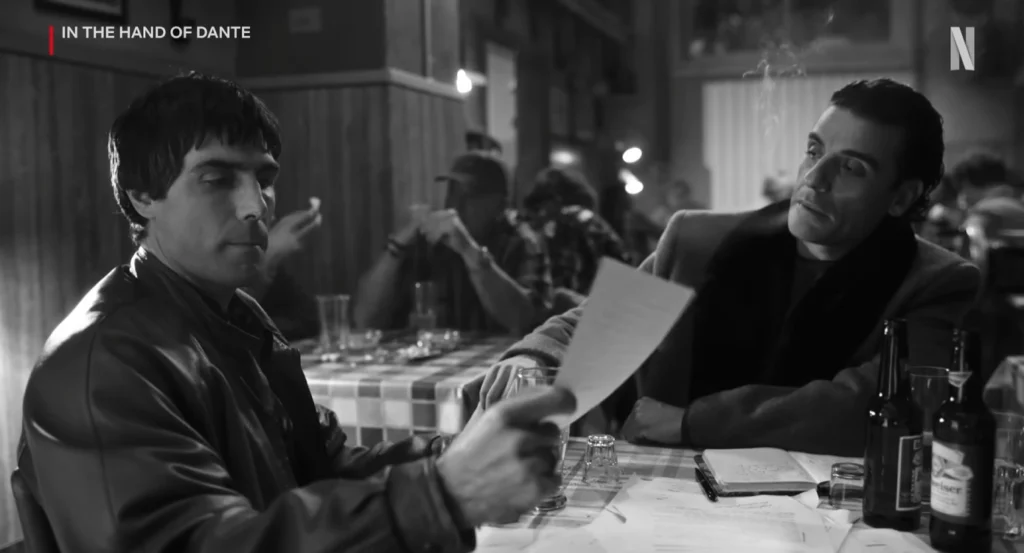
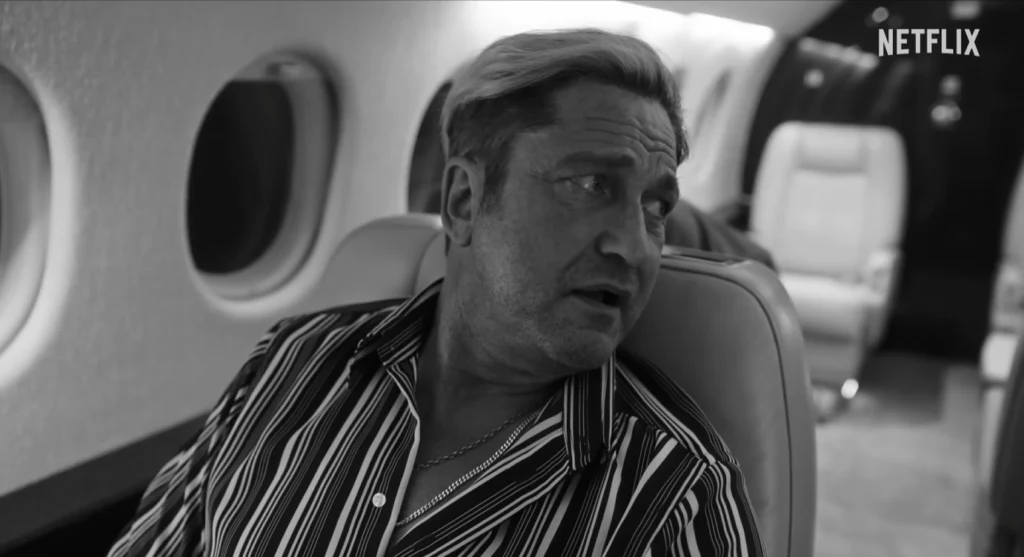
The plot kicks off when a handwritten manuscript of Dante Alighieri’s The Divine Comedy makes its way from a priest to a New York City mob boss named Joe Black, played by John Malkovich. One of Black’s employees, played by Louis Cancelmi, connects him with Nick Tosches (Oscar Isaac), a writer with deep ties to the literary world. Tosches is hired to authenticate the manuscript. What follows is a violent, blood-soaked trip to Europe alongside Joe’s ruthless hitman, Louie (Gerard Butler). They brutally eliminate witnesses and steal the manuscript back to America.
But the real distraction here is the ridiculous stunt casting. Schnabel literally packed this film with legends just for the sake of having them on the poster. We get Al Pacino showing up for a random two-minute flashback where a young Tosches gets into a scuffle, and Uncle Pacino drops some generic life advice. Then there is Martin Scorsese playing Isaiah, Dante’s mentor in the 14th century. The lines Scorsese is forced to deliver are so bland and pseudo-mystical—it’s as if the script is screaming, “Look how profound we are!” It’s honestly insulting to their legacy.
The Black and White Illusion
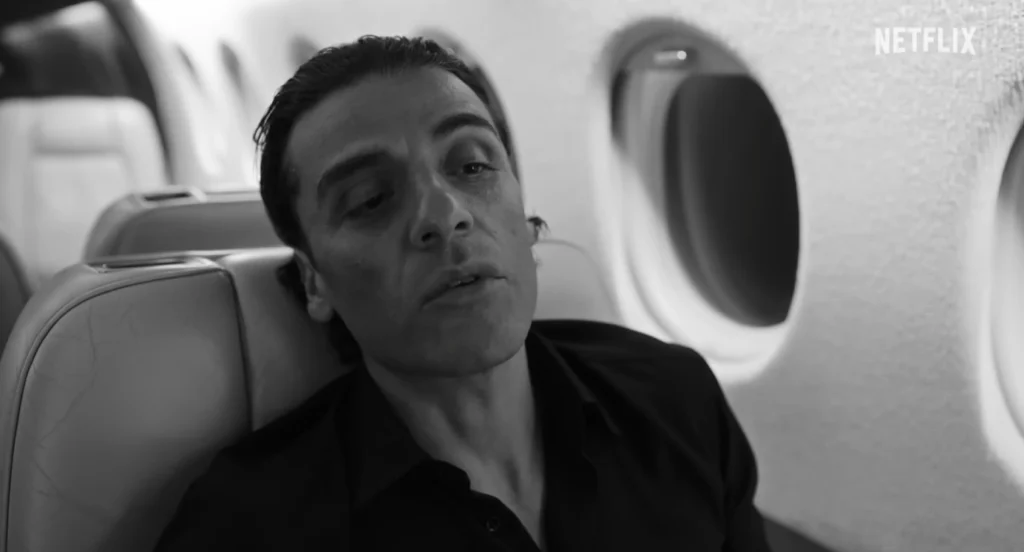
The film splits its narrative between two parallel timelines. The 14th-century scenes are shot in rich color, while the modern-day 21st-century scenes are presented in gritty black and white. Personally, I absolutely despise when directors use monochromatic filters just to appear “artsy,” but I have to admit, it was the only way to keep track of the chaotic storylines.
Oscar Isaac carries the massive burden of playing both Dante Alighieri in the past and Nick Tosches in the present. In the 14th century, Dante is a tortured artist born into noble blood but exiled by a ruthless Pope (bizarrely played by Gerard Butler with a heavy beard). Dante is unhappily married to Gemma (Gal Gadot) and obsessed with his lost muse, Beatrice. These period pieces take up maybe 20 to 30 minutes of the total runtime, but they drag the pacing down so badly you’ll wish your brain would just delete them like a bad dream.
The Heist, The Double-Crosses, and Jason Momoa’s Bizarre Plot Hole
Let’s dive straight back into the present-day timeline, where the movie actually finds its chaotic, entertaining rhythm. The vast majority of the runtime follows Tosches in black-and-white, desperately authenticating the document so Joe Black can sell it and split the cash. But Tosches has his own greedy motives. In a surprisingly violent twist, he outright murders Joe Black and Louie because he wants to keep the priceless manuscript entirely for himself.
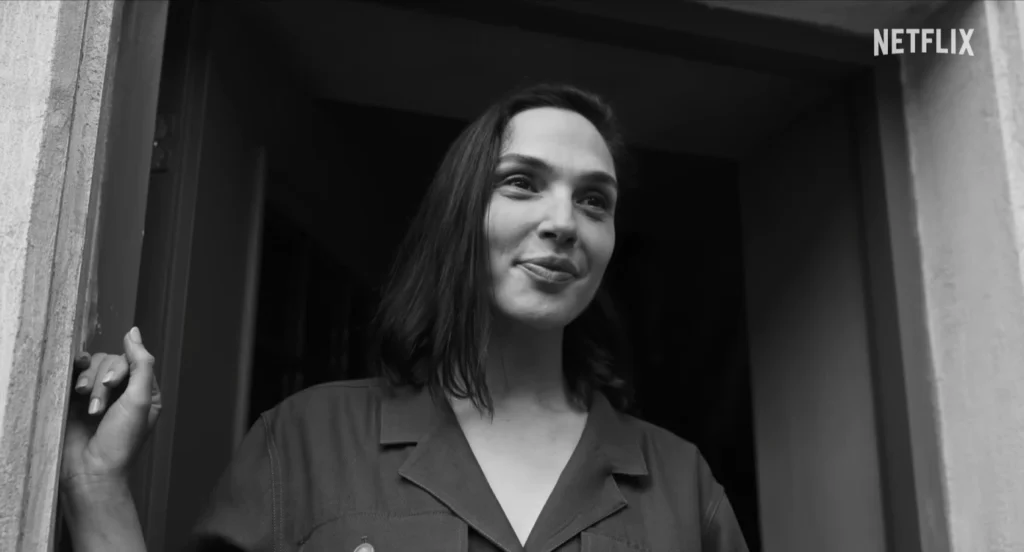
He is deeply tortured by his love for his secretary, Giulietta, who is also played by Gal Gadot. I have to be completely honest here, Gadot’s performance is incredibly wooden. Both she and Jason Momoa deliver some of the most dodgy accents I have heard in years, actively working against the movie’s favor.
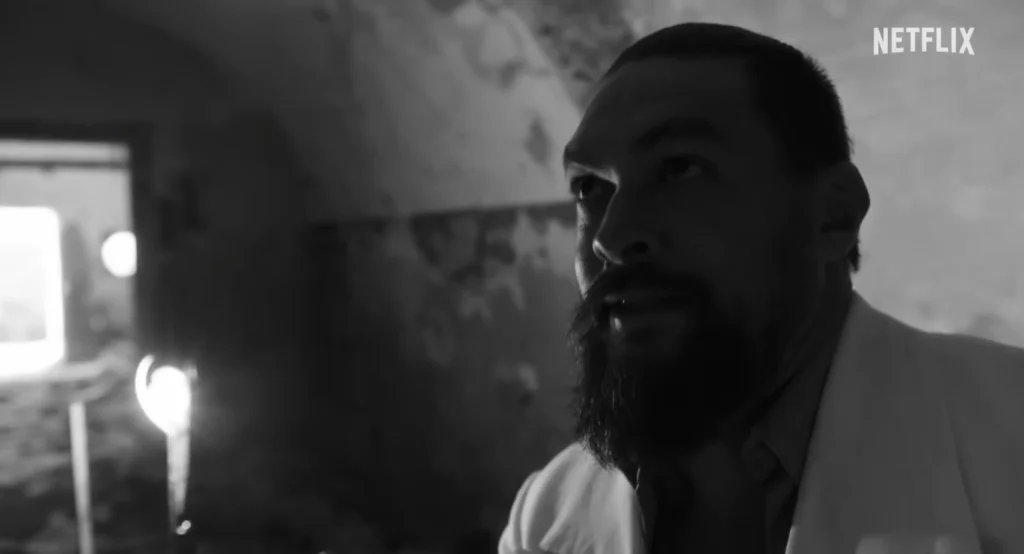
Speaking of Momoa, his character Rosario is a walking plot hole. Rosario is the boyfriend of Susanna Pulice (Sabrina Impacciatore), an Italian expert helping Tosches authenticate the ancient pages. For absolutely no logical reason, Rosario magically knows every single move Tosches and Louie make across Europe. He secretly tails them… wait, actually, it isn’t a secret at all because he just shows up out of nowhere in the final hour demanding the manuscript. The movie never bothers to explain how he tracks them; it is just silly, lazy writing.
The climax turns into an absolute bloodbath. Rosario takes Tosches hostage, forcing Giulietta to deliver the manuscript. In the ensuing chaos, Rosario shoots Giulietta, grabs the pages, and is immediately gunned down by his own girlfriend, Susanna! She doesn’t shoot him to save Tosches; she kills him because she zealously believes the manuscript rightfully belongs to her museum and the nation of Italy.
This is where Oscar Isaac truly shines as a manipulative anti-hero. Tosches, desperate to escape and save Giulietta, maliciously exploits Susanna’s obsession with the poet’s legacy. He looks at her and calls her “Beatrice,” tricking her into believing that they are the reincarnated souls of Dante and his eternal muse. It is a brilliant, twisted psychological play.
But the second her guard is down, he violently pushes her to her death.
He doesn’t care about Beatrice, the museum, or the 14th-century romance anymore. He rushes to a bleeding Giulietta, proving she is his one true love in this lifetime. Unlike the historical Dante, who spent his life chasing a fantasy while ignoring his loyal wife Gemma, Tosches finally wakes up and realizes what actually matters.
A Deal with the Devil?
After the smoke clears and the bodies drop, Tosches and Giulietta take the manuscript and make a desperate deal with a man literally named Mephistopheles. Played by Benjamin Clementine, his inclusion is one of the film’s most surreal and confusing moments. Is he a supernatural guide helping them escape death, or just a highly connected underground fixer providing new identities? Schnabel intentionally leaves it completely ambiguous, letting the audience decide.
They manage to sell most of the priceless pages, securing enough money to start afresh and live happily on an isolated island. But Nick keeps a single memento: the very first page of Inferno. He preserves a tiny piece of his past while finally letting go of the toxic obsession that nearly destroyed him. As they find peace, the film abruptly cuts back to the 14th century, revealing that Dante and his wife Gemma are also finally sharing a loving relationship.
The 700-Year Reincarnation Plot
This is where Julian Schnabel tries to pull off a massive thematic convergence, but it feels incredibly rushed. The movie is essentially about reincarnation and spiritual awakening.
The idea that Tosches is the modern incarnation of Dante is heavily hinted at throughout the entire runtime. Schnabel literally cast Oscar Isaac in both roles just to build this specific connection. When Nick first meets Giulietta in Italy, he immediately feels a bizarre sense of familiarity. Later, she even explicitly refers to their 700-year-old romance. Having a man with the devil’s name help Tosches escape is the final, heavy-handed wink at the reincarnation angle.
The film suggests that the historical Dante spent his life chasing the wrong dream. He ignored his loyal wife Gemma because his heart was entirely devoted to his muse, Beatrice. Nick almost repeats this exact same historical mistake. Instead of chasing a woman, he becomes blindly obsessed with recovering the physical manuscript. But unlike Dante, Tosches actually has an awakening at the end of the movie. He learns from the past, breaks the generational cycle, and chooses Giulietta over his dangerous ambitions. He succeeds where Dante failed, finally giving both of their stories a hopeful resolution.
Why the Ending Will Make You Furious
Does this fantastical, centuries-spanning wrap-up actually work? No. It doesn’t.
The ending leaves the audience feeling deeply unsatisfied. While the spiritual angle might resonate with a few hardcore art-house fans, it is a completely confusing mess for everyone else. The biggest issue is Schnabel’s jarring tonal shifts. The artistic, slow-paced premise of the 14th-century scenes is a far cry from the violent, fast-paced heist storyline involving Tosches. They feel like two entirely different movies forcefully stitched together.
By the time the climax approaches, the timeline of events becomes chaotic, and viewers are left entirely unsure of what each character’s actual intentions are. The story desperately needed just a bit more time to properly establish these motivations… actually, more time wouldn’t have saved it if the core script was this fundamentally disjointed. Add in the aggressively distracting performances from Gal Gadot and Jason Momoa, which actively work against the movie’s favor, and you are left with a 153-minute epic that crumbles under its own massive ambition.
Is In the Hand of Dante a bold, experimental swing at adapting an unadaptable book, or just an arrogant, bloated disaster?
Are Nick and Giulietta Reincarnations?
Oh, 100%. The movie basically screams this at you. Schnabel doesn’t just hint that Nick is the modern reincarnation of Dante and Giulietta (Gal Gadot) is the reborn Gemma Donati; he practically writes it in neon letters. It ties into this whole exhausting philosophical exploration of an “eternal present.” The idea is that artistic obsession and unrequited love transcend time completely. The closing voiceover and imagery strongly imply that even across centuries, the tortured artist is eternally drawn to the exact same muse and the same search for spiritual truth. Honestly, I thought the reincarnation angle was gonna be an absolute disaster, but… well, it sort of works if you buy into the heavy romance.
How Do the Parallel Timelines Actually Converge?
If you are expecting some cheap sci-fi portal where Nick and Dante physically shake hands, you are watching the wrong movie. They never actually meet. Instead, the film aggressively collapses their timelines through shared thematic struggles.
Both men are fighting the disgusting commodification of art. In the modern era, the mafia just wants Dante’s manuscript for cold hard cash. Back in the 14th century, Dante is wrestling with severe existential dread, questioning if his epic poem is actually divine or just another useless earthly creation. Both versions of the man violently reject the corrupt power structures suffocating them—the Mafia for Nick, the Catholic Church for Dante—to seek a more profound, personal connection with the divine.
What the Hell Does the Uncle Carmine Flashback Mean?
Let’s talk about Al Pacino. One of the modern sequences flashes back to a young Nick Tosches who commits a murder in self-defense. I read some early production notes claiming Pacino played the young Nick… wait, what? No, that is physically impossible unless the CGI budget was a billion dollars. Pacino actually plays his Uncle Carmine.
Young Nick turns to Carmine for moral absolution, and the uncle drops a heavy truth: God is everywhere, hears absolutely everything, and confessing your sins to a priest is a complete waste of time. This scene is vital. It establishes Nick’s lifelong, bloody struggle with sin and morality. He has always existed in this chaotic grey area of violence, completely setting the stage for his outright rejection of the criminal underworld at the end.
What Is the Significance of That Final Song?
Fading to black while blasting Nick Cave and the Bad Seeds’ track “Into My Arms”? A masterstroke.
The song famously opens with the lyric, “I don’t believe in an interventionist God.” That specific choice aggressively underscores the movie’s entire spiritual philosophy. Instead of preaching about a terrifying, punishing deity obsessed with strict religious rituals, the film argues that God is simply present in every single moment. Nick choosing to turn his back on his violent criminal buddies to embrace a quiet, solitary existence is his absolute final act of salvation. He finds the divine through his own internal peace. No dogma required.
Cast and Actors :
| Actor / Actress | Character Name | Role / Description |
| Oscar Isaac | Nick Tosches / Dante Alighieri | Plays both the 21st-century New York writer hired to authenticate the manuscript and the 14th-century poet composing The Divine Comedy. |
| Gal Gadot | Giulietta / Gemma | Plays Tosches’s love interest and secretary in the present, and Dante’s loyal but unhappily married wife in the 14th century. |
| Gerard Butler | Louie / The Pope | Plays Joe Black’s ruthless mob hitman in the present, and the heavily bearded Pope who exiles Dante in the past. |
| John Malkovich | Joe Black | A powerful New York City mafia don who recruits Tosches to authenticate and sell the manuscript. |
| Martin Scorsese | Isaiah | Acts as an old sage and Dante’s mentor who guides him through philosophical conversations in the 14th century. |
| Jason Momoa | Rosario | Susanna’s boyfriend who secretly tracks Tosches and Louie across Europe to steal the manuscript for himself. |
| Sabrina Impacciatore | Dr. Susanna Pulice | An Italian expert helping to authenticate the document, who strongly believes the manuscript belongs to her museum and the nation of Italy. |
| Benjamin Clementine | Mephistopheles | A mysterious figure who makes a deal with Tosches and Giulietta to help them start a new life. |
| Al Pacino | Unnamed Uncle | Appears in a present-day flashback as the uncle of a young Nick Tosches, teaching him about life after a scuffle. |
| Louis Cancelmi | Unnamed Employee | An employee of Joe Black who knows Tosches’s literary connections and introduces him to the mob boss. |
read also : The Invite Ending Explained: Secrets, Orgies, and a Broken Marriage