Minions and Monsters Ending Explained and Spoilers alert !
Honestly, I went into the theater expecting this to be pure garbage. After the absolute tick-tock brain rot that was Despicable Me 4—a movie that couldn’t pick a plotline or a theme to save its life—I assumed this seventh entry in the franchise would be more of the same. Actually, let me take that back. I didn’t just assume it; I actively dreaded it. But I have to admit, Minions and Monsters completely won me over by doing something genuinely bizarre. Instead of a standard, lowbrow cash grab, they basically made Babylon for children.
The Museum Framing Device and The Cyclops Disaster
The movie tricks you right out of the gate. It opens with a framing device set in a modern museum, where a group of kids are looking at famous artifacts from aliens, superheroes, and Hollywood legends. The teacher suddenly points them toward two figures they’ve never heard of: James and Henry. She tells them that without these two specific Minions, Hollywood as they know it might never have existed.
Why? Because James was an outlier. Thousands of years ago, while the other Minions were obsessively searching for the biggest, most dangerous villain to serve, James just wanted to paint colorful scenes and invent stories. When the tribe finally discovers a gigantic, destructive Cyclops, the other Minions try to do chores to please him. James? He paints a beautiful portrait of the beast.
Naturally, the Cyclops hates it.
He stomps on the painting, but accidentally steps on a sharp object hidden underneath it, causing him to panic, jump around in agony, and completely destroy everything in sight. This hilarious disaster becomes one of the most famous moments in Minion history.
Christoph Waltz, George Lucas, and Corporate Lingo
The film then jumps into the 1920s and 1930s silent film era of old-school Hollywood. It is packed with cinephile references, doing Buster Keaton and Charlie Chaplin bits that are completely going over the heads of the five-year-olds in the audience.
I actually loved the inside-baseball industry humor. When the studio executives decide to part ways with the Minions, they use that exact, sickening corporate lingo where they say awful things to you but make it sound loving. We get Christoph Waltz securing the easiest paycheck of his life, voicing a frustrated director yelling “action” and “cut” while trying to stage scenes. And then there is George Lucas. Yes, the George Lucas provides a voice cameo that is so perfectly cast I laughed out loud, even though the kids in the theater had absolutely no idea who he was or what the joke meant.
Where Are the Monsters?
Here is the massive structural problem with this movie. The title is literally Minions and Monsters. It has a tight 90-minute runtime. You would expect monsters.
Well, keep waiting.
You will literally check your watch 45 minutes into the film and realize there hasn’t been a single monster on screen yet. The entire first half is just a long, drawn-out story about the rise of the Minions in filmmaking. The actual monsters do not show up until you are 60% of the way through the movie.
When they finally do appear—triggered by a cool-looking sorcerer with a floating beard reading from a magic spell book—it feels incredibly rushed. It is almost as if the studio suddenly remembered what title they slapped on the poster and aggressively pivoted into a chaotic third act.
The Forgettable Monsters and Dort’s Bizarro Romance
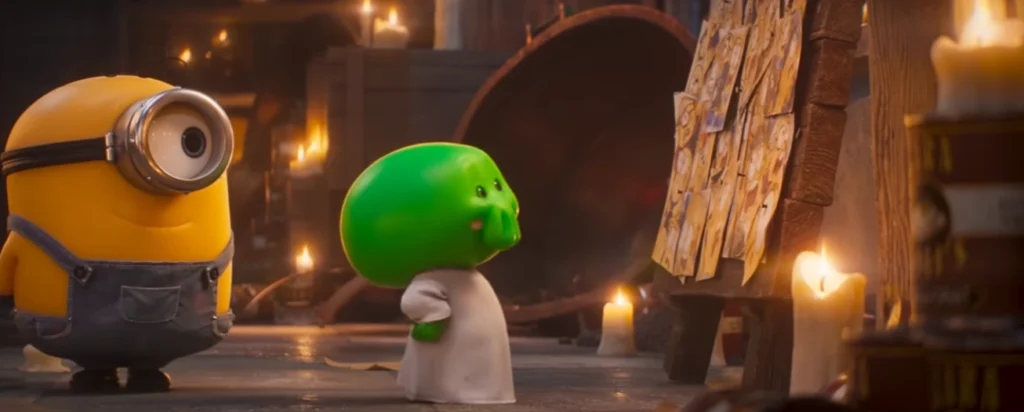
When the monsters finally show up, it is a completely mixed bag. On one hand, we get this “Baby Cthulhu” creature voiced by Trey Parker. Hearing a South Park voice coming out of this animated monster is hilarious and weirdly fitting. But the rest of the monsters? I couldn’t tell you what a single one of them looked like, aside from a generic big blob covered in eyeballs.
They are so incredibly forgettable that it feels like the animators were asked to draw a monster without ever having seen one. They are essentially just monsters acting as minions to the main monster.
But the film completely saves itself by introducing a character named Dort, voiced by Jesse Eisenberg. Dort is fantastic. He gets this totally bizarro romance subplot that adds an unexpected emotional arc to the chaos.
The Spaceship Climax
The Hollywood shenanigans accidentally trigger a massive monster crisis that threatens to destroy the entire city, entirely brought on by a character named Irene. Irene’s destructive rampage pushes everything to the absolute brink.
So, how do they solve it? Dort and his family step forward, jump into an advanced spaceship, and launch a massive battle against the creatures.
It is pure, chaotic slapstick. We get explosions, wild chases, and classic Minion stupidity. Through teamwork and sheer dumb luck, they successfully use the spaceship to defeat the monsters, end Irene’s rampage, and save the city.
This all sounds like a standard third-act resolution, right? Well, brace yourself for the final minutes.
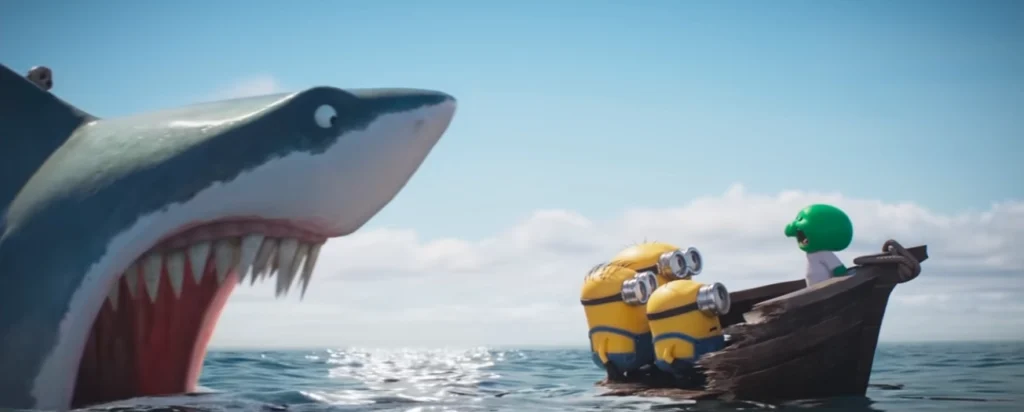
The Intentionally Confusing Fake-Out Ending
The ending of this movie is a confusing, layered mess, and I am entirely convinced the filmmakers did it on purpose just to mess with us.
After the monsters are defeated, we see James screening his completed “Minions and Monsters” movie for a massive theatrical audience. The humans and Minions give him a standing ovation, and Henry literally hands James an Oscar. You naturally expect the film to cut back to the museum teacher from the opening scene to neatly wrap up the story.
Nope.
Instead, the camera pulls back to reveal that everything we just saw was actually a set. James and Henry are filming a documentary about themselves. We see a bunch of props and guys standing around in monster suits—kind of like the bizarre, human-sized stand-ins they used behind the scenes on the Sonic movie. The movie actively tries to make you believe that the entire monster attack was just a fake production within a movie.
I honestly hated this twist for a second until I noticed something. Actually, wait, no, it wasn’t just a passing detail, it was a massive clue staring us right in the face.
Sitting right there on the documentary set is the actual magical book of invocation, along with the real monster Gumi. The monster attack did happen. James and Henry just recreated their real-life trauma into a theatrical movie, and then filmed a documentary about the movie they made. It is a deliberate misdirection designed to trick the audience, and honestly, it is a brilliant piece of meta-filmmaking for a kids’ movie.
Do You Need to Stay for a Post-Credits Scene?
Let me save you ten minutes of your life.
- Yes, there are fun bonus gags and cameos playing during the credits.
- These mid-credit scenes include small fan-service tributes and callbacks to the broader Despicable Me universe.
- However, once the scrolling text completely finishes, there is absolutely nothing waiting at the end.
You can safely grab your empty popcorn buckets and walk right out of the theater. There is no hidden post-credits scene, no plot twist, and no sequel tease waiting for you when the lights come on.
The “Gateway Spooky” Vibe, Dark Jokes, and Ed the Chill Guy
Let’s talk about the tone for a second, because the movie takes some unexpected swings. While it maintains that classic, manic Minion energy, it actually functions as a fantastic “gateway spooky movie” for young kids, sitting in the same introductory horror vein as ParaNorman or Corpse Bride. During the middle of the film, there is an eerie spell-casting scene where the characters raise a monster. It is atmospheric enough to make a five-year-old cover their eyes in terror, but the moment the monster is fully revealed, the tension instantly breaks into comedy.
Surprisingly, the writers also snuck in some genuinely dark humor. There is literally a decapitation in this movie. Yes, it is completely bloodless and played for laughs, but I was shocked they got away with it in a family film.
Beyond the slapstick, the movie serves as a bizarrely effective film history lesson. Before we even reach the 1920s Hollywood set pieces, the film gives us that mandatory, classic prologue montage of the Minions traveling through time hunting for vile masters. But once they hit Tinsel Town, the script throws out deep-cut cinematic references, including direct nods to Casablanca. I had this surreal realization in the theater: an entire generation of kids is being introduced to 1940s classic cinema tropes through gibberish-speaking yellow pills. It is weird, but I kind of love it.
Finally, amidst the chaotic roster of James, Henry, and the forgettable monsters, the film introduces a brand-new Minion named Ed. He doesn’t have a massive, world-ending character arc. His entire personality is simply being a “chill guy”. In a movie filled with screaming and explosions, Ed’s deadpan, relaxed demeanor is a hilarious contrast.
Oh, and if you are trying to keep up with the updated Minionese vocabulary this time around? “Bellow” means hello, “Meusta banana” is still a staple, and “Poopey” means goodbye. It is completely absurd, lowbrow potty humor. But honestly? It works.
Read Also : Supergirl Ending Explained: 2026 DCU Movie Breakdown & Spoilers