Obsession 2026 Ending Explained: The Definitive Breakdown of Curry Barker’s Horror Masterpiece

Obsession 2026 ending explained: For audiences and critics seeking a definitive, exhaustive breakdown of the cinematic phenomenon that dominated the global box office this year, they have just stepped into the most intricately woven, psychologically profound, and terrifying narrative in modern horror cinema. By taking the classic, folklore-driven framework of the “be careful what you wish for” trope and filtering it through the terrifying modern lens of toxic codependency, generational dating anxiety, and the complete stripping of bodily autonomy, writer-director Curry Barker has completely shaken up the psychological thriller genre.

Moving drastically away from the innocent wonder of traditional supernatural fantasies, and bypassing the sheer physical violence of standard slasher narratives, Barker has crafted a 109-minute cinematic event that is overflowing with a suffocating, ambient dread. Here at memoria.film, the absolute passion lies in unraveling complex psychological mysteries and deconstructing cinematic puzzle boxes. By applying a rigorous, scene-by-scene analytical lens to the fog of paranoia surrounding the characters of Baron “Bear” Bailey, Nikki Freeman, and the shadowy corporate entity known as Tabbycat Curiosities, this document will exhaustively deconstruct every single frame, hidden message, and thematic implication of the 2026 blockbuster.

Backed by an elite roster of producers including James Harris, Christian Mercuri, Haley Nicole Johnson, and Roman Viaris, alongside executive producer Jason Blum of Blumhouse Productions, this film moves decisively away from the pure escapism of traditional supernatural fiction. Instead, it leans heavily into modern, visceral horrors: the weaponization of unrequited affection, the manipulation of personal boundaries, the fragility of mental health, and deep-seated societal trauma regarding consent and control. The real monsters here are not necessarily demonic entities crawling from the underworld, but the selfish human desires that would rather risk destroying a person’s soul than surrender the illusion of romantic possession.

In this massive, comprehensive research report, the analysis is divided into highly detailed, exhaustive parts to cover every single nuance required to master the film’s complex lore. This report will dissect the history of the production, analyze the psychological profiles of the cast, explain the shocking twists of the narrative act-by-act, unearth the darkest hidden secrets and theories that audiences missed in theaters, and provide a dedicated, highly optimized FAQ section to answer the internet’s burning questions regarding the unforgettable final frames of the movie.

The Ultimate Question: Why Did Nikki Cook the Cat?

In a film filled with deeply disturbing moments, one scene stands out and leaves audiences furiously searching for an explanation: why did Nikki cook the cat in Obsession? This horrific act wasn’t just included for pure shock value; it was a calculated narrative choice to demonstrate the absolute breaking point of her psyche. By the time this scene occurs, Nikki has completely detached from reality. The act of cooking the pet symbolizes her total loss of empathy and her desperate, twisted need to consume or destroy the things associated with the life she envies. It’s the definitive moment the movie shifts from a psychological thriller into unhinged horror.

The Dark Truth: What Did Nikki Do to Sarah?

While the incident with the cat was horrifying, the ultimate psychological break happens later in the film. A major question that leaves viewers deeply unsettled is: what did Nikki do to Sarah? The movie intentionally leaves some of the graphic details off-screen to build dread, but the implication is clear. Nikki didn’t just physically attack Sarah; she systematically dismantled her life. By isolating Sarah from her support system and adopting her exact persona, Nikki essentially erased Sarah’s identity before the final, fatal confrontation. It was a complete psychological and physical consumption.

Obsession 2026 Ending Explained

The Evolution of a YouTube Auteur: Production and Industry Impact

To fully grasp the magnitude and cultural footprint of Obsession, it is absolutely essential to contextualize the film within the director’s fascinating, unconventional career trajectory. Curry Barker, a 26-year-old filmmaker who initially gained prominence through YouTube sketch comedy on the channel “That’s a Bad Idea” alongside his creative partner Cooper Tomlinson, represents a new, highly disruptive wave of digital-first auteurs transitioning seamlessly into Hollywood powerhouses.

As his second feature-length film—following the highly praised 2024 found-footage thriller Milk & Serial, which was famously distributed for free on YouTube—this project represents a culmination of an independent, fiercely original cinematic vision. However, the tonal and financial shift present in the 2026 release marks a radical evolution in his storytelling capabilities and industry standing.

Shot in the Burbank area of Los Angeles in October 2024 on an astonishingly tight micro-budget of just $750,000, the film was completed in a mere 20 days. The film subsequently premiered at the Toronto International Film Festival (TIFF) on September 5, 2025, where it triggered an unprecedented bidding war. It ultimately commanded a historic $14–$15 million acquisition by Focus Features, marking the highest price ever paid for a genre film in TIFF’s entire history. Upon its wide theatrical release in the United States on May 15, 2026, the film grossed a staggering $286.5 million worldwide, instantly becoming Focus Features’ highest-grossing film of all time and the eighth-highest-grossing film of the year.

The historical progression of these thematic explorations demonstrates a filmmaker constantly recalibrating his understanding of horror and audience psychology. The following table illustrates this evolutionary trajectory and the critical reception of his work:

Project TitleRelease YearFormat & BudgetThematic Core & Horror RepresentationSocietal Context & Industry Impact
The Chair2023Short Film (Micro)Unsettling psychological paranoia utilizing confined, domestic spaces.Early cinematic experimentation on YouTube; served as the viral proof of concept that attracted producer James Harris.
Milk & Serial2024Feature Film (Low)Found-footage realism, blurring the lines between harmless digital pranks and actual, premeditated malice.Explored the anxiety of the content creator economy and the performative, often sociopathic nature of internet culture.
Obsession2026Feature ($750k)The supernatural enforcement of toxic male loneliness, systematically stripping away female autonomy and agency.Tapped into modern crises of dating, the dangers of the “Nice Guy” syndrome, and the weaponization of parasocial affection. Box office: $286.5M.
Anything but GhostsUpcomingFeature Film (TBD)Comedic horror focusing on ghost hunter con artists faking supernatural cleansings for profit.A deliberate pivot to horror-comedy, expanding the shared cinematic universe established in Obsession with returning actors like Cooper Tomlinson.

While early 2000s supernatural films simply asked, “Are the ghosts real?”, Obsession operates under the modern, deeply cynical assumption that the magic is indeed real, but the human being wielding it is the true, inescapable danger. The thematic question is no longer about the discovery of the occult; it is about the agonizing, terrifying process of emotional imprisonment. Barker has transitioned from viewing curses as simple, mechanical plot devices to viewing them as devastating psychological cages, utilizing a world-class crew to bring this vision to life.

The Technical Architects of Dread

The suffocating atmosphere of the film was not achieved by accident. Barker assembled a lean but highly effective technical team to execute his vision. Taylor Clemons served as the Director of Photography, utilizing a visual language that heavily relies on claustrophobic framing, deep, impenetrable shadows, and unsettling stillness. The film’s production design, meticulously crafted by Vivian Gray, grounded the supernatural elements in incredibly mundane, relatable spaces—a local pub, a messy bedroom, a fluorescent-lit music store—making the horror feel uncomfortably close to home.

The auditory landscape was equally vital. Composer Rock Burwell and Sound Designer Ben Zarai crafted a minimalist, deeply uncomfortable sonic experience. Rather than utilizing overpowering, symphonic strings that explicitly dictate the audience’s emotional response, the score is ambient, pulsing, and discordant, often mimicking the 8-bit jingle of the cursed toy itself.

Obsession 2026 Ending Explained

PART 2: Deconstructing the Psychological Profiles of the Cast

To fully comprehend the nightmare unfolding across the narrative—from the suffocating domestic spaces to the blood-soaked finale—the analysis must first deeply deconstruct the flawed human beings at the center of the story. This is not a simple, binary tale of an innocent victim being terrorized by a faceless monster. The protagonist is riddled with ideological selfishness, moral ambiguity, and a deep, toxic entitlement. The success of this ambient dread relies entirely on an absolute powerhouse cast, executing performances that ground the fantastical elements in raw, recognizable human emotion.

Inde Navarrette as Nikki Freeman: The Vessel of Tragedy

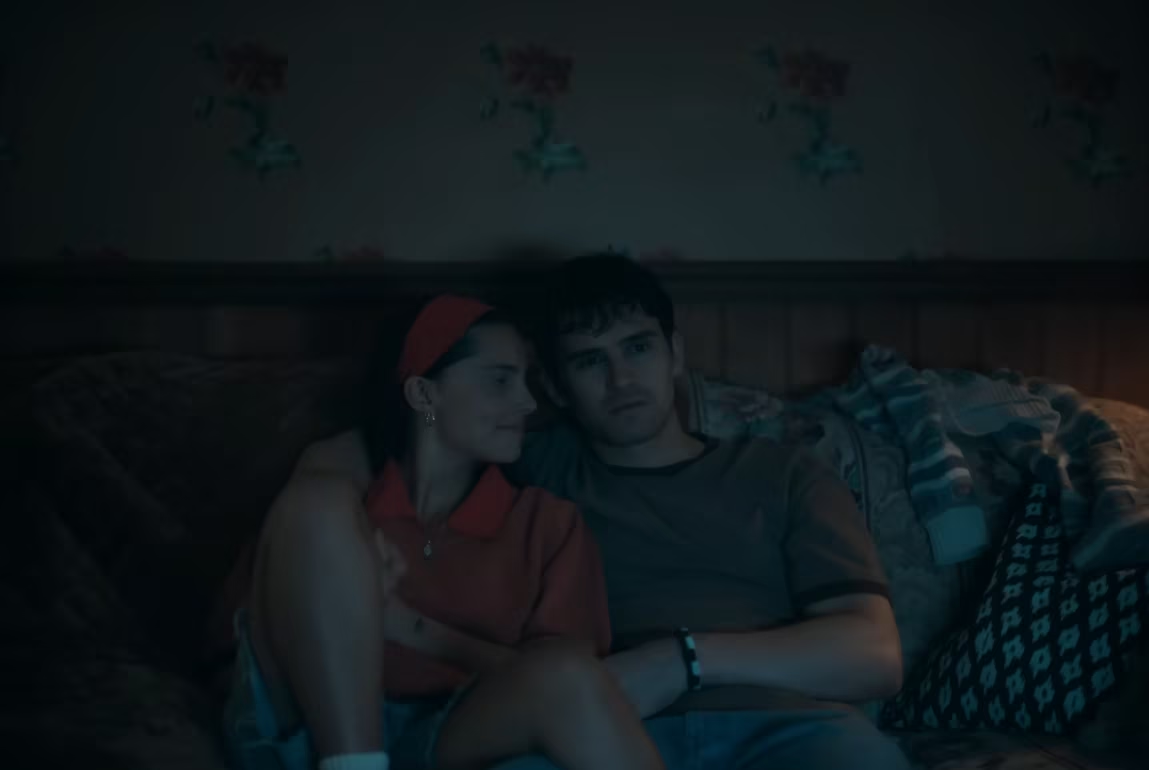
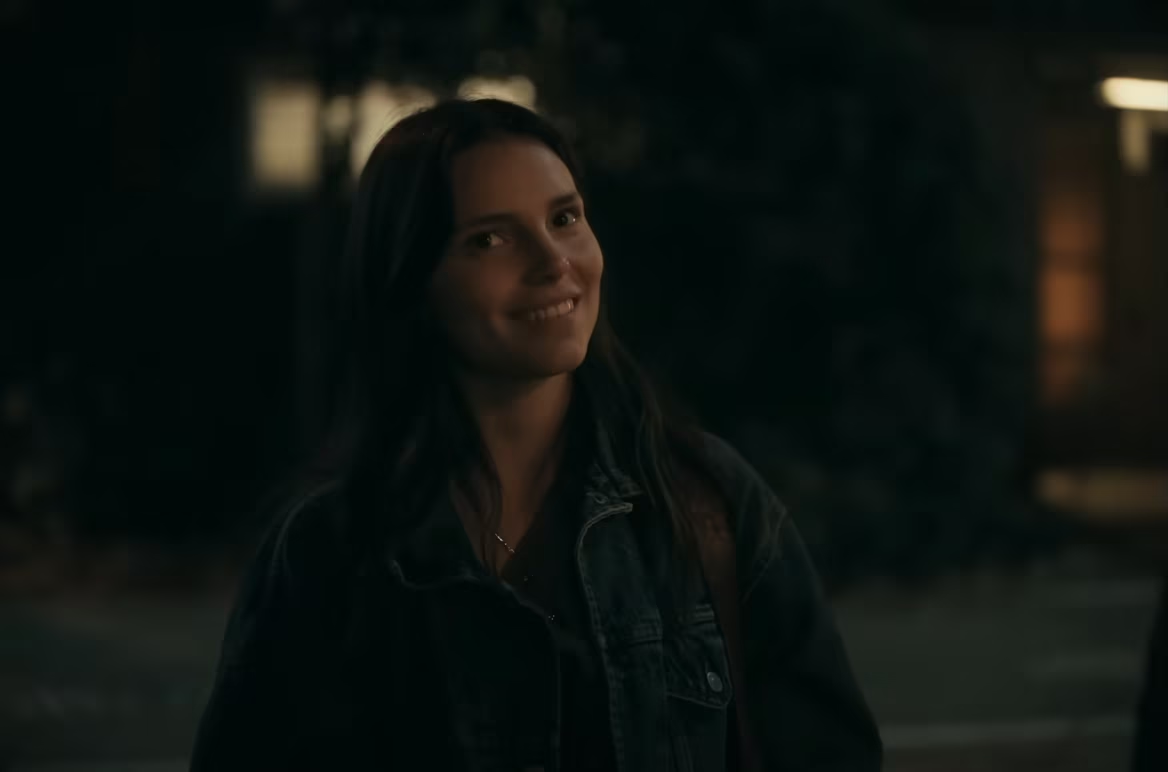
Inde Navarrette delivers what critics and audiences alike have described as an unhinged, dizzying, and utterly transcendent performance as Nikki Freeman. Nikki is introduced as an ordinary, kind-hearted music store employee who harbors dreams of quitting her job to become a full-time writer. Her narrative role is fundamentally tied to her autonomy. She is a young woman navigating the unwanted, hovering affections of her male peers, utilizing humor and distance to maintain her boundaries.

When her mind is suddenly and violently hijacked by the “One Wish Willow” curse, she becomes the ultimate unpredictable variable. Navarrette is required to navigate extreme emotional whiplash, transitioning seamlessly from a grounded, friendly coworker to a state of profound, terrifying, and unnatural obsession. She functions simultaneously as the film’s primary physical threat and its ultimate, helpless victim.

Navarrette’s performance is the anchor of the film. The subtle, agonizing moments where the “real” Nikki attempts to break through the curse—screaming for death in her sleep, crying inexplicably, or leaving cryptic written warnings—elevate the film from a standard thriller to a profound tragedy. The audience is forced to watch a vibrant woman become a prisoner inside her own flesh.

Michael Johnston as Baron “Bear” Bailey: The Architect of Misery

Michael Johnston plays Bear, a character deliberately written to deconstruct the archetypal “Nice Guy” who feels inherently entitled to a woman’s love simply because he exhibits basic decency. Bear is deeply passive, socially awkward, and profoundly lonely. He is mourning the recent death of his grandmother, Barbara, whose house he now occupies, and the opening of the film sees him weeping uncontrollably over the death of his cat, Sandy.

Bear’s psychological profile is rooted in self-pity, avoidance, and a rigid, deluded romantic compass. He utilizes a supernatural trinket to force Nikki to love him, crossing a massive, unforgivable moral threshold. The horror of the character is that he knows what he is doing is wrong, but he simply does not care. When faced with the horrific reality of Nikki’s suffering, he actively chooses his own gratification over her freedom.

Johnston plays the role with a terrifying, pathetic calmness. He represents the institutionalized entitlement that suppresses female agency in the name of romantic fantasy. He is a coward who wants the rewards of love without the vulnerability of earning it.

Cooper Tomlinson as Ian: The Toxic Instigator

Cooper Tomlinson, Barker’s real-life YouTube collaborator, provides a deeply toxic, enabling presence as Ian, Bear’s supposed best friend. Ian represents the worst kind of male camaraderie. He is secretly sleeping with Nikki while simultaneously coaching Bear on how to pursue her, offering deliberately terrible advice (such as telling Bear to call her “Freaky Nikki”) designed to sabotage Bear’s chances and keep Nikki for himself.

Ian’s narcissism knows no bounds. Later in the film, when Bear begs Ian to use a second One Wish Willow to reverse the curse and save Nikki’s life, Ian selfishly wishes for a billion dollars instead, sealing the tragic fate of the entire group. Tomlinson perfectly captures the archetype of the self-serving, chaotic instigator who views the women in his life as property rather than people.

Megan Lawless as Sarah: The Ignored Reality

Megan Lawless portrays Sarah, the innocent bystander whose character introduces the film’s crucial emotional dichotomy. Sarah genuinely harbors unrequited feelings for Bear, serving as a direct mirror image to Bear’s feelings for Nikki. However, unlike Bear, Sarah handles her rejection with grace and does not resort to manipulation or supernatural coercion.

Her brutal, senseless murder at the hands of the possessed Nikki acts as the narrative’s definitive point of no return. It forces the audience, and Bear, to confront the horrific, bloody collateral damage of the initial wish. Sarah represents the genuine, healthy love that Bear could have had if he wasn’t so blindly obsessed with a fantasy.

CharacterActorNarrative ArchetypePsychological FlawUltimate Fate
Nikki FreemanInde NavarretteThe Object of Desire / The VesselOverly accommodating; ignores red flags to maintain peace.Survives, but is left deeply traumatized, covered in blood, and likely facing triple homicide charges.
Baron “Bear” BaileyMichael JohnstonThe “Nice Guy” / The True VillainExtreme entitlement, cowardice, and a complete lack of genuine empathy.Dies from a deliberate overdose of Oxycodone, ironically breaking his own curse.
IanCooper TomlinsonThe Saboteur / The False FriendNarcissism, greed, and a complete disregard for the well-being of his friends.Shot to death by the cursed Nikki after selfishly wishing for a billion dollars.
SarahMegan LawlessThe Mirror / The InnocentUnrequited affection; tragically drawn into a conflict she had no part in making.Brutally murdered; her face smashed into a steering wheel by the cursed Nikki.
Obsession 2026 Ending Explained

PART 3: Exhaustive Plot Breakdown and Scene-by-Scene Thematic Analysis

The sheer terror of this adaptation lies in its masterful pacing and structure. The narrative drops the audience directly into the middle of a mundane, highly relatable crisis—unrequited love and social awkwardness—before rapidly and violently escalating into a claustrophobic nightmare. Let us break down the critical events, act by act, that set up the ultimate, bloody endgame.

Act I: The False Romance and The Cosmic Trigger

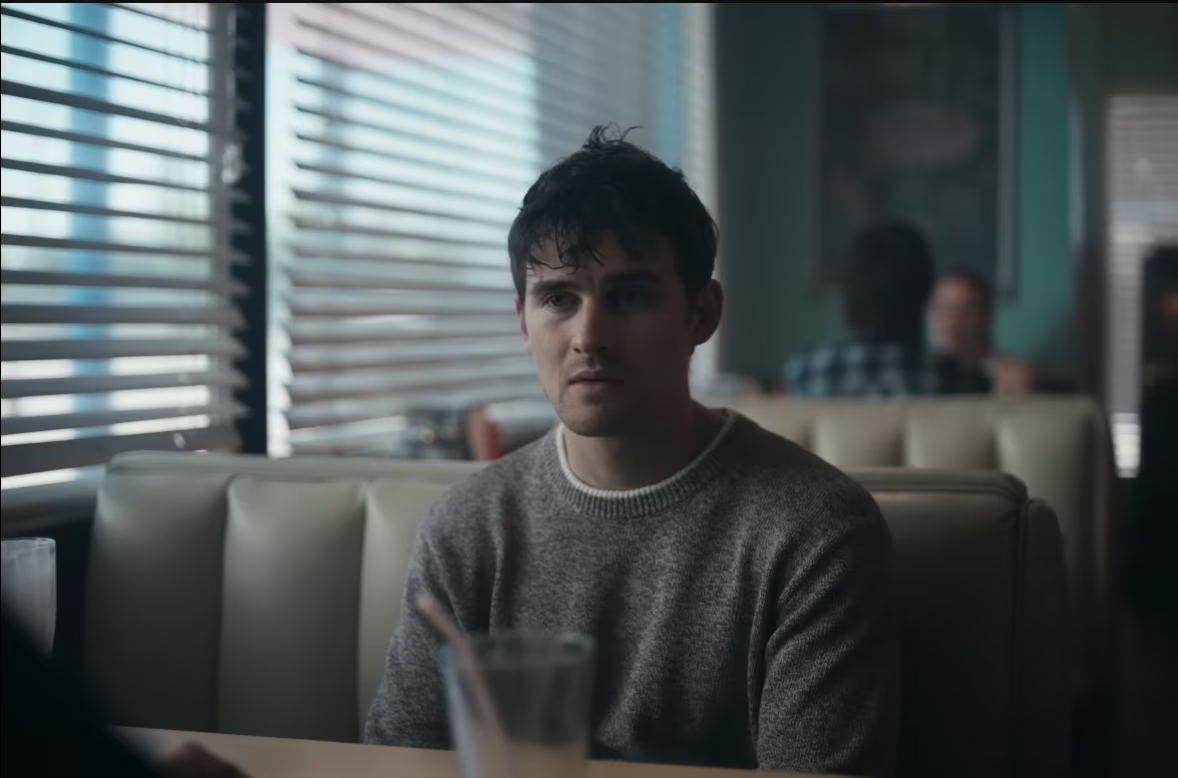
The film opens with a deliberately misleading, highly manipulative sequence. Bear is seen sitting in a warm, warmly lit diner, passionately rehearsing a deeply romantic monologue. He states: “I feel like I’m coming apart. I think about you all the time, Nikki. I tried not to. You’re in every song I listen to. You were the only person who was nice to me when I moved here. And when my nana passed away, you were there for me”.

The warm lighting and sappy dialogue create a false sense of security, mimicking the tropes of a traditional romantic comedy or a mumblecore romance. However, the reality is far more pathetic: Bear is not speaking to Nikki. He is rehearsing his lines to a polite, highly uncomfortable diner waitress, while his toxic friend Ian critiques his delivery. This establishes the film’s core theme immediately: Bear treats love as a script to be performed, rather than a connection to be nurtured.

The background context of Bear’s life is equally grim. He returns to his deceased grandmother Barbara’s house, where he currently lives, only to discover a tragedy. His cat, Sandy, has died after getting into a bottle of Oxycodone pills left in the bathroom cabinet. In a display of profound emotional detachment that serves as a major red flag for his character, Bear does not bury the cat or hold a meaningful memorial; he simply places the cat’s corpse into a black trash bag and throws it in the rubbish bin. He then self-soothes by aggressively stalking Nikki’s Instagram account, staring at her photos while crying.

The following day, Nikki casually mentions over the phone that she dropped her favorite Tiger’s Eye crystal necklace down the drain. Desperate to win her affection, Bear visits an esoteric occult shop called “The Green Man” just as it is closing. While looking for a replacement crystal, he spots a vintage, 1980s-style novelty toy: The One Wish Willow. Produced by a mysterious company named Tabbycat Curiosities, the box promises to grant a single wish if the user states their desire and snaps the wooden twig hidden inside.

That evening, the core group attends a trivia night at Barker’s Pub (a meta-reference to the director, with the trivia host voiced by Curry’s father, Jeff Barker). Bear attempts to confess his feelings, but is constantly interrupted by Ian, who is actively trying to sabotage him. During the car ride home, Nikki reveals her plans to quit the music store to focus on her writing. When Bear asks if she is writing a romance, she firmly corrects him: “It’s not a romance, it’s a love story”. Bear fails to understand the difference, highlighting his profound ignorance regarding genuine human connection.

When Bear finally attempts to flirt, he utilizes Ian’s terrible advice and calls her “Freaky Nikki”—a nickname her childhood bullies used. Offended and deeply uncomfortable, Nikki asks point-blank if Bear has feelings for her. Terrified of rejection, Bear lies and says he only sees her as a friend. Nikki, relieved but annoyed that her safe friendship has been compromised, walks away.

Sitting alone in his car, stewing in a toxic mixture of sadness and entitlement, Bear pulls out the One Wish Willow. As a distinctly 8-bit, video-game-style jingle emanates from the box, Bear declares: “I wish Nikki Freeman loved me more than anyone else in the fucking world”. He violently snaps the branch. The cosmic trigger is pulled, and the fabric of reality immediately tears.

Act II: The Descent into the Uncanny Valley

The second act operates as a masterclass in kinetic, suspenseful filmmaking, abandoning the rom-com facade for pure psychological terror. The effects of the wish are instantaneous. Before Bear can drive away, he looks up to see Nikki standing on her porch, silhouetted entirely in darkness, her demeanor completely altered.

The film brilliantly subverts the “dream girlfriend” fantasy. The possessed Nikki invites Bear inside, feigning a sudden panic attack and lying about her father dying of cancer to manipulate Bear into staying the night. When Bear attempts to sleep on the bed fully clothed, Nikki aggressively initiates physical contact, kissing him. However, in a terrifying moment of dissonance, the real Nikki suddenly breaks through the curse. She gasps, yells, “What the fuck?!” and falls off the bed, completely horrified by her own actions. A second later, the curse reasserts control, and the obsessed version of Nikki begins weeping and apologizing.

This establishes the central horror mechanic of the film: the real Nikki is trapped inside her own mind, forced to watch her body perform acts of sickening devotion to a man she does not love.

The following days are a masterclass in escalating discomfort. Bear returns home from work to find that Nikki has broken into his house. In the kitchen, she has retrieved the rotting corpse of his cat, Sandy, from the outside trash bin and set up a bizarre, candle-lit memorial for it on the floor. Later, when Bear attempts to leave for work, he finds the front door covered entirely in duct tape. When he finally pries the door open, the possessed Nikki simply stands in the hallway, frozen, with a grotesque smile on her face. She refuses to move, standing there so long that she literally urinates on herself, completely abandoning her human dignity just to wait for Bear to return.

The most disturbing manifestation of this corrupted love occurs when Bear opens his packed lunch at work. Inside is a sandwich filled with the cooked meat of his dead cat. Hidden beneath the sandwich are two Polaroid photos. One shows Bear sleeping, labeled with the word “You.” The other shows Nikki, staring blankly, with the chilling caption, “Not me”. This is undeniable, physical proof that the real Nikki is utilizing whatever microscopic fragments of control she has left to send a desperate SOS to her captor.

Act III: The Customer Service Call and the point of No Return

As the horror becomes undeniable, Bear searches his internet history, looking up the “Mandela Effect” and Reddit forums (referred to as “Threadit” in the film) regarding the One Wish Willow. In a moment of desperation, he calls the Tabbycat Curiosities customer service hotline printed on the back of the box.

The voice on the other end of the line—provided in a brilliant cameo by director Curry Barker—sounds bored, corporate, and completely indifferent to Bear’s suffering. When Bear asks if he can simply “alter” the wish to make Nikki act normal, the operator coldly informs him that wishes cannot be modified or canceled. The operator states the terrifying terms and conditions: the company is not liable for “psychological distress, emotional trauma, extreme personality changes, violent displays of love, bodily harm, death, or anything resembling possession”.

When Bear asks if her love is real, the operator delivers the film’s most chilling line: “Just because you chose this for her doesn’t make it less real”. To drive the absolute horror home, the operator asks Bear if he would like to speak to her. The line clicks, and Bear hears the agonizing, blood-curdling screams of the real Nikki, echoing from the purgatory of her own subconscious.

Despite hearing the literal torture he has inflicted upon a woman he claims to care for, Bear hangs up the phone. He selfishly chooses to maintain the relationship, cementing his status as the film’s true, irredeemable villain.

Act IV: The Siege of the Self and Bloody Escalation

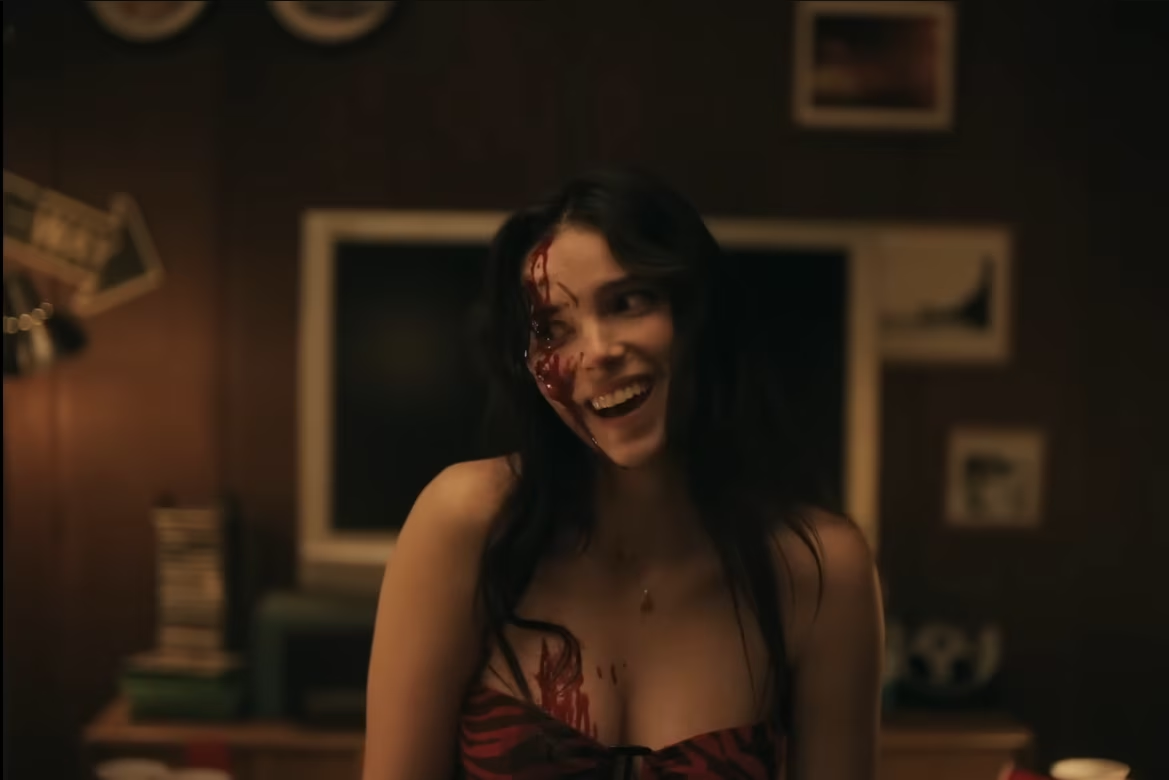
The film’s third act shifts from psychological torment to physical carnage. At a house party hosted by Ian, the group plays a Jenga-style drinking game. When Bear draws a block commanding him to kiss the person to his left (which happens to be Sarah), the obsessed Nikki violently drags Sarah’s chair out of the way, forcing herself into the position. Later that night, the real Nikki temporarily breaks through the curse’s control, grabbing a glass bottle and smashing it violently into her own face in a desperate attempt to end her captivity.

Later, while the obsessed Nikki is asleep, the real Nikki manages to speak through her resting lips, begging Bear: “Kill me, please. She’s sleeping. It’s me. Please don’t wake her up. Just kill me”. Bear’s chilling, sociopathic response is simply: “What would be so bad about being with me?”. He then walks out of the room, leaving her to suffer.

Bear sneaks out to meet Sarah in her car. Sarah reveals that Nikki and Ian have been secretly hooking up for two years, and suggests that Bear deserves someone better—heavily implying herself. Just as Bear begins to realize he might actually have a chance at a genuine, healthy relationship with Sarah, the narrative explodes into violence.

The possessed Nikki violently smashes through the passenger-side window with a heavy brick. In one of the most brutal sequences in modern horror, Nikki repeatedly slams Sarah’s face into the steering wheel using the brick. The sound design here is excruciating; with every wet, heavy impact of the brick against Sarah’s skull, the car’s horn emits a pathetic, muffled squeak. Sarah is beaten until her face is completely unrecognizable.

Rather than fleeing or calling the police, Bear helps the possessed Nikki move the body to the music store. Bear’s complicity in the murder completes his moral downfall.

Act V: The Bathroom, The Overdose, and The Broken Twig

Desperate to stop the violence but unwilling to sacrifice himself, Bear purchases the last remaining One Wish Willows from the occult shop. He attempts to use one to reverse the curse, but the magic rejects him—the twig refuses to break, and the jingle sounds distorted, indicating a user can only make one wish per lifetime.

He runs to Ian’s house, begging his toxic friend to use a twig to undo the original wish. Ian, demonstrating his profound narcissism, ignores Bear’s pleas and wishes for a billion dollars instead. Instantly, massive pallets of hundred-dollar bills begin raining down from the ceiling, but Nikki remains cursed.

Returning home, Bear is met with a grotesque, deeply disturbing shrine. Nikki has undressed Sarah’s corpse, placed it in a chair, and donned Sarah’s clothes. She has utilized markers to meticulously draw Sarah’s tattoos onto her own body, and has seemingly utilized Sarah’s hair or scalp. The obsessed entity is desperately trying to physically transform into the woman Bear briefly desired, proving that the curse does not understand love, only possession and imitation.

When Ian arrives at the house, the deranged Nikki—now armed with a gun stolen from the music store’s safe—shoots him dead without hesitation.

With three people dead and his life in absolute ruins, Bear realizes there is no escape. He calms the blood-soaked Nikki by repeatedly screaming, “I love you,” manipulating her long enough to steal the gun and lock himself in the bathroom.

Bear contemplates shooting himself, knowing that his death is the only mechanism to break the curse. However, he is a coward and cannot pull the trigger. Instead, he opens the medicine cabinet and consumes the remaining Oxycodone pills—the exact same pills that killed his cat at the beginning of the film.

It appears, for a fleeting moment, that Bear is making a heroic sacrifice to set Nikki free. However, the script delivers one final subversion. In a display of profound, defining cowardice, Bear regrets his decision. He leans over the toilet, shoving his fingers down his throat, attempting to induce vomiting to save his own life.

Before he can purge the pills, the distinct, sickening snap of a One Wish Willow echoes from outside the bathroom door. Nikki, sensing she is losing him, has broken the final twig, wishing for Bear to love her back.

Bear is instantly thrown into a supernatural trance. His eyes glaze over. He unlocks the door, stepping out and staring lovingly at Nikki. They embrace and kiss amidst the blood and the corpses. But the magic cannot stop pharmacology. The massive overdose of Oxycodone stops Bear’s heart. He collapses, convulsing, and dies in Nikki’s arms.

Because Bear is finally dead, his original wish is terminated. The curse is instantly lifted. The supernatural possession evaporates, and the real Nikki is violently thrust back into control of her physical body. She gasps for air, shoving Bear’s corpse off her, looking around the room in absolute, unadulterated horror. She is covered in the blood of her friends, surrounded by the corpses of Bear, Ian, and Sarah, with no memory of committing the atrocities.

The film violently cuts to black. The final audio the audience hears is not music, but the real Nikki’s agonizing, uncontrollable sobs echoing through the theater.

Obsession 2026 Ending Explained

PART 4: The Darkest Hidden Secrets, Lore, and Thematic Analysis

The narrative architecture of Obsession is a dense, meticulously constructed puzzle box. By synthesizing background details, character tics, and throwaway lines of dialogue, several massive theories emerge regarding the true nature of the magic, the psychological subtext, and the ultimate meaning of the film’s enigmatic conclusion.

The True Nature of the Possession: The Internal Purgatory

One of the most debated aspects of the film is the exact nature of Nikki’s possession. Is she possessed by a demon from hell? According to director Curry Barker, the answer is definitively no. There is no external, ancient evil piloting Nikki’s body. The entity is a manifestation of the wish itself. It is a fabricated, highly obsessive version of Nikki’s own consciousness, forcibly constructed by the magic to fulfill Bear’s mandate.

This specific mechanical distinction makes the horror profoundly worse. The real Nikki is not displaced or sent away; she is completely suppressed. She is trapped in the “sunken place” of her own mind, forced to watch, feel, and experience every horrific act the obsessive version commits. The film provides multiple subtle clues to this internal war, proving the real Nikki was fighting back the entire time:

  1. The Cat Sandwich Photo: The Polaroid reading “Not Me” was a desperate SOS from the real Nikki breaking through the curse’s control for a fraction of a second.
  2. The Somniloquy (Sleep Talking): When the obsessed Nikki falls asleep, the curse’s grip physically loosens, allowing the real Nikki to whisper, “Kill me, please” to Bear.
  3. The Self-Harm at the Party: When the real Nikki temporarily surfaces at Ian’s party, she grabs a broken bottle and smashes it into her own face. This is not the curse acting crazy; this is the real Nikki attempting to commit suicide to end her captivity and protect her friends.

The Masterful Foreshadowing in the Photo Booth

At the very beginning of the film, Bear examines a strip of photo booth pictures featuring the core friend group. This mundane prop serves as a flawless, microscopic spoiler for the entire movie :

Photo PanelVisual DescriptionThematic Foreshadowing
Photo 1Nikki appears blurry, out of focus, and distorted.Foreshadows the loss of her true identity to the supernatural curse; her image is corrupted.
Photo 2Nikki is alone with Bear, looking deeply unhappy and flipping the middle finger.Establishes her true, baseline lack of romantic interest in him before the wish alters reality.
Photo 3Nikki is happily grabbing onto Ian, pulling him close.Hints at their secret sexual relationship, which is revealed much later in the film.
Photo 4Ian’s eyes are crossed out; Nikki stares blankly; Sarah is lying down at the bottom of the frame.Directly foreshadows the finale: Ian dies (crossed eyes), Nikki becomes a blank vessel, and Sarah is murdered and placed on the floor.

The Hansel and Gretel Metaphor

During the party scene, the obsessed Nikki forces the room into silence by reading a deeply unsettling, original short story about Hansel and Gretel (written by the director’s father, Jeff Barker). In her grotesque version, the siblings are forced to be husband and wife.

This is a brilliant piece of psychological translation by the film’s writing team. The real Nikki explicitly stated earlier in the film that she viewed Bear strictly as a “little brother”. Therefore, when the wish forced romantic, sexual love onto a strictly platonic, sibling-like foundation, the magic glitched. The resulting dissonance is expressed through the incestuous horror of the poem, culminating in the chilling line: “Hansel is my soul. A love that only the branch of a willow tree could conjure”. The poem is the curse admitting that it is an unnatural, corrupted force.

The Significance of the Tiger’s Eye Necklace

Before the curse takes hold, Nikki casually mentions over the phone that she dropped her favorite Tiger’s Eye crystal necklace down the sink drain. In metaphysical and occult traditions, Tiger’s Eye is a potent stone of protection, utilized for grounding and warding off negative energy, hexes, or curses.

The exact moment Nikki loses her protective talisman is the exact moment Bear visits the occult shop to purchase the One Wish Willow. Visually and symbolically, Nikki’s spiritual defenses are stripped away just hours before the supernatural assault begins. It is a tiny detail, but in a movie built on possession and corrupted love, losing the necklace is the first sign that Nikki has been left spiritually exposed.

The “Monkey’s Paw” Subversion and the Surviving Billion Dollars

Curry Barker has openly stated that the core premise of Obsession was heavily inspired by the classic W.W. Jacobs short story, The Monkey’s Paw, where wishes are granted but always with horrific, ironic consequences. However, Barker deliberately subverts this trope.

In the lore of Obsession, not all wishes turn out bad. The magic itself is neutral; it is the intent of the human that dictates the horror. When Ian selfishly wishes for a billion dollars, the money simply materializes in his living room in massive pallets. There is no ironic twist where the money comes from an insurance payout (as it does in The Monkey’s Paw).

The terrifying implication of this subversion lies in the aftermath. The logical assumption is that once Ian dies, his wish is undone, and the money vanishes. However, Curry Barker has explicitly confirmed that Ian’s money remains in the physical world after his death; it is likely seized by the police.

This drastically changes the rules of the film. It proves that the One Wish Willow’s effects are not temporary, magical illusions; they create permanent, physical wounds in reality. By extension, this means Bear’s wish also left permanent psychological and physical damage. The trauma inflicted upon the real Nikki cannot be magically erased just because Bear died. She is left to face the very real, very physical consequences of the magic.

Obsession 2026 Ending Explained

PART 5: Societal Commentary and Generational Anxiety

Beyond its supernatural mechanics, Obsession has resonated so deeply with audiences—grossing nearly $300 million—because it successfully taps into very specific, modern anxieties.

The Weaponization of the “Nice Guy”

Bear is the ultimate deconstruction of the “Nice Guy” trope. He believes that because he listens to Nikki complain about her day, he has earned access to her body and her romantic affection. The horror of the film is that it gives a man like Bear the ultimate power to bypass the requirement of consent. By treating a human being as the object of his wish, he stripped away the very thing that made her who she was. Bear did not wish for mutual happiness or personal growth; he wished for possession.

Gen Z Anxiety and the Fear of “Cringe”

The film brilliantly captures the modern, digital-age fear of misinterpreting social cues. Early in the film, Ian convinces Bear not to confess his feelings because it would be “cringe”. The characters are paralyzed by the fear of being perceived poorly. Bear’s entire descent into madness is fueled by his inability to communicate honestly; he would rather use dark magic to force a relationship than risk the temporary embarrassment of a rejection.

Furthermore, the film touches on the terrifying reality of digital stalking. The opening scenes feature Bear obsessively scrolling through Nikki’s Instagram, analyzing her likes and comments. The film posits that modern social media already encourages a low-level form of obsession; the One Wish Willow merely weaponizes it into something lethal.

Obsession 2026 FAQ: Answering the Internet’s Biggest Questions

To ensure this ultimate Obsession ending explained is fully comprehensive, here are the direct, definitive answers to the web’s most pressing questions regarding the film’s intricate lore, optimized for absolute clarity.

What is the deeper meaning of the movie Obsession (2026)? Obsession is a psychological horror film exploring the devastating consequences of toxic codependency, the loss of bodily autonomy, and the dangers of male entitlement. It illustrates that forcing someone to love you against their free will does not create romance; it creates a suffocating, destructive psychological prison. The thematic equation of the film is simple: selfish desire combined with supernatural coercion results in absolute tragedy.

Is Nikki possessed by a demon in Obsession? No. Director Curry Barker has explicitly confirmed that the film is not a demonic possession story. Nikki is controlled entirely by the mathematical mandate of the One Wish Willow. The “freaky” Nikki is a fabricated, highly obsessive version of her own psyche, created specifically to fulfill Bear’s wish, while the real Nikki is trapped helplessly in the passenger seat of her own mind, fully aware of the atrocities being committed.

What happens to Nikki at the end of Obsession? After Bear dies from a deliberate Oxycodone overdose in the bathroom, his original wish is broken, and the curse immediately lifts. The real Nikki regains control of her body, only to find herself covered in blood and surrounded by the corpses of Bear, Ian, and Sarah. Because Nikki physically pulled the trigger to kill Ian and wielded the brick to kill Sarah (albeit under the curse’s influence), it is highly implied she will be arrested and go to prison for a triple homicide she could not control. The director confirmed he envisions her transitioning “from a mind prison to a real-life prison”.

Will there be an Obsession 2 or a direct sequel? Curry Barker stated in late 2025 that the specific characters from Obsession are unlikely to return for a direct sequel, given the incredibly high body count of the finale. However, he is actively developing a shared cinematic universe. His next film, a horror-comedy titled Anything but Ghosts, will exist in the same universe and will feature a news report directly referencing the tragic, bloody events of Obsession. Barker has also floated the idea of an anthology TV series where each episode follows a new, desperate character utilizing a Tabbycat Curiosities product with varying results.

How much money did Obsession make at the box office? Obsession was a monumental, historic box-office success. Shot on a micro-budget of just $750,000, the film was acquired by Focus Features for $14-$15 million at TIFF. It went on to gross an astonishing $286.5 million worldwide, making it the eighth-highest-grossing film of 2026 and Focus Features’ highest-grossing film in the studio’s entire history.

What are the exact rules of the One Wish Willow? According to the packaging from Tabbycat Curiosities, the user must state their wish clearly and then snap the wooden twig in half. A user can only successfully break one twig in their lifetime. The magic cannot be altered, paused, or canceled by customer service. The only mechanism to break a romantic curse conjured by the willow is the physical death of the person who made the wish.

Did Nikki actually have a crush on Bear before the wish? This is a point of contention. Director Curry Barker controversially stated in an interview that Nikki might have been slightly disappointed Bear didn’t ask her out initially. However, the actual text of the film overwhelmingly contradicts this. The photo booth pictures, her explicit statement that she sees him as a brother, and her relief when he says they are just friends all prove that her feelings were strictly platonic. The horror of the film works significantly better when viewed as the total overwrite of her true, platonic feelings.

A Final Thought on the Masterpiece

The absolute brilliance of this cinematic achievement lies in its unyielding, fearless commitment to exploring the psychological devastation of profound human selfishness. By substituting traditional haunted house tropes and masked killers with the slow, agonizing, and highly relatable erosion of human free will, the narrative creates a masterclass in ambient dread and speculative horror.

The characters in this film do not conquer a great evil with ancient rituals, nor do they vanquish a demon with holy water; they merely succumb to the agonizing, crushing weight of their own fatal flaws. As the screen violently cuts to black on the real Nikki’s agonizing, uncontrollable sobs, the audience is left to grapple with the terrifying, beautiful reality that the monster outside the door is merely human hubris. Baron Bailey got exactly what he wished for, and it cost everyone their lives, their sanity, and their freedom. Obsession stands as the defining horror film of 2026, a brutal, unforgettable reminder that love without absolute consent is merely captivity.

read also : In the Grey Ending Explained: The Definitive Breakdown of Guy Ritchie’s 2026 Heist Masterpiece