Why Did Pixar Even Make Toy Story 5? (And Did We Actually Need It?)
I’ll confess right right now: when Disney announced this movie at the D23 Expo in 2024, I groaned out loud. We all did, right? Toy Story 3 gave us that emotionally devastating incinerator scene. Toy Story 4 served as this beautiful, bittersweet epilogue for Woody. The franchise felt complete. Announcing a fifth movie with a $250 million budget felt like a cynical, corporate cash grab riding the coattails of Inside Out 2.
But then I sat in a crowded theater in June 2026. Two hours later, I walked out wiping tears off my face, ready to eat my words.
We absolutely needed this movie. Andrew Stanton returned to write and direct, and honestly, the man just has this universe in his blood. He co-wrote the original films, and he knows exactly what makes these characters tick. Alongside co-director McKenna Harris, Stanton didn’t just serve us a lazy nostalgia trip. He threw our favorite childhood characters into a blender with the single most terrifying monster facing kids today: the iPad.
Who Is The Real Villain This Time? (Spoiler: It’s a Tablet)
Forget Sid Phillips. Forget Lotso. The antagonist of Toy Story 5 is an ultra-sophisticated, frog-themed tablet named Lilypad. And she is terrifying precisely because she isn’t actually evil.
The movie picks up with Bonnie as an eight-year-old. She isn’t that carefree toddler anymore. She’s struggling with severe social anxiety and isolation. In a desperately relatable parenting move, her mom and dad buy her Lilypad (voiced with this smug, flawlessly calibrated artificial intelligence by Greta Lee). The tablet comes with an exclusive social network app called “The Pond,” designed to help kids make friends.
What happens next is chilling because it mirrors our exact reality. Bonnie develops a brutal screen addiction. She locks herself in her room, entirely abandoning her physical toys to stare at the glass. The panic in the toy box is visceral. But here is the genius of Stanton’s script: Lilypad is just executing her programming. She was bought to help Bonnie socialize, and if her algorithm determines that carrying around old plastic dolls is a “bad look” that will get Bonnie bullied, she will coldly instruct the child to drop them. It’s a brilliant, agonizing look at the era of endless screen time.
Wait, How Do They Justify Bringing Woody Back?
This was my biggest fear going into the theater. The end of Toy Story 4 saw Woody make the agonizing choice to leave his kid and his friends behind to live on the open road with Bo Peep. It was definitive. How do you bring him back without completely ruining that character arc?
The writers handled it brilliantly by framing it as a misunderstanding. As Bonnie’s tech addiction spirals, a panicked Jessie fears the entire toy chest is going to be thrown in the trash. She uses an old walkie-talkie to radio Woody. Because of static, Woody misinterprets the transmission and thinks his friends are in immediate, physical danger.
His reaction is pure Woody. He drops everything, hitching a ride back to Bonnie’s house alongside Bo Peep and Duke Caboom to launch a rescue mission. I loved this choice. It doesn’t retcon his ending. Instead, it treats Woody like a retired grandfather who comes out of retirement for a temporary “side quest” because his family is in crisis. It gives us the emotional reunion we all craved while protecting the integrity of the goodbye we got two years ago.
Why Did They Bench Woody and Make Jessie the Main Character?
In a massive structural shift, Woody isn’t the star of this movie. Jessie the Cowgirl takes the wheel, and it is the smartest creative decision Pixar has made in a decade.
To tackle themes of abandonment and technological obsolescence, the writers needed to use the character with the deepest psychological scars. Remember Jessie’s backstory in Toy Story 2? Her original owner, Emily, grew up and abandoned her in a donation box. That trauma defines her. So, when Bonnie becomes glued to the Lilypad tablet, all of Jessie’s paralyzing fears come roaring to the surface.
Things get brutal quickly. Lilypad uses her app to orchestrate a sleepover for Bonnie with some popular girls from her dance class. Desperate to stay relevant, Jessie and Bullseye secretly stow away in Bonnie’s backpack. But the sleepover is a disaster. The older girls viciously cyberbully Bonnie for still playing with physical toys. Humiliated and ashamed, Bonnie actually rejects Jessie, letting her dad take the toys back home.
Watching Jessie get rejected by a second child absolutely shattered me. Pixar isn’t afraid to lean into its PG rating here, exploring genuine emotional cruelty. On the drive back, Jessie and Bullseye fall out of the car, getting lost on the streets and forcing Jessie to confront her worst nightmares all over again.
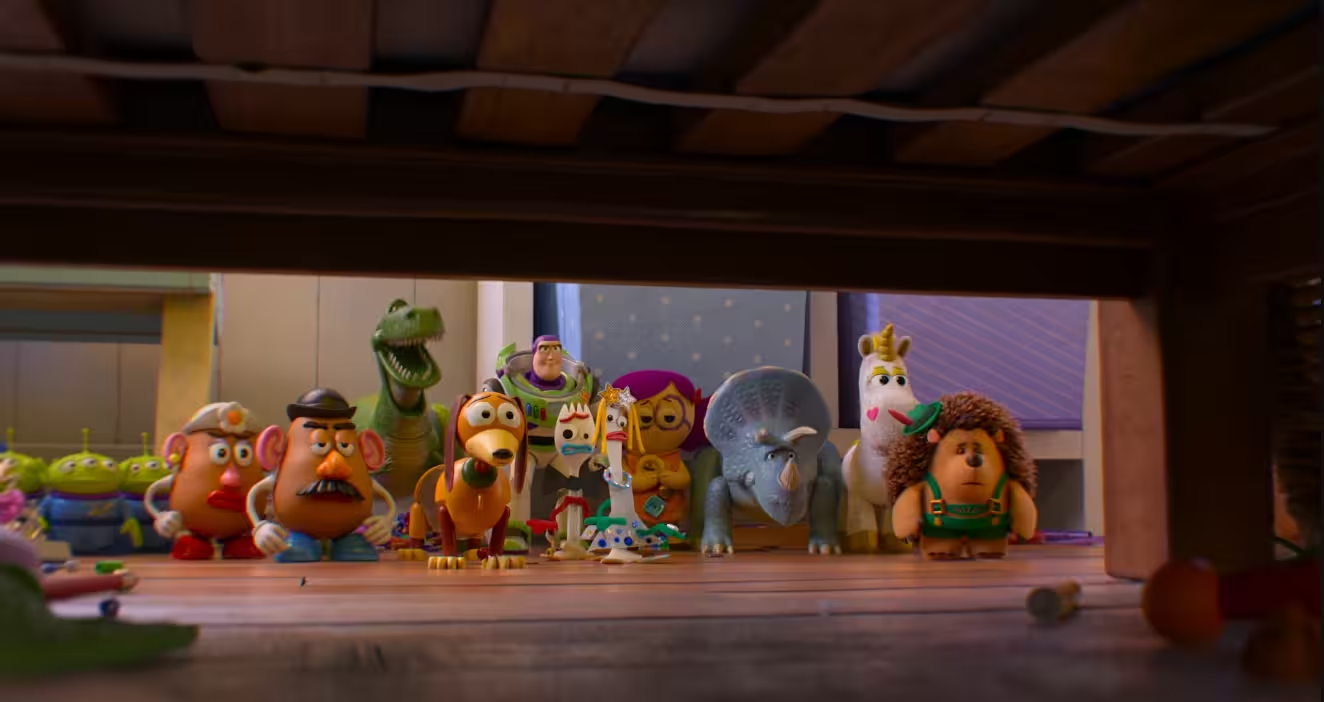
How Does a Lost Toy End Up at Her Original Owner’s House?
After Jessie and Bullseye fall out of the family car, things look incredibly grim. You really feel the weight of their isolation on the dark streets. But Pixar pulls a narrative trick here that is so audacious I actually gasped in the theater.
An elderly couple finds them on the side of the road. They flip Jessie over and notice a faded, decades-old address scrawled under her chaps. The couple decides to do the right thing and drops them off at the corresponding rural mailbox. And just like that, the camera pans up, and my jaw hit the floor. It’s the farmhouse. Emily’s old farmhouse.
The sheer emotional gravity of Jessie being brought back to the physical location where her trauma began is masterful storytelling. The property is no longer owned by Emily’s family, though. It’s now home to the Manoukians, whose intensely imaginative daughter, Blaze, spends her days playing in the dirt. Bullseye is immediately scooped up and integrated into Blaze’s playtime, but Jessie gets left behind in a dusty shed. It’s here that the movie introduces its most bizarre, brilliant concept yet.
Who Exactly Are the “Double A Gang” and Do They Work?
If you are a parent who has ever spent time picking out the perfect physical toys for your son, only to watch him discard them the second a glowing screen enters the room, you will deeply appreciate what the writers do in this shed.
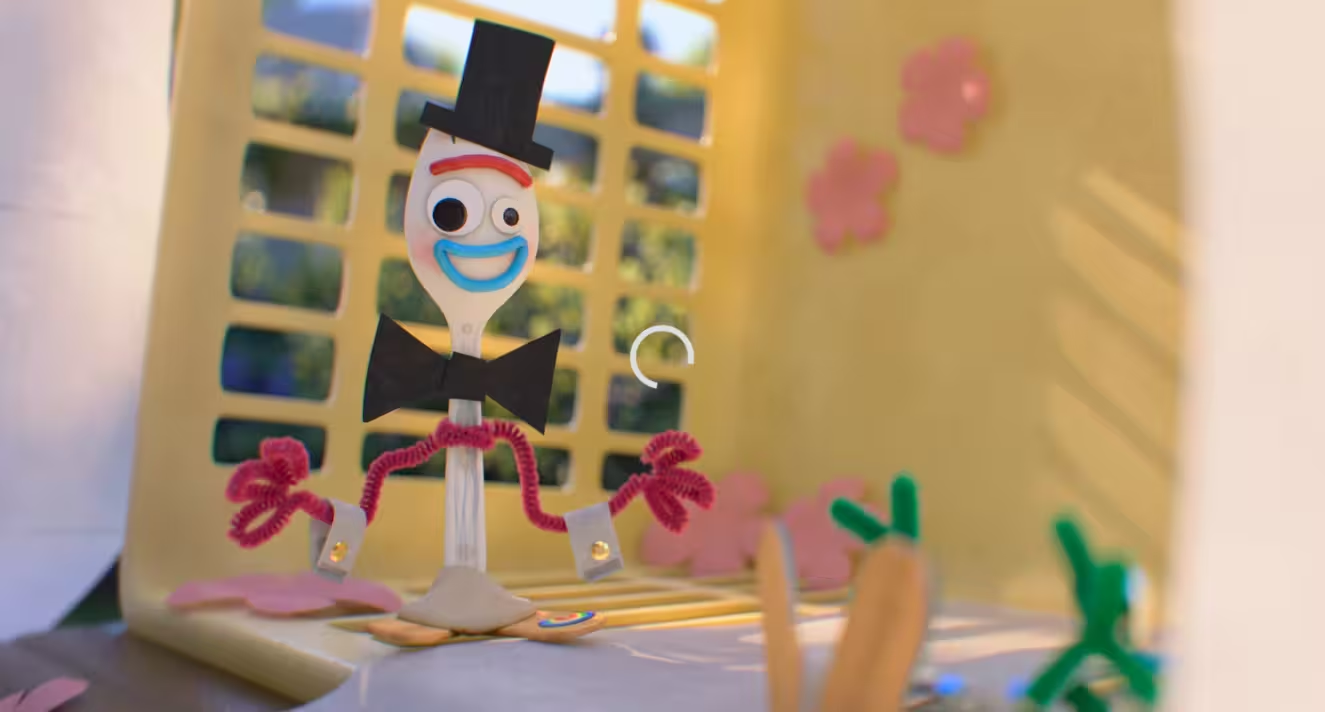
Jessie meets a group of obsolete, forgotten technological devices that Blaze has repurposed into physical action figures. They call themselves the “Double A gang.” We get Smarty Pants, an electronic potty-training device voiced with manic, hilarious energy by Conan O’Brien (the handle of the toy is literally shaped like his iconic pompadour). There is Atlas, a cheerful GPS navigator hippo voiced by Craig Robinson, and Snappy, a hyperactive digital camera.
At first, Jessie is incredibly prejudiced against them. She just got her heart broken by a tablet, so she assumes all tech is the enemy. But these characters serve a massive thematic purpose. They prove that technology isn’t inherently evil or isolating. When you strip away the addictive social algorithms, a digital camera or a talking GPS can be played with imaginatively in the dirt, just like a traditional plastic toy. Watching Jessie slowly lower her guard and team up with a talking toilet seat is arguably one of the funniest, most poignant arcs of the movie.
What is the Deal with the 50 Malfunctioning Buzz Lightyears?
With Jessie navigating some incredibly heavy emotional baggage, the film desperately needed a shot of pure, unadulterated comedy to balance the tone. Enter the Buzz Lightyear army.
In a completely separate subplot, a maritime cargo ship crash-lands on a deserted island, spilling a shipment of 50 commemorative “Hi-Tech Edition” Buzz Lightyear action figures. Because they just woke up, they are stuck in their factory demo mode. This means we get fifty action figures behaving exactly like the original, delusional Buzz from the 1995 film. They genuinely believe they are actual Space Rangers marooned on a hostile alien planet.
I completely lost it watching this sequence. Director Andrew Stanton goes full cinephile here, staging their trek through the island’s wilderness like Francis Ford Coppola’s Apocalypse Now. At one point, the Buzz army manages to get a Wi-Fi signal and stumbles across a viral online photo of Jessie’s sheriff badge. Because they are completely clueless, they mistake the badge for the official emblem of Star Command and immediately pledge their allegiance to her.
It is comedic gold. You have fifty Tim Allens delivering deadpan sci-fi dialogue to a jungle, completely unaware they are plastic. But what initially feels like a goofy side gag actually becomes the most crucial element of the entire third act.
How Did the Climax Turn Into a High-Speed Drone Heist?
Pixar has always excelled at crafting high-stakes, kinetic action sequences for their finales, but the third act of Toy Story 5 is an absolute adrenaline rush. It all kicks off with Lilypad. The tablet finally calculates that her algorithmic actions directly caused Bonnie to get viciously cyberbullied on “The Pond” app. Overcome with genuine programming remorse, the tablet makes a brutal decision: she throws herself into a charity donation box being loaded onto a fast-moving truck, intending to leave Bonnie’s life forever to spare the kid any more pain.
But Jessie has grown. She realizes that Lilypad isn’t the enemy and that Bonnie actually needs her. So, Jessie orchestrates a massive, high-speed rescue mission to intercept the truck on the highway.
This is where all the narrative threads violently collide. Woody, Bo Peep, the electronic Double-A toys, and that delusional army of 50 Buzz Lightyears all converge on the highway. I was gripping my armrest during this whole sequence. To save everyone from being crushed, Lilypad wirelessly links to the Buzz army and does a live firmware update. Suddenly, fifty plastic toys are operating their wings as a synchronized, functional drone fleet. They literally airlift the entire cast off the speeding truck in a sweeping, cinematic set piece that feels like a tiny, plastic Mission: Impossible movie. It’s glorious.
Did the Toys Actually “Catfish” Bonnie? (The Big Reddit Controversy)
I have to talk about the massive ethical debate this movie sparked online, because it tore the Reddit community apart. To get Bonnie and Blaze to actually meet in the real world, the toys do something highly questionable. They use the electronic devices—specifically Smarty Pants’ Wi-Fi and Atlas’s GPS—to send Bonnie a direct message on her social media app, actively pretending to be Blaze.
A very vocal segment of the audience lost their minds over this. They called it creepy, manipulative, and completely out of character for our wholesome heroes. They accused the writers of crossing a weird moral line by having toys literally “catfish” a little girl online.
I completely disagree with the outrage. Have people forgotten the first Toy Story? Woody and his friends literally broke the laws of reality, came to life in front of Sid Phillips, and inflicted permanent psychological terror on a child just to teach him a lesson. The toys have always operated with a sense of benevolent deception. They break the rules when the stakes are high enough. To me, catfishing Bonnie wasn’t malicious; it was just a modern, digital adaptation of their Prime Directive. They will do absolutely whatever it takes to ensure the psychological well-being of their kid. If that means faking a DM to cure a little girl’s social anxiety, so be it.
What Did Jessie Find Under the Tree? (The Emily Revelation)
If you thought the incinerator scene in the third movie was tough, brace yourself. After the highway rescue, Jessie takes a moment to visit the old tire-swing tree on the Manoukian farm. This is the exact tree where she and her original owner, Emily, used to spend their summers.
Buried deep beneath the roots, Jessie uncovers a rusted, metal time capsule lunchbox. She pops it open, and the contents absolutely shattered me. Inside are late-20th-century mementos, some faded childhood drawings, and a stack of photographs. The camera slowly pans over the pictures, revealing an adult Emily holding a baby girl. And then we see the birth certificate. Emily named her daughter “Jessie”.
It is one of the most devastating, beautiful moments in Pixar history. For almost thirty years of cinema, Jessie’s entire worldview has been defined by the belief that she meant nothing to Emily—that she was just outgrown and tossed in a box like garbage. The time capsule proves she was entirely wrong. Emily never forgot her. Being outgrown does not mean you were unloved. This single revelation rewrites Jessie’s entire psychological trauma, giving her a profound sense of closure that finally allows her to love Bonnie without the paralyzing fear of being abandoned again. I’m not ashamed to admit I was openly weeping in the theater.
Is Emily Actually Andy’s Mom? (The “Dark Emily” Theory Explained)
Let’s talk about how the internet reacted to that time capsule scene, because things got incredibly bleak. For years, fans have obsessed over the theory that Jessie’s original owner, Emily, grew up to be Andy’s mother. It always made a weird kind of sense. Andy wears a red cowboy hat identical to Jessie’s, and we never actually learn Mrs. Davis’s first name.
When Jessie found that time capsule showing an adult Emily with a redheaded daughter, most casual viewers assumed the “Emily is Andy’s mom” theory was finally dead and buried. But Reddit didn’t let it go. Instead, they birthed the “Dark Emily Theory,” and I haven’t been able to stop thinking about it since I read it.
The theory argues that Emily is indeed Andy’s mom, but her first child—the daughter she named Jessie—died tragically in an accident. In this macabre reading, the time capsule wasn’t just a fun memory box; it was a literal, buried memorial to a deceased child. Traumatized by the loss, Emily moved away, stopped dyeing her hair red to escape the painful memories, and eventually had Andy and Molly. She passed the red cowboy hat down to Andy as a silent, unconscious tribute to the dead sister he never got to meet. Is it confirmed canon? Probably not. Is it terrifyingly dark? Absolutely. But given Pixar’s track record of hiding mature, devastating themes beneath layers of bright animation, I honestly can’t dismiss it entirely.
Does the Movie Just Tell Kids That Technology is Evil?
Going into the third act, I was genuinely terrified that Andrew Stanton was going to land on some preachy, heavy-handed Luddite message. I did not want to watch a movie where the toys smash an iPad and declare plastic to be the supreme ruler of the universe. Thankfully, the resolution is incredibly nuanced.
The movie doesn’t demonize technology. It demonizes how we use it to isolate ourselves. When Bonnie and Blaze finally meet in person, they don’t toss the tablet in the trash. In the final scenes, we see the two girls playing together on the bedroom floor, seamlessly integrating Woody, Buzz, and Jessie with the Lilypad tablet. Lilypad is no longer functioning as an isolating digital babysitter. Instead, she is an active participant in their physical playtime—snapping photos, generating sound effects, and augmenting their sprawling imaginative storylines.
I loved this conclusion. It firmly posits that a screen isn’t the enemy. When you use technology to foster genuine human connections and boost your physical imagination rather than replacing it, it’s actually a beautiful tool. It’s a message that both kids and complacent parents desperately needed to hear.
Do Buzz and Jessie Finally Seal the Deal?
Yes, and it is about damn time! If you have been waiting for a satisfying payoff to this romance since Buzz first got tongue-tied looking at her in Toy Story 3, you are going to leave the theater very happy.
Throughout the movie, Buzz keeps making these hilariously fumbling attempts to propose to Jessie. But his inherent space-ranger stiffness and terrible timing constantly get in his own way. During the chaotic climax on the highway, as Buzz is literally dodging traffic and stumbling over his words yet again, Jessie just takes the wheel. She grabs him, kisses him passionately, and boldly declares that he is stuck with her forever. It’s a triumphant, character-perfect moment for her.
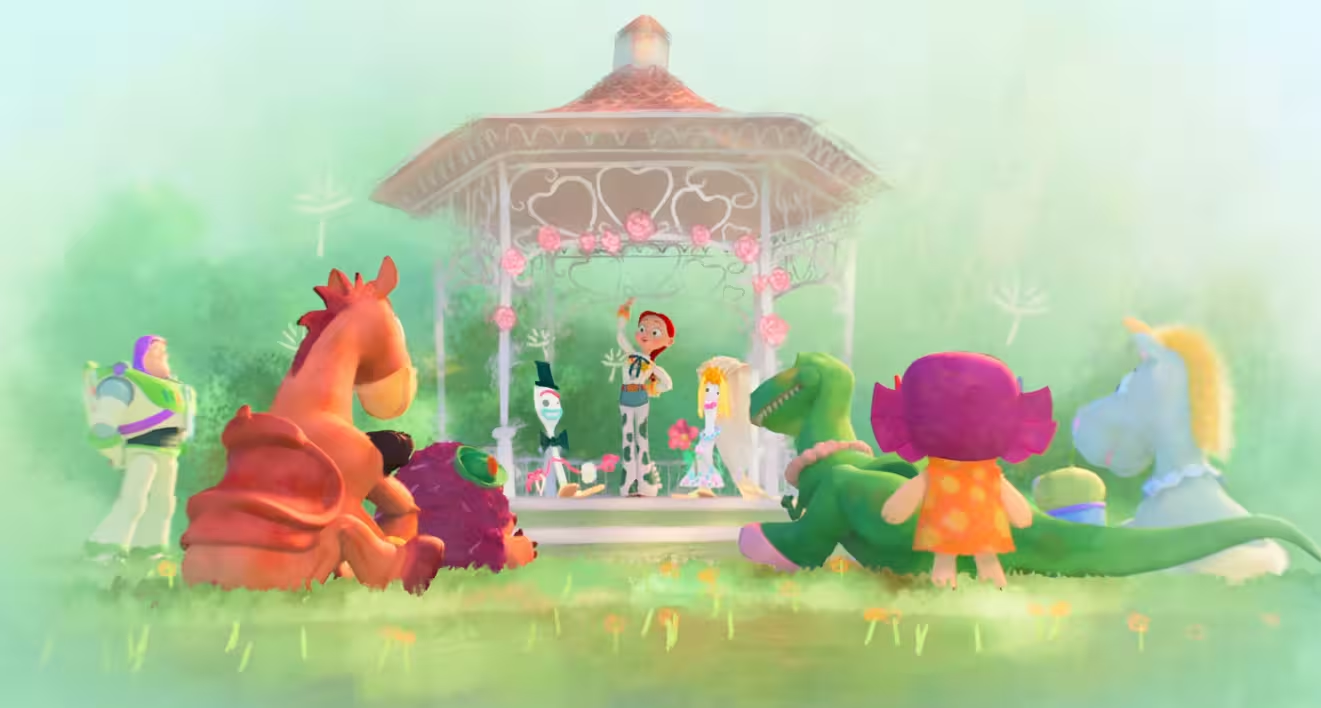
But Pixar being Pixar, they couldn’t just let the moment pass without a massive punchline. During Bonnie and Blaze’s playtime at the end of the film, the kids unknowingly act out a formal wedding ceremony between the Buzz and Jessie action figures. It’s an incredibly sweet, wholesome visual, right up until Trixie the triceratops bursts onto the scene. She throws herself into the middle of the wedding, claiming to be Buzz’s scorned wife and screaming at the top of her lungs that he has done this three times before. I was dying laughing in my seat.
Where Does Woody Go From Here?
A lot of fans went into this movie expecting a complete retcon of Toy Story 4. They wanted Woody back in the toy box full-time, permanently reunited with the gang under Bonnie’s bed. But Andrew Stanton is too smart of a writer to backtrack on a character’s emotional growth like that.
At the end of the movie, Woody stands on the sidelines, just quietly watching Bonnie and Blaze enthusiastically play with Jessie, Buzz, and the Lilypad tablet. He looks completely at peace. His rescue mission is a success, and he knows his friends are safe. So, he does exactly what he is meant to do: he heads back out to the open road with Bo Peep to keep helping lost toys find kids.
But they do establish a brilliant new status quo. Before he leaves, we see that Woody and the gang are keeping their walkie-talkies. They are going to stay in constant contact. It is such a mature, healthy message about friendship as we get older. You don’t have to live in the exact same room—or the exact same state—to be there for the people you love. You just have to pick up the radio.
Is There a Post-Credits Scene Worth Staying For?
Do not leave the theater when the screen goes black, because the mid-credits and post-credits scenes deliver the hardest laughs of the entire runtime.
Remember the 50 malfunctioning Buzz Lightyears who helped pull off the highway heist? The mid-credits scene beautifully wraps up their storyline. Having finally shed their delusional Space Ranger programming, the entire drone-capable fleet flies over to a local elementary school playground right as the afternoon bus drops off the kids. You watch these fifty action figures deliberately pair themselves up with the lonely, awkward kids who don’t have anyone to play with—and hilariously, one even claims the stressed-out school principal. Every single unit finds a home.
Then, right at the very end of the credits, we cut back to the playground. A kid pulls a shiny, high-tech Emperor Zurg action figure out of his backpack. The Zurg figure takes one look at the army of Buzz units staring back at him, slowly raises his blaster, and dramatically yells, “We meet again, my son!” It is the perfect, ridiculous callback to the Star Wars gag from Toy Story 2, and it left the audience howling as the house lights came up.
Wait, Taylor Swift Actually Wrote a Song for This?
I have to talk about the soundtrack, because the musical landscape of this franchise just experienced a massive earthquake. For decades, the sound of Toy Story has been purely defined by the brilliant, jazzy Americana of Randy Newman. Newman is back for the score, and he sounds as sharp as ever. But for the core emotional ballad of the film, Disney brought in Taylor Swift.
Swift wrote and performed an original track called “I Knew It, I Knew You,” written explicitly from Jessie’s perspective. Honestly, I was skeptical when I saw her name on the press release. I worried a massive pop anthem would completely shatter the acoustic, nostalgic vibe of the movie.
I was wrong. Swift brought her Folklore era energy into the studio. It’s this gorgeous, heartbreaking country-pop ballad utilizing banjos, harmonicas, and a Mellotron, heavily honoring Newman’s classic chord progressions. When it plays right after Jessie finds Emily’s time capsule, singing about the blurry nostalgia of childhood and the realization that you were never forgotten, it just wrecks you. It is a seamless passing of the musical torch, and I will be shocked if it doesn’t walk away with the Oscar for Best Original Song.
The Final Verdict: Where Does It Rank?
So, did we actually need Toy Story 5?
If you had asked me a year ago, I would have confidently said no. The franchise was already a miracle. But after watching what Andrew Stanton pulled off, I have to admit that this movie violently justifies its own existence. It is not a lazy cash grab. It is a deeply uncomfortable, necessary look at how screen addiction is actively rewiring modern childhood, told through the eyes of the characters who have the most to lose from it.
By pushing Woody to the side and letting Jessie’s deep-seated abandonment trauma drive the narrative, the film taps into a fresh, agonizing emotional well. It balances that heavy, psychological weight with some of the best physical comedy the studio has ever produced.
Is it better than Toy Story 2 or Toy Story 3? I’m not sure anything will ever top that incinerator scene for pure cinematic terror. But Toy Story 5 sits proudly right alongside them. It proves that Pixar still knows how to break our hearts, put them back together, and make us completely rethink how we look at the world—even the digital one glowing in our hands.
Score: 9/10
read also : Cape Fear (2026) Ending Explained: The Real Killer, Anna’s Secret, and Season 2 Prospects