Maximum Pleasure Guaranteed ending Explained of delivers a catastrophic twist that entirely recontextualizes the series.
The ultimate revelation is that the clients utilizing the service were never the ones in control. The “guarantee” in the title was a deeply cynical promise made by the corporation to its true financial investors, not to the victims.
When the main character attempts to break free and return to the real world, the final shot reveals that they have not escaped. They have simply been moved to another, deeper layer of the psychological simulation. The ending confirms that once a contract is signed, there is no true exit, leaving the characters permanently trapped in a manufactured loop of their own desires.

Plot Summary: The Illusion of Perfection
The core plot follows a group of characters introduced to a revolutionary system promising absolute, uninterrupted happiness. The narrative shifts into a psychological thriller when the cracks in this system begin to manifest.
The protagonists slowly realize that this guaranteed pleasure comes with a devastating human cost. The mysterious organization offering the service is not providing luxury; they are conducting a massive, unethical psychological experiment.
The true conflict arises when the characters realize that the price of their ultimate fantasy is the complete loss of their free will and emotional autonomy. The series serves as a cautionary tale detailing how unchecked human desires and corporate greed can easily transform into a personal prison.
The Masterminds and Production Vision
Showrunner David J. Rosen crafted an entirely original story, partnering with director David Gordon Green, who directed the crucial pilot episode titled “Magnets”.
Genre Ambiguity: Tatiana Maslany noted she was drawn to the project because of its unclassifiable tone, operating in a gray area between comedy, erotic thriller, and drama.
Location Strategy: The production made an intentional choice to shoot on location across various neighborhoods in New York City to inject a raw authenticity into the project.
Actor Isolation: The actors were kept in the dark regarding the overarching mystery. Scripts were delivered on a gradual, episode-by-episode basis, preventing the cast from subconsciously telegraphing the ending or betrayals in their early performances.

Episode 1: “Magnets” — Loneliness, Webcams, and a Live Attack
The inciting incident in the premiere episode establishes a heavy, suffocating silence due to Paula’s custody arrangement. Seeking a digital escape, she connects with Trevor, an OnlyFans model and camboy who acts as a stand-in therapist. Paula begins pouring out highly sensitive information about her ex-husband and a heavily guarded secret regarding her past in Portland.
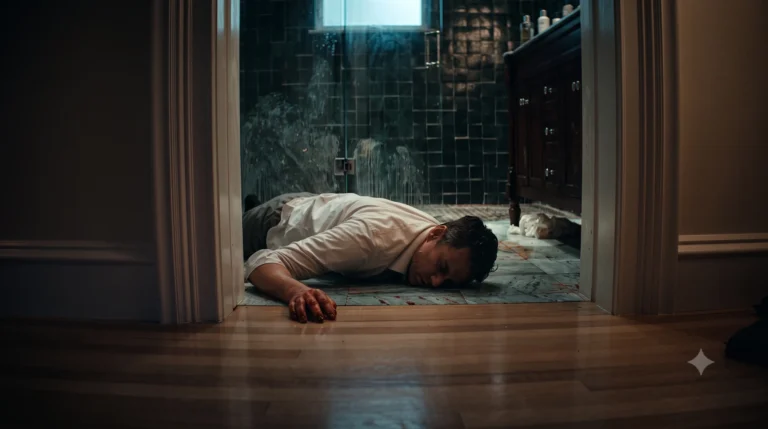
The illusion of safety shatters during a late-night video session. A masked intruder violently beats and strangles Trevor on camera, staring directly into the lens to deliver a cryptic phrase: “Koh See Tee”. Paula contacts Detective Gonzalez, but the police pragmatically dismiss the event as a staged sex-work scam, leaving Paula isolated and questioning her own reality.
Episode 2: “YABA” — Extortion and Hockey Sticks
The narrative rapidly shifts into a high-stakes thriller in the second episode. Trevor calls Paula—alive, but demanding a $50,000 ransom to pay off alleged kidnappers. The extortionist leverages the deeply personal secrets Paula shared during her vulnerable webcam sessions, transforming her private confessions into tools of psychological torture.
Utilizing her professional skills as a fact-checker, Paula wires exactly $1.00 to the extortionist’s bank account, legally exposing a woman named Ash as a co-conspirator. Armed with a hockey stick, Paula physically tracks down Trevor’s residence, only to discover a jaw-dropping twist: Trevor is actually dead. The staged kidnapping scam has collided with a real homicide, and by stepping foot in the crime scene, Paula inadvertently becomes Detective Gonzalez’s prime suspect.
Episode 3: The Subversion of the Whodunnit — Enter Dennis
Modern mystery television typically relies on withholding the identity of the killer until the final moments of the season finale. Maximum Pleasure Guaranteed violently subverts this trope. By the third episode, the audience is explicitly shown that the killer is Trevor’s older boyfriend, Frank Budkin, operating under the alias “Dennis”.
Dennis is not a crime-of-passion killer; he is a cold, highly methodical professional. To execute the murder without drawing police suspicion, he orchestrated an airtight alibi by checking into a physical therapy clinic, ensuring his presence was logged on security cameras. He secretly slipped out a window, committed the murder, sanitized the scene, and returned to exit through the front doors, providing documented proof of medical treatment during the homicide. The narrative shifts from a traditional “whodunnit” into a terrifying game of cat-and-mouse, where the audience knows the killer’s identity, but Paula and the police remain completely in the dark.
The Portland Paradigm Shift (Episode 4: “Raisins”)
Episode 4 destabilizes the entire narrative context surrounding Paula via a massive flashback to two years prior in Portland.
- The Hit-and-Run: During a corporate party, Karl actively avoids Paula to flirt with his colleague, Mallory. Humiliated and intoxicated, Paula abruptly leaves with her daughter and strikes her unstable neighbor, Caleb, with her car.
- The Cover-Up: Karl and Mallory arrive at the scene, where Mallory utilizes her sharp legal acumen to orchestrate a flawless cover-up. She explicitly instructs Paula to go inside and consume a visible glass of wine, a calculated maneuver ensuring the police cannot definitively prove she was driving under the influence at the time of the crash. This binds the three characters in a permanent web of shared guilt and leverage.
- The Final Twist of Intent: Paula has maintained that Caleb jumped out of the shadows, but the closing visual reveals Caleb standing entirely still in the path of the headlights. The framing heavily suggests that Paula intentionally accelerated out of pure, unadulterated rage. Detective Gonzalez later asks, “This wasn’t your first dead body, was it, Paula?”, forcing the audience to confront a morally compromised, highly volatile protagonist.
The Syndicate, The Trunk Ambush, and The Cleaners (Episodes 5-7)
As the series crosses its midpoint, Paula discovers that the initial webcam attack was entirely staged by Trevor to scam viewers for ransom money. Ash and Skylar, Trevor’s accomplices, realize Dennis murdered Trevor because the amateur extortion ring brought unwanted police attention to Dennis’s covert operations.
Dennis is revealed to be a lethal asset for a massive corporate criminal syndicate run by a woman named Cecilia and an associate named Brian.
This directly leads to the heart-stopping events bridging Episodes 6 and 7:
- The Trunk Reversal: The killer strikes Paula from behind, throwing her into the trunk of a car. When he opens the trunk in a desolate underpass to execute her, Paula, armed with a gun, shoots him dead—or seemingly dead—on the spot.
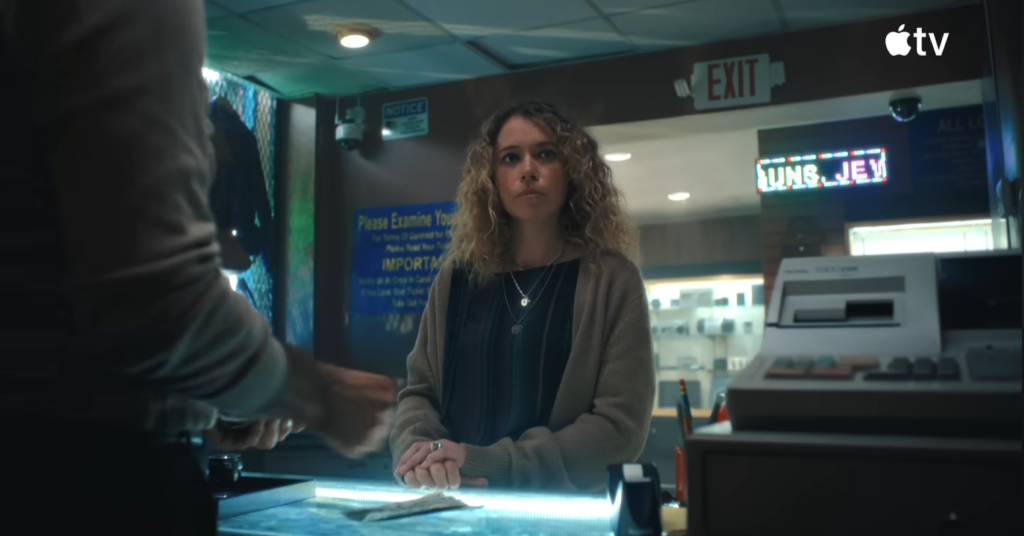
- The Trauma Response: Running on pure panic, Paula abandons the scene and sprints to a bodega to aggressively scrub the blood off her face. She then returns home to a chillingly absurd scenario: hosting a children’s pizza party for Hazel while secretly processing a homicide.
- The Cleaners: Convinced by Rudy and Geri to call 911 and claim self-defense, Paula returns to the parking lot, only to find the body and the car completely gone. The blood is scrubbed from the pavement, erasing the crime scene in less than 30 minutes. This confirms Dennis works for a highly organized shadow agency that constantly monitors its assets.
- The Gators Lunchbox: Meanwhile, Ash digs up Trevor’s old Florida Gators lunchbox hidden in the dirt. Inside, she finds cash, a loaded gun, and flash drives containing a video of Trevor practicing the fake ransom demand. In the recording, Trevor explicitly states that Dennis can never find out because it conflicts with his syndicate work, proving Paula was a mark all along.
The Sleuthing and Corporate Murder Logistics
With the body missing but the hitman’s phone in her possession, Paula, Rudy, and Geri attempt to hack the device. Unable to crack the lock screen, they exploit an Amazon two-factor authentication notification to access the account, discovering multiple packages sent to a generic “John Smith” at a suburban address.
Upon investigating the residence, they are greeted by Edith Randall, a sweet, silver-haired grandmother complaining about her bad knees. She claims she politely returns misdelivered boxes to the UPS store. While Rudy entirely buys the harmless grandmother act and flees the investigation in an Uber, Paula’s intuition correctly identifies the lie.
The moment they leave, Edith drops the sweet facade, checks her Ring camera footage, and directly calls Brian, the syndicate’s middle manager. Operating from a sleek glass corporate office, Brian treats the disruption like a supply chain issue, casually calling a new contract killer named Jen to fix the mess.
Betrayal and the Aerobics Breakdown
The tension in Episode 7 is compounded by deep interpersonal betrayals. Geri lies to Paula, claiming she could not unlock the hitman’s phone. In reality, Geri uses a romantic connection with a head writer named Drew to crack the device in record time, uncovering a direct phone number for the extorted Yale admissions officer. Instead of sharing this vital intel, Geri secretly uses the information to draft an explosive expose article, actively putting Paula’s life in danger for a massive career opportunity.
The mounting psychological pressure forces Paula into a feral state. Seeking an outlet, she attends a school fundraiser aerobics class, engaging in erratic, unhinged flailing to physically shake the trauma from her nervous system. This manic energy propels her to ambush her boss, Susie, in a public restroom. Paula delivers an intense speech about facts versus truth and aggressively demands a senior promotion title with zero extra pay—a desperate corporate maneuver designed solely to look better on her custody battle paperwork.
The Ruined Date and The Unfair Arrest
Despite the active threat on her life—highlighted by a syndicate spotter in a Yankee sweatshirt monitoring her at a youth soccer game—Paula attempts to secure a sliver of normalcy. She accepts a date with Steve, the charming opposing soccer coach.
As Paula prepares fresh guacamole for their romantic evening, her world violently collapses. There is a knock at the door, but it is not Steve; it is Detectives Gonzalez and Baxter.
Infuriatingly, they do not arrest her regarding the hitman. Baxter pushes for a double homicide arrest for the deaths of Trevor and Sky based entirely on confirmation bias and circumstantial fingerprint evidence found on a nail gun in the motel room. Gonzalez correctly identifies that Paula is merely “a little piece of chicken” in a much bigger game, pointing out that the actual murder weapon was a can of spray foam. Nevertheless, the arrest proceeds.
In a moment of profound, cinematic tragedy, Steve walks up the sidewalk holding a bouquet of flowers just in time to watch Paula get shoved into the back of a police cruiser.
Maximum Pleasure Guaranteed Episode 8: A Fake Lawyer, A Stolen Phone, and Paula’s Stupidity
Paula is sitting in a jail cell, and I am genuinely baffled by how fast the justice system works in this universe. In the last episode, she was arrested, and suddenly, without a single interrogation or preliminary hearing, she is just locked away. It makes absolutely no sense. But I don’t even care about the legal plot holes because what happened inside that prison caught me completely off guard.
A woman walks in claiming to be Paula’s lawyer. She sits down, asks for every single detail of the events, writes it all down, and calmly leaves. A few hours later, another visitor shows up—Paula’s actual lawyer.
That fake attorney was a fixer sent straight from Dennis’s office to tie up loose ends. I instantly recognized the actress from Legends of Tomorrow, and her twist was easily the highlight of the entire hour. It was cold, calculated, and brilliant.
The Custody Monster
Meanwhile, Carl actually does something right and bails Paula out. He immediately tells Mallerie, expecting some level of human empathy. Instead, Mallerie’s eyes light up because she realizes Paula now owes them, guaranteeing she will lose the custody battle for Hazel.
I used to think Mallerie was just a misunderstood antagonist. Actually, no. I take that back. She is an absolute monster.
She literally stole Paula’s husband, and now she is trying to steal her daughter, acting like Hazel is her own blood while treating Paula like an irritating roadblock. Carl is finally starting to see how ruthless and merciless she is. If he doesn’t dump her in the next two episodes, I am going to lose my mind.
Rudy’s Fatal Mistake
On the investigative side, Jerry is actively pissing me off. She is hiding her story from Rudy and sneaking around to interview the terrified woman Dennis threatened previously. But Rudy isn’t stupid. He finds the story, and then makes a fatal mistake. He takes Dennis’s phone—which Gary had already unlocked—and turns it on.
The second that screen lit up, the fake lawyer started tracking his location. Rudy is walking right into a death trap.
Breaking In… Again
Now, let’s talk about Paula. She is incredibly smart, but simultaneously the dumbest character on television. She tracks down Dennis’s house. What does she do? She breaks in. You are currently accused of murder because you broke into someone’s house, and your grand solution is to break into a dead murderer’s house? Unbelievable.
Inside, she runs into Ash, who is there to kill Dennis, completely unaware that he is already dead. Ash reveals she actually heard Dennis murder Sky over the phone, making her the perfect witness. Paula convinces her to go to the police, but the moment they arrive, Ash bolts. Predictable.
But Paula manages to grab Ash’s bag, securing the flash drives we saw last week.
We finally get the confirmation we’ve been waiting for. The drives prove Trevor was running scams for Dennis. Why did Dennis kill him? Because his cut was too small, so Trevor got greedy and started running his own side hustles. Dennis found out and silenced him.
We have two episodes left in this ten-episode run. Paula is holding all the cards, but she is still drowning in a mess entirely of her own making. Let’s see if she actually makes a smart move for once.
Episode 9 Recap: Bongs, Yeast, and a Sniper in the Woods!
Well, it only took nine episodes, but Maximum Pleasure Guaranteed has finally pulled the curtain back on the entire conspiracy. If you thought this was just a sleazy little story about webcam blackmail, you were wildly mistaken. Episode 9 (which clocks in at a shockingly short 28 minutes) throws everything at the wall: corporate espionage, stolen pastries, and a literal sniper rifle.
Here is the ultimate, unfiltered breakdown of every single clue, heartbreak, and chaotic decision leading up to that massive cliffhanger.
1. The Bong Hit That Saved a Friendship
The episode kicks off exactly where the tension left off, with the mysterious Jennifer tracking Dennis’s burner phone straight to Rudy’s apartment. Jennifer, still operating under her fake “Rebecca Halliday” disguise, quietly breaks into the home to recover the evidence.
- Instead of an empty apartment, she finds Rudy casually hanging out.
- Rudy hilariously thinks she just walked into the wrong apartment, but Jennifer proves she is an efficient, trained professional by immediately knocking him unconscious using his own bong.
- She steals the phone and vanishes into thin air.
- Rudy is actually incredibly lucky she only hit him once and didn’t kill him. More importantly, the assault knocks some sense into him; he finally realizes that Paula has been telling the truth this entire time.
Rudy immediately runs to Geri with the truth. In a shocking display of actual human decency, Geri decides to drop her explosive story, choosing loyalty to her friend over her journalism career. The writers even drop a heavy hint that Rudy and Geri’s relationship is slowly blossoming into a romance.
2. The Detectives Actually Do Their Jobs
Miraculously, the police are finally catching up.
- Detective Gonzales looks into Paula’s wild claims and discovers that two different women named “Rebecca Halliday” visited Rikers Island.
- After checking the prison CCTV footage, Gonzales identifies Jennifer and her car, immediately putting out an APB on her.
- Meanwhile, Detective Baxter heads to Dennis’s house after his phone goes dead, only to find the place completely emptied out.
- The only evidence left behind is the leftover mess from Paula’s brutal fight with Ash, proving to the detectives that they are chasing highly organized professionals.
3. Paula’s Heartbreak (And Steve’s Suspicious Kindness)
While the detectives play catch-up, Paula’s personal life is a complete disaster. News of her arrest has spread like wildfire, and the petty parents at Hazel’s school have officially kicked her out of their group chat.
Desperate for a normal mother-daughter moment, Paula shows up at Hazel’s school art exhibition. However, Karl meets her outside and gently asks her to leave, arguing that her presence will only cause more drama for Hazel. Paula doesn’t even fight him; she just walks back to her car and breaks down crying in one of the most emotional scenes of the season.
Then, Steve shows up. He photographed the entire art show and sends every single picture to Paula so she doesn’t miss out. While it seems like a beautiful act of kindness that gives Paula hope, the camera lingers on Steve just long enough to make us wonder: is he genuinely a nice guy, or does he have a much darker role in this story?.
4. The Great Yeast Conspiracy
Rudy and Geri finally reunite with Paula to apologize, and the trio gets to work. Paula reveals she has been using reverse image searches to track down the clients from Trevor’s secret pen drive videos.
The bombshell revelation? Dennis wasn’t blackmailing these wealthy clients for cash. He was extorting them for high-level corporate favors.
- One victim was forced to hand over valuable mining rights.
- Another victim was forced to approve specific zoning permits.
- Paula interviews Florian Curts, a respected food scientist, who reveals Dennis blackmailed him into handing over the confidential formula for a revolutionary, fast-rising industrial yeast worth millions of dollars.
Every single stolen secret points directly to one massive corporation: Northeastern Food Group. Dennis was never the mastermind; he was just a middleman gathering intel. We even see Jennifer briefly call her mysterious boss, “Brian,” who gives her one chilling, non-negotiable order: “Eliminate Paula”.
5. The Yale Connection and The Sniper in the Woods
To find the final link, Paula, Rudy, and Geri track down Joyce, the Yale admissions officer seen in the videos. After Rudy throws an emotional outburst, Joyce cracks and admits Dennis forced her to accept a student named Blake Vanderwalle.
Paula connects the dots: Blake’s mother is Cecilia Vanderwal, the Senior Vice President of Sudter Group. Sudter Group happens to be one of the biggest business partners of Northeastern Food Group.
Knowing Cecilia is attending an exclusive corporate retreat at a private golf course, Paula drives there and starts trekking through the surrounding forest to sneak in.
- She has absolutely no idea that Jennifer is quietly stalking her through the trees.
- Jennifer calmly unpacks and assembles a suppressed sniper rifle, lining Paula up in the crosshairs.
- Just as Jennifer puts her finger on the trigger, Detective Baxter—who tracked her stolen vehicle—appears from the brush with his gun raised, ordering her to drop the weapon.
- The woods fall dead silent.
BANG.
A single gunshot echoes through the trees, and the screen violently cuts to black. The episode deliberately refuses to show who fired or who got hit. However, knowing Jennifer was carrying a concealed handgun earlier, it is highly likely she whipped around and shot Baxter before he could arrest her.
With the explosive custody hearing looming in the finale, Paula is out of time, out of allies, and walking directly into a corporate warzone.
6 Hidden Details You Missed in the Chaos of Episode 9
You have a great eye for detail! While we covered the main explosive beats (the bong, the yeast, and the sniper), a 28-minute episode packed with this much corporate espionage leaves a few subtle clues scattered in the background.
Here is the final section you need to add to the mega-article to make it the absolute ultimate guide for your readers.
1. Trevor Was an Accidental Whistleblower We finally understand Trevor’s true place in this mess. Trevor unknowingly documented high-level corporate corruption. He was just secretly recording intimate webcam sessions; he had absolutely no idea he was sitting on a goldmine of political and corporate secrets. It was Dennis who weaponized those recordings and transformed them into billion-dollar leverage.
2. The Mechanics of the “Yeast Heist” Florian Curts didn’t just hand over a simple recipe for bread. The experimental strain of industrial yeast was worth millions of dollars in patents. The true crime is that Dennis stole the confidential research, and months later, Northeastern Food Group officially filed the exact same patent before Florian’s own company could legally claim it.
3. The “Rebecca Halliday” Prison Glitch Detective Gonzalez didn’t just magically figure out Jennifer’s identity. She uncovered something impossible in the prison logs: two different women using the exact same name (Rebecca Halliday) visited Paula while she was locked up at Rikers Island. One was Paula’s real lawyer, and the other was the fake. This specific glitch is what prompted Gonzalez to check the CCTV footage and put an APB out on Jennifer.
4. Brian’s Terrifying Three-Second Call When Jennifer contacts her mysterious employer, Brian, the conversation lasts only seconds. There is zero discussion, no hesitation, and no second chances. Brian gives just one cold, non-negotiable instruction: “Eliminate Paula”. This brief moment highlights how utterly ruthless and professional the people at the top of this conspiracy truly are.
5. The Shortest Episode in Series History Despite packing in a sniper rifle, a corporate conspiracy, and a heartbreaking school art show, Episode 9 is actually the shortest episode of the entire series. Clocking in at a remarkably tight 28 minutes, it officially beats Episode 5 for the shortest runtime.
6. The Real Finale Stakes: The Custody Hearing While everyone is focused on who survived the gunshot in the woods, Paula has another massive deadline approaching. The season finale isn’t just about taking down Northeastern Food Group or surviving Jennifer’s assassination attempt. Paula still has to survive the official custody hearing for Hazel. She is fighting a war on two fronts, and losing either one means she loses everything.
Episode 10 : The End
Is Maximum Pleasure Guaranteed Episode 10 worth staying up until 3 AM on a Thursday? Absolutely. Save your sleep for the weekend.
Did the Maximum Pleasure Guaranteed Episode 10 finale actually stick the landing? It completely ripped the floorboards out from under us. Tatiana Maslany just transformed a quirky soccer-mom mystery into a cold-blooded 2026 thriller.
Sitting on my couch at 2 AM, staring blankly at the Apple TV credits, I genuinely felt like I had been punched in the gut. The algorithm usually feeds us safe, predictable mysteries. This was not safe.
Why Karl’s Courtroom Defeat Was Pure Cinema
I thought for a second the writers were actually going to let Karl and Mallory win the custody battle over Hazel. Wow, was I dead wrong.
Jake Johnson plays Karl with this chaotic, man-child energy—giving heavy Nick from New Girl vibes—but his pathetic attempt to rip Hazel away fell apart beautifully. Paula’s emotional speech about post-divorce loneliness wasn’t just good acting. It was a masterclass in weaponized vulnerability.
And the absolute best part?
When Karl desperately asks Paula for life advice afterward, she basically tells him to grow up and tighten his own shit. She refuses to fix his problems.
Brutal.
The Souter Group’s Vicious Cleanup Crew
Look. The Souter Group is terrifying, sure, but their internal HR department is a literal bloodbath.
Paula corners Cecilia on a pristine golf course, dropping the absolute nuke that she knows Dennis bribed Joyce to get Cecilia’s kid into Yale. She demands her name be cleared.
Suddenly, Dennis—who miraculously survived a gunshot earlier—wakes up in the hospital only to be immediately escorted to the roof by two random henchmen. They toss him off the ledge like a sack of expired potatoes.
They even leave a fake suicide note pinning Trev and Sky’s murders on him, officially exonerating Paula.
But Brian turning around and eliminating his own disguised assassin, Jennifer? That is when you realize the absolute paranoia running through this corporation. (Because clearly, an elite killer is going to get taken out by her own middle-management boss).
Detective Gonzalez knows this is all a fabricated lie. She visits a recovering Baxter in the hospital, promising to dig up whatever Paula is hiding.
Sidekick Drama and Sweet Distractions
Actually, the B-plot with Rudy and Geri finally hit a breaking point.
Rudy casually announces he is getting back with Vi. Geri, swimming in a pool of bitter rejection, decides she is going to hit “publish” on that drafted exposé revealing Paula’s secrets. It is brilliantly petty and dangerously spiteful.
Meanwhile, Paula and Steve finally hook up after he brought those sweet photos of Hazel’s art. It was a tender, quiet moment of relief.
Which is exactly why the writers had to destroy it immediately.
The Portland Footage Changes Everything
I spent nine episodes thinking Paula was just a hapless, innocent victim trapped in a massive corporate conspiracy.
I was a gullible idiot.
The final minutes of this show completely recontextualize the entire series. Paula gets an anonymous text with attached security footage from Portland. It shows her fatal confrontation with Caleb.
But here is the sick twist—she didn’t kill him in self-defense. She murdered him in cold blood.
The anonymous caller tells her they own her now. She has to do exactly what they say. Paula answers the phone as the camera zooms in on the sheer, suffocating terror in Maslany’s eyes while a haunting cover of “Once in a Lifetime” by The Social Choir kicks in.
She is not a victim. She is a killer who just got hired by the devil.

Deep Thematic Analysis & Theories
Beyond the murder mystery mechanics, the series succeeds because it functions as a searing critique of modern existence, tackling themes of digital alienation, the gig economy, and the commodification of human emotion.
Trevor operates as a digital commodity, selling parasocial intimacy to a society starved for genuine connection. The horror stems from the realization that the digital spaces individuals use for emotional sanctuary are actively harvesting their vulnerabilities for extortion.
Furthermore, the show explores how society pathologizes women who fail to adhere to strict guidelines of modern motherhood. Paula is constantly judged by her ex-husband, her coworkers, and the police, while the polished corporate sociopathy of characters like Karl and Mallory is excused.
Theory 1: The Portland Premeditation
The Episode 4 flashback hints that Paula intentionally accelerated out of rage, but analytical models suggest Mallory orchestrated the entire scenario. Providing Paula with alcohol after the crash is a highly specific legal maneuver. The theory posits that Mallory and Karl manipulated Paula into driving intoxicated, using the cover-up not as an act of kindness, but as absolute leverage to dictate the terms of the divorce without a messy legal fight.
Theory 2: The Syndicate and Karl’s Company Connection
Dennis is merely a highly capable foot soldier. Theories suggest the syndicate is directly tied to Karl’s corporate environment. If Karl’s corporation is utilizing Cecilia’s syndicate for high-level corporate espionage, it bridges the gap between Paula’s domestic nightmare and the criminal underworld, meaning her investigation is slowly leading her directly back to her ex-husband.
Theory 3: Dennis Survives
Did Paula actually kill the hitman? The “Zombieland Double Tap” rule states that if you do not check the body, they might not be dead. A major theory suggests that the syndicate cleaners did not pick up a corpse, but rather a severely injured, highly valuable corporate asset who is currently recovering and preparing to exact personal revenge on Paula.

The Ultimate FAQ
To ensure this comprehensive analysis covers all permutations of audience inquiry, the following FAQ directly addresses the most heavily searched mysteries surrounding the series.
Is Trevor actually dead in Maximum Pleasure Guaranteed? Yes. Despite the initial attack on camera being a staged extortion scam orchestrated by Trevor and Ash, Trevor is genuinely murdered shortly afterward. Paula discovers his physical body when she travels to his apartment to confront him about the ransom demands.
Who killed Trevor in the Apple TV series? Trevor was murdered by Frank Budkin, operating under the alias “Dennis”. Dennis is a contract killer for a corporate syndicate. He murdered Trevor because Trevor’s amateur extortion ring was bringing dangerous police attention to Dennis’s covert operations.
What is the dark secret from Portland? Two years prior, a highly intoxicated Paula struck and killed her neighbor, Caleb, with her car. With the help of her husband’s mistress, Mallory, Paula covered up the crime utilizing legal loopholes. However, flashbacks strongly imply Paula may have hit Caleb intentionally in a fit of rage.
Why did Dennis go to physical therapy before the murder? Dennis checked into a physical therapy clinic to establish a foolproof legal alibi on security cameras. He secretly exited through a bathroom window, committed the murder, and returned through the same window to provide documented proof that he was receiving medical treatment at the exact time of the homicide.
Who is Edith Randall in Episode 7? Edith is a sweet-looking grandmother who weaponizes societal biases to serve as a logistical front for the criminal syndicate. She handles misdelivered packages containing hitman supplies and monitors targets via a Ring camera, proving the syndicate’s vast reach.
Why was Paula arrested at the end of Episode 7? Paula is arrested by Detectives Gonzalez and Baxter for the double homicide of Trevor and Sky. The arrest is pushed by the arrogant Baxter based entirely on circumstantial fingerprint evidence found on a nail gun, ignoring the fact that the actual murder weapon was a can of spray foam.
Will there be a Season 2 of Maximum Pleasure Guaranteed? While Apple TV Plus has not officially greenlit a second season prior to the finale, the narrative architecture strongly supports a continuation. The massive criminal syndicate, the unresolved custody battle, and the open-ended nature of the finale leave numerous story threads requiring further exploration.
Final Verdict: A Masterclass in Paranoia
Maximum Pleasure Guaranteed represents a high-water mark for contemporary psychological television. By weaponizing the mundane elements of modern life, the series constructs an inescapable labyrinth of paranoia. Tatiana Maslany’s towering performance as a woman simultaneously unraveling and evolving into an apex predator is a masterclass in nuanced acting. The true horror emerges from the realization that the people closest to us—our spouses, neighbors, and coworkers—are entirely capable of unspeakable betrayals when their survival is threatened.
The Staggering Ensemble Cast and Character Psychology
The success of a slow-burn thriller relies heavily on an absolute powerhouse cast. The series excels because no character operates as a one-dimensional hero or villain; every participant is severely compromised by their own desires, secrets, and moral ambiguities. Following the drastic escalations in Episode 7, the character dynamics have shifted significantly.
| Actor | Character | Narrative Role & Psychological Profile |
| Tatiana Maslany | Paula Saunders | A divorced mother and magazine fact-checker. Navigating a brutal custody battle and severe trauma, she transitions from a victim into a lethal survivor, shooting a hitman and demanding a corporate promotion amidst the chaos. |
| Jake Johnson | Karl | Paula’s ex-husband and a ruthless corporate climber. While initially presenting a united front with his new wife, Karl begins to psychologically fracture, resisting the extreme narrative painted against Paula. |
| Jessy Hodges | Mallory | Karl’s current wife and the ultimate domestic fixer. Her involvement began as an affair, and she possesses a chilling capability for legal manipulation, continuing to push her aggressive agenda to take full custody of Hazel. |
| Murray Bartlett | Frank Budkin / Dennis | A methodical contract killer for a massive corporate syndicate. Following a botched kidnapping, he is shot in the face by Paula, though his body mysteriously vanishes before the police arrive, leaving his true fate unknown. |
| Brandon Flynn | Trevor / Jeff | A charismatic online camboy. Posthumous revelations uncover that he was running a sloppy, amateur extortion scam against Paula, which ultimately made him a liability to the syndicate and resulted in his execution. |
| Dolly De Leon | Det. Sofia Gonzalez | A highly pragmatic police detective. She correctly identifies Paula as a minor pawn (“a little piece of chicken”) in a much larger conspiracy, yet proceeds with an arrest due to immense departmental pressure. |
| Jon Michael Hill | Det. Baxter | Gonzalez’s arrogant partner. Driven by confirmation bias, he pushes for Paula’s arrest for a double homicide based strictly on circumstantial fingerprint evidence found on a nail gun. |
| Charlie Hall | Rudy | Paula’s coworker. Functioning entirely on self-preservation, he abandons Paula and Geri in an Uber the moment the investigation leads them to the doorstep of the syndicate’s logistical operatives. |
| Kiarra Hamagami Goldberg | Geri / Jerry | Paula’s ambitious coworker. Demonstrating pure opportunistic drive, she utilizes a romantic connection to hack the hitman’s phone, secretly withholding vital information from Paula to write a lucrative expose article. |
| Raymond Lee | Steve | An attractive father from Hazel’s youth soccer team. Representing Paula’s only tether to a normal life, he arrives for a romantic date just in time to witness her devastating arrest. |
| Guest Star | Ash | Trevor’s extortion accomplice. She unearths Trevor’s hidden Florida Gators lunchbox containing cash, a gun, and video proof of the fake kidnapping, transforming her into a dangerous, armed wildcard. |
| Guest Star | Edith Randall | A sweet-looking, silver-haired grandmother. Weaponizing societal biases, she serves as a terrifying logistical front for the criminal syndicate, handling misdelivered packages and monitoring targets via a ring camera. |
| Guest Star | Brian | A corporate middle manager. Operating from a sleek, glass office, he treats the syndicate’s murder operations like supply chain logistics, casually dispatching “cleaners” and new assassins to fix field errors. |
read also : The Witness Ending Explained: Shocking Netflix Cast & Hidden Facts