If you are hunting for a definitive Michael 2026 movie ending explained, you have just stepped into one of the most intricately woven, legally fraught, and psychologically complex narratives in modern cinematic history. Directed by Antoine Fuqua and penned by three-time Academy Award nominee John Logan, the highly anticipated biopic Michael has completely shaken the foundation of the musical biography genre.
By taking the terrifying framework of a child prodigy’s ascent and fusing it with the operatic tragedy of the world’s most famous entertainer, the creators have crafted a 127-minute epic that is overflowing with ambient tension, breathtaking musical recreations, and glaring historical omissions. Here at memoria.film, the obsession lies in unraveling complex psychological mysteries. Just as deep-dive reviews of complex thrillers rack up thousands of impressions from viewers desperately trying to piece the puzzle together, that same rigorous analytical lens must be applied to the fog of paranoia, ambition, and trauma surrounding the Jackson family.
Backed by powerhouse producer Graham King (the architect behind Bohemian Rhapsody) and co-executors of the Jackson Estate, John Branca and John McClain, this film moves away from pure tabloid sensationalism and leans heavily into modern horrors: the weaponization of familial expectation, the isolating cage of unparalleled fame, and the devastating consequences of a stolen childhood. However, the film’s abrupt conclusion in the year 1988 has left global audiences stunned, searching for answers, and questioning the historical authenticity of the narrative.
In this massive, exhaustive breakdown, the analysis is divided into comprehensive parts to cover every single detail you need to know. This report will dissect the elite cast, explain the shocking twists of the opening acts, unearth the darkest hidden secrets regarding multimillion-dollar reshoots, explore the thematic theories behind the cinematography, and provide a dedicated FAQ and streaming guide to answer the internet’s burning questions.
The Poignant Michael Movie Ending Explained
Biopics face the difficult task of deciding exactly where to end a massive legacy. If you are looking for the Michael Jackson movie ending explained, the director made a highly emotional and respectful choice. Rather than focusing heavily on the tragic details of his passing, the Michael movie ending chooses to celebrate his artistry. The film concludes by focusing on the intense, grueling preparations for the This Is It tour. It leaves the audience with a powerful reminder of his unparalleled creative genius, freezing his legacy in a moment of pure musical passion rather than controversy.
PART 1: The Setup and The Shocking Ensemble Cast
To fully grasp the nightmare and the triumph unfolding on screen, one must first look at the deeply flawed human beings at the center of the story. This is not a simple tale of an innocent boy achieving his dreams; the Jackson family dynamic is riddled with dark secrets, moral ambiguity, and deep psychological scars. The success of this ambient dread and electrifying stage presence relies on an absolute powerhouse ensemble cast.
The film operates as a sprawling ensemble piece, wherein every supporting character represents a different facet of the pressures placed upon the protagonist. The casting choices themselves sparked intense industry debates regarding nepotism, historical accuracy, and the ethics of estate-funded biographies.
The Core Cast and Psychological Profiles
| Actor | Character | Narrative Role & Psychological Profile |
|---|---|---|
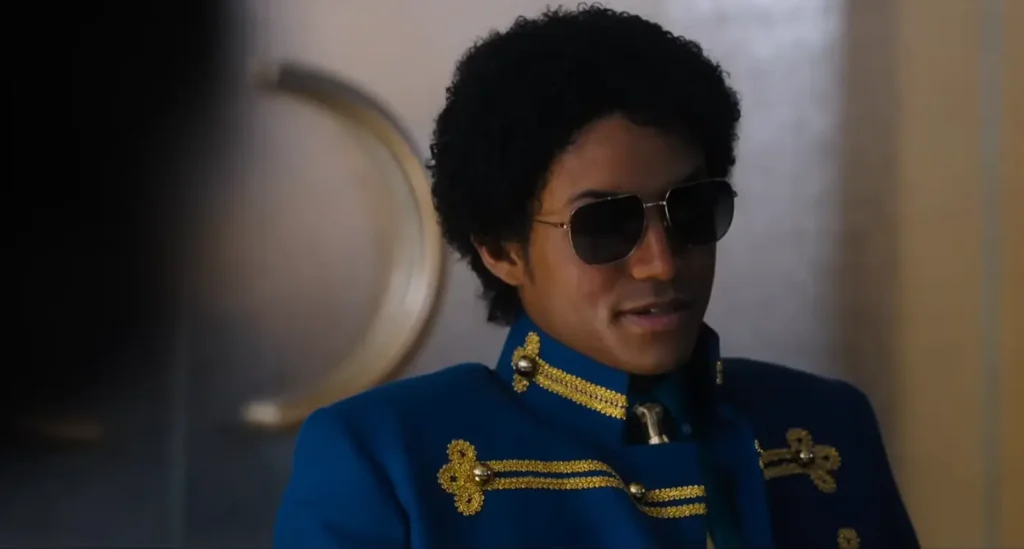
| Jaafar Jackson | Michael Jackson | The protagonist. Jaafar, the real-life nephew of Michael, delivers a transformative performance that transcends mere impersonation. He captures the paradox of the King of Pop: an unstoppable, electrifying force on stage, yet a cripplingly lonely, Peter Pan-obsessed man-child in private. |
| Juliano Krue Valdi | Young Michael | The prodigy. Valdi portrays Michael during the 1960s Gary, Indiana era. His performance highlights the innate, God-given talent that made him the undeniable frontman, while also capturing the terrifying vulnerability of a child subjected to ruthless physical discipline. |
| Colman Domingo | Joe Jackson | The antagonist. Domingo plays the Jackson family patriarch not as a cartoonish, screaming monster, but as a chillingly calm, calculating authoritarian. His abuse is portrayed as a twisted manifestation of love, driven by a desire to pull his family out of poverty through sheer, relentless pressure. |
| Nia Long | Katherine Jackson | The passive protector. Katherine is depicted as the emotional anchor who provides Michael with unconditional love and religious grounding (referencing their Jehovah’s Witness faith). Yet, she repeatedly fails to physically intervene against Joe’s tyranny until the very end, highlighting the entrenched patriarchal dynamics of the era. |
| Miles Teller | John Branca | The corporate enabler. Teller portrays the legendary entertainment lawyer who helps Michael achieve independence from his father. Branca represents the transition from familial control to corporate commodification, positioning Michael as a global brand. |
| KeiLyn Durrel Jones | Bill Bray | The silent sentinel. Serving as Michael’s longtime bodyguard, Bray is one of the few characters who demands nothing from the star. His presence provides a rare safe space, acting as a surrogate father figure who allows Michael room to breathe creatively and emotionally. |
| Larenz Tate | Berry Gordy | The industry titan. The founder of Motown Records who first recognizes Michael’s rare, generational talent. Gordy is portrayed as a strict but visionary mentor who forces the Jackson 5 to refine their raw energy into polished superstardom. |
| Mike Myers | Walter Yetnikoff | The aggressive executive. As the president of CBS Records, Yetnikoff is the abrasive, powerful industry player who goes to war with MTV, ultimately breaking the network’s racial barriers to air the “Billie Jean” music video. |
The Nepotism Debate and The Triumph of Jaafar Jackson
When Lionsgate initially announced that Jaafar Jackson—the son of Jermaine Jackson—would step into the sparkling loafers of his uncle, the casting was met with intense skepticism. Critics questioned whether an untested actor, whose primary background was in music rather than cinema, could carry a $200 million tentpole production. Playing Michael Jackson requires a near-impossible alchemy: mastering the distinct, breathy vocal cadence, executing the physics-defying choreography without looking like a Las Vegas impersonator, and projecting a deeply fractured internal psychology.
However, the performance rapidly silenced detractors. The analysis indicates that Jaafar’s lifelong proximity to the Jackson family lore allowed him to embody the mannerisms of his uncle with eerie authenticity. He does not merely mimic the dances; he understands the origin of the movement. When recreating the iconic “Billie Jean” performance at Motown 25, Jaafar deliberately performs the “infant” version of the routine—the slightly less polished, raw iteration that Michael debuted in 1983—rather than the perfected version Michael would execute on the HIStory tour a decade later. This granular attention to historical accuracy elevates the film from a standard biopic to an immersive historical document.
The Menace of Colman Domingo
If Jaafar Jackson provides the film’s soaring highs, Colman Domingo anchors its terrifying depths. Domingo’s portrayal of Joe Jackson serves as the narrative engine for the first two acts. The film astutely refrains from depicting Joe purely as a loud, chaotic physical abuser. Instead, Domingo plays him with a menacing stillness. His abuse is characterized by subtle, terrifying shifts in facial expressions, a drop in his cheekbones, and a dangerously calm vocal tone.
When Joe removes his belt to punish young Michael for daring to express fatigue after a performance, the horror is amplified by the silence of the rest of the family. Domingo portrays Joe as a man who genuinely believes his cruelty is a necessary armor for Black children growing up in 1960s America. The philosophy is brutally simple: the world will show them no mercy, therefore, neither will their father. This complex rendering makes Joe Jackson one of the most compelling antagonists in recent cinematic history.
PART 2: The Cinematic Journey and Plot Breakdown
The sheer terror and triumph of this adaptation lie in how meticulously the film charts Michael’s evolution. Operating with a staggering 127-minute runtime, the narrative covers 22 years of intense cultural history, beginning in the claustrophobic confines of a steel town and ending in the sprawling arenas of Europe. Let’s break down the most critical eras that set up the ultimate endgame.
The Steel Town Origins and Motown Ascension (1966-1975)
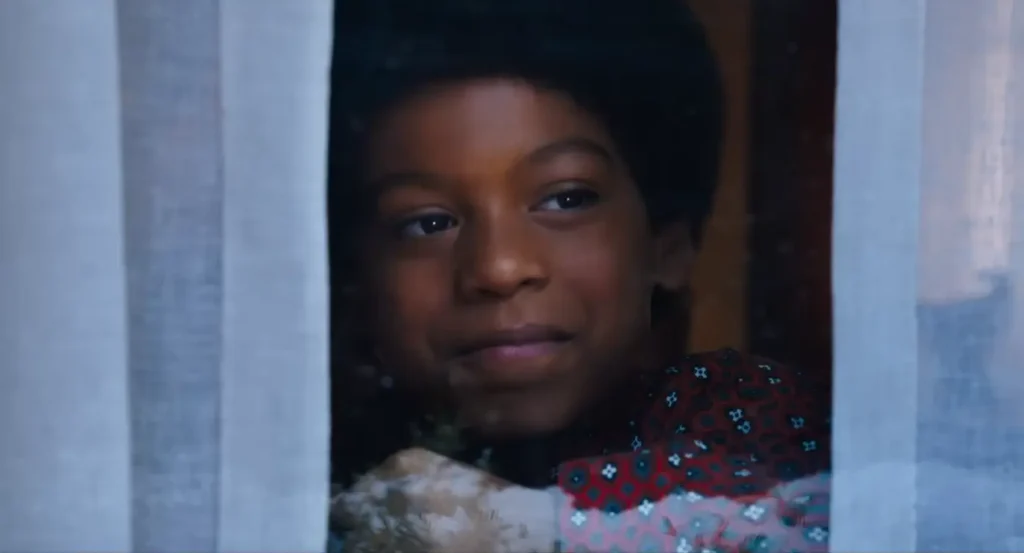
The film opens in 1966 in Gary, Indiana. The visual language established by cinematographer Dion Beebe is deliberately desaturated, gritty, and oppressive. Young Michael (Juliano Krue Valdi) is shown watching other children play outside his window, immediately establishing the theme of isolation. His childhood is entirely consumed by grueling, militaristic rehearsals orchestrated by his father.
The transition to Motown Records highlights the corporatization of the Jackson 5. A pivotal sequence involves Suzanne de Passe (Laura Harrier) discovering the boys and bringing them to Berry Gordy (Larenz Tate). During a studio session, Gordy criticizes Michael for moving too much while singing. Michael quickly adapts, absorbing the lessons of industry veterans. This scene establishes Michael not just as an instinctual performer, but as a sponge for show business mechanics. As hits like “I Want You Back” and “ABC” rocket to the top of the Billboard charts, the family escapes Gary for a sprawling mansion in Encino, California. However, the change in geography does not change the internal dynamic; Joe’s grip only tightens as the stakes grow higher.
The Rebellion of Off The Wall (1979)
The second act marks Michael’s transition into adulthood and his desperate bid for solo recognition. The narrative glosses over his crucial work on the 1978 film The Wiz—a notable omission, as it was on that set where he forged his partnership with producer Quincy Jones (played by Kendrick Sampson). Instead, the film jumps directly to the formulation of the Off The Wall album.
Michael is shown navigating the end of the disco era, taking a massive creative risk to mature his sound. To execute this, he must hire entertainment lawyer John Branca (Miles Teller) with one specific directive: fire Joe Jackson as his manager. The scene where Joe receives a brief, one-sentence fax terminating his managerial control is a masterclass in tension, underscoring Michael’s growing ruthlessness in protecting his art.
Despite Off The Wall becoming a massive commercial success, the film highlights Michael’s deep, agonizing frustration at winning only a single Grammy Award. This perceived failure acts as the ultimate catalyst for the creation of Thriller. The film posits that Michael’s perfectionism is driven by a deep-seated inadequacy instilled by his father; no amount of success is sufficient unless it achieves total, undeniable global subjugation.
The Thriller Phenomenon and Breaking the MTV Color Line (1982-1984)
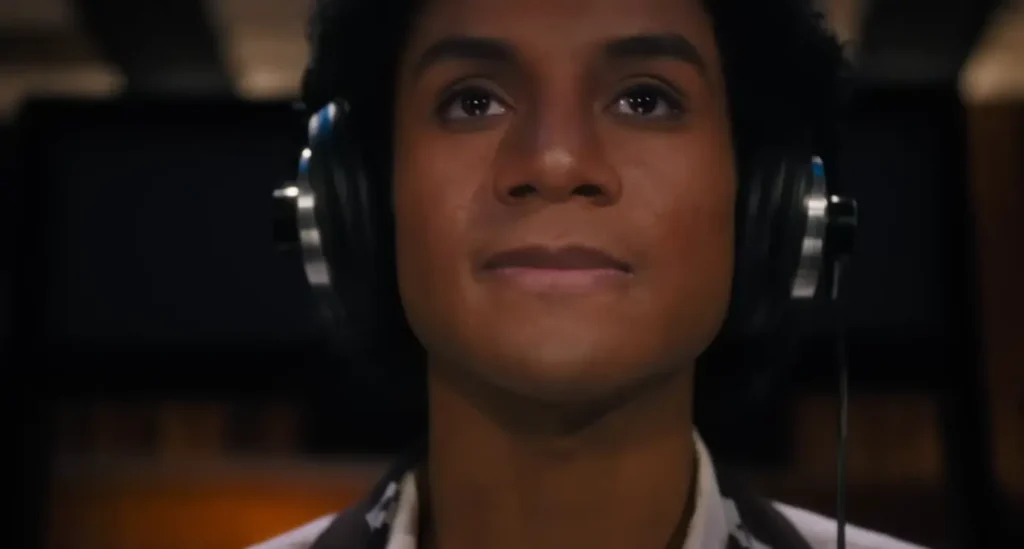
The Thriller sequence operates as the pulsing centerpiece of the film. The production value peaks as the narrative delves into the creation of the highest-selling album in human history. The film shines when it pulls back the curtain on Michael’s creative process. A standout scene depicts Michael waking up in the middle of the night, rushing into his home studio, and beatboxing the intricate baseline and melodies of a new track entirely from his head.
A sociologically profound sequence involves the creation of the “Beat It” music video. In a bold display of his evolving cultural power, Michael reaches out to real-life members of the Bloods and Crips street gangs in Los Angeles. The film portrays Michael attempting to use dance as a unifying force, convincing hardened, rival gang members to participate in choreographed routines under heavy police supervision.
Simultaneously, the film tackles the systemic racism of the 1980s music industry. A powerful scene depicts Michael and Branca confronting CBS Records president Walter Yetnikoff (Mike Myers). Michael demands that his cutting-edge short films be played on MTV, a network that exclusively aired white rock artists and actively refused to play Black musicians. The film shows Yetnikoff blackmailing the network, threatening to pull all massive CBS artists—including Bruce Springsteen and Bob Dylan—unless “Billie Jean” is aired. The subsequent broadcast completely fractures the racial barrier of television, cementing Michael as a cultural revolutionary.
The Pepsi Commercial Tragedy and The Victory Tour (1984)
The film treats the 1984 Pepsi commercial accident with terrifying, unvarnished realism. Driven by the manipulative tactics of boxing promoter Don King (Deon Cole) and Joe Jackson, Michael is strong-armed into a corporate sponsorship and a family reunion tour he desperately wishes to avoid.
During the filming of the pyrotechnic display, a mistimed explosion sets Michael’s hair on fire, resulting in severe second and third-degree burns to his scalp. The sequence is not played for sensationalism; rather, it is depicted as the tragic, fatal pivot point of his life. In the hospital, doctors warn his family that he may never perform again, and the film explicitly connects this agonizing recovery to his subsequent, lifelong dependency on powerful prescription painkillers.
Furthermore, the incident highlights the grotesque machinery of his management. While Michael is recovering in the burn unit, wrapped in bandages and screaming in agony, Joe Jackson is shown callously calculating the financial losses of a delayed tour. The Victory Tour proceeds, but the internal rot is visible. The ticketing system is a disaster, prices are exorbitant, and Michael is forced to donate his entire earnings to charity to save his public image from his father’s greed.
PART 3: Michael 2026 Movie Ending Explained
To make sure your ultimate Michael 2026 movie ending explained is complete, one must analyze the abrupt, jarring narrative shift that concludes the film. Rather than culminating in the tragic demise of the superstar in 2009, or the harrowing legal battles of the mid-1990s, the film deliberately severs its timeline in 1988.
The Declaration of Independence
The climax of the film’s linear narrative occurs on the final night of the Victory Tour in December 1984. The tension is palpable as Michael, exhausted and physically scarred, performs with his brothers. As the concert concludes, Michael takes the microphone and publicly announces, against the prior knowledge of his father and brothers, that this will be the final time the Jacksons perform together.
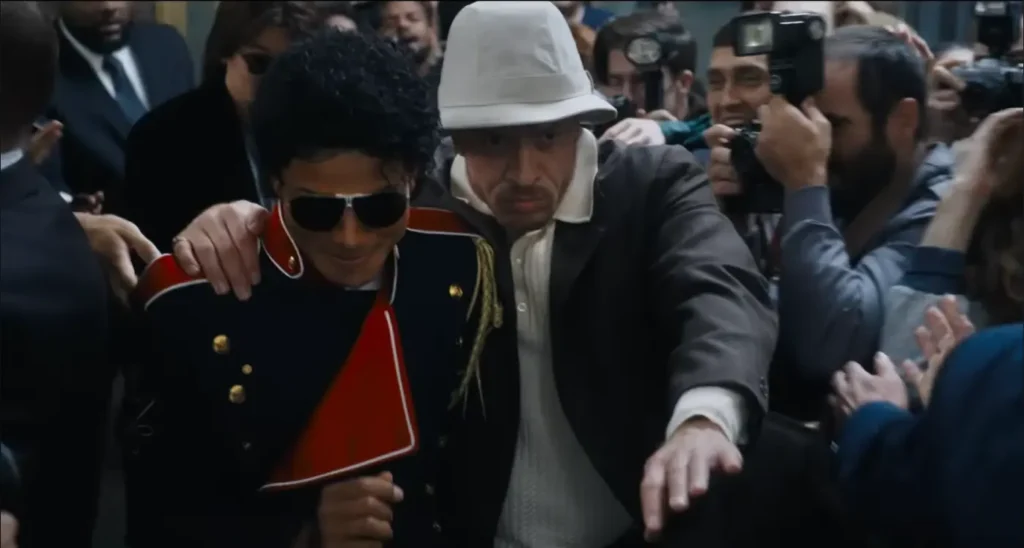
This is the ultimate act of defiance. When Michael walks off the stage, Joe attempts to confront him, but is physically blocked by Bill Bray, Michael’s loyal bodyguard. For the first time in his life, Michael is entirely untethered from the familial obligations that anchored his trauma.
The Abrupt Shift to Wembley Stadium
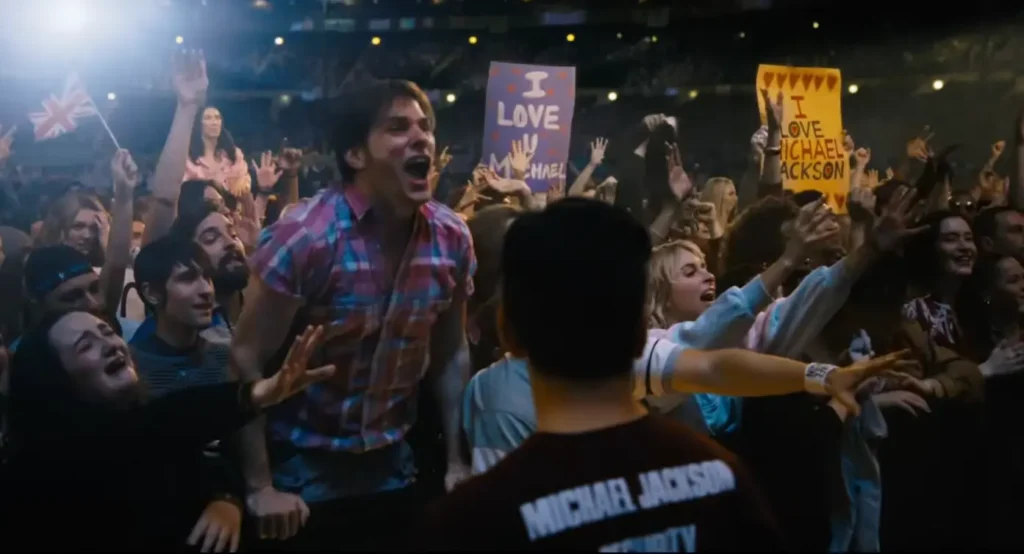
Following this declaration, the film executes a sudden temporal jump. The narrative thrusts forward four years to 1988. The claustrophobic backstage corridors are replaced by the colossal scale of Wembley Stadium in London during the Bad World Tour.
Michael, now possessing a radically different physical appearance—featuring a sharper jawline, lighter skin due to Vitiligo, and a wardrobe of black leather and buckles—commands the stage. The crowd is a sea of hysteria. The film presents a full, uninterrupted recreation of the title track “Bad.” As the performance reaches its crescendo, Michael strikes his iconic final pose, raising his hand over his face.
The screen abruptly cuts to black. A solitary title card appears: “His Story Continues.”.
The Thematic Meaning of the Stage
This ending operates on profound psychological levels. On the surface, it is a moment of total triumph. Michael has achieved his lifelong goal of complete autonomy and global subjugation. However, the subtext is deeply melancholic. By ending the film with Michael standing alone in front of hundreds of thousands of screaming strangers, the filmmakers emphasize the crushing isolation of his existence.
Throughout the film, the narrative establishes that Michael’s life off-stage is a prison of expectations, corporate demands, and familial exploitation. The stage is depicted as the only geographical location on earth where Michael experiences an equitable exchange of energy—where the love he gives to the audience is returned unconditionally. He is surrounded by millions, yet entirely alone.
The Illusion of Closure
The decision to end in 1988 makes the film function as an origin story rather than a definitive, cradle-to-grave biography. By concluding at the height of the Bad era, the film deliberately avoids the devastating 1993 allegations, the marriages to Lisa Marie Presley and Debbie Rowe, the birth of his children, the dangling baby incident in Berlin, and his ultimate death via propofol intoxication.
The text “His Story Continues” acts as a blatant promise of a sequel. Financial projections and the film’s record-breaking box office haul virtually guarantee that Lionsgate will greenlight a second installment. However, the ending leaves audiences with a sense of dissonance. It is a hagiographic pause point that freezes the protagonist in amber before the onset of his darkest chapters.
PART 4: The Darkest Hidden Secrets, Cut Scenes & Theories
Apple TV and Amazon Prime audiences dissecting the film at home have uncovered a treasure trove of hidden secrets. The most fascinating aspects of Michael (2026) are found in what the film deliberately leaves out. The production was a minefield of legal threats, family infighting, and sanitized history.
Secret 1: The Jordan Chandler Clause and $15 Million Reshoots
Why does the film end so abruptly in 1988? The answer lies in a catastrophic legal oversight. Industry insiders and leaked production documents revealed that John Logan’s original script was vastly different. The film was originally slated to open in media res in 1993, with Michael staring into a mirror as police raided his Neverland Ranch. The script initially attempted to tackle the child sexual abuse allegations head-on, reportedly painting the accusers’ parents as opportunistic extortionists.
However, after principal photography wrapped, attorneys for the Jackson Estate discovered a terrifying reality. A strict non-disclosure and non-disparagement clause buried in the 1994 financial settlement with the family of Jordan Chandler expressly prohibited the estate from portraying or mentioning Chandler in any commercial film or dramatization.
This legal landmine rendered the entire original third act completely unusable. Lionsgate and Graham King were forced to scrap substantial amounts of finished footage. The estate reportedly fronted between $10 million and $15 million for massive reshoots in June 2025, hastily rewriting the ending to conclude at the 1988 Bad Tour, safely avoiding the 1993 timeline altogether. This forced, panicked pivot explains the narrative whiplash of the film’s final ten minutes.
Secret 2: The Erasure of Diana Ross (The Kat Graham Cut)
In a shocking development just weeks before the film’s theatrical premiere, actress Kat Graham took to social media to announce that her entire performance as Motown legend Diana Ross had been left on the cutting room floor. Graham stated that “certain legal considerations” forced the removal of her scenes.
The implications of this cut are massive. Diana Ross was a monumental figure in Michael’s life, serving as an early mentor, a maternal figure, and a lifelong muse who helped shape his public persona. The exact nature of the legal dispute remains undisclosed, but industry theories suggest that Ross’s legal team may have objected to how her deeply enmeshed relationship with Michael was portrayed, forcing Lionsgate to scrub her from the final edit to avoid a defamation lawsuit. Without Ross, the film inadvertently alters the historical record, transferring the narrative weight of his early mentorship entirely to Berry Gordy and Suzanne de Passe.
Secret 3: The Janet Jackson Boycott
While almost the entire Jackson family is represented on screen, Janet Jackson—the second most successful artist in the dynasty—is completely absent. She is not mentioned, and no actress was cast to portray her.
Reports indicate that Janet was invited to participate but firmly declined. Following a private screening for family members, insiders reported that Janet expressed severe distaste for the film, critiquing everything from the dialogue to the makeup to the historical accuracy. Theories suggest that her refusal to be involved stems from deep-seated family grievances, specifically her historically strained relationship with her brother Jermaine (Jaafar’s father), who served as a producer on the film. Her glaring absence serves as a reminder that the “unified” Jackson family narrative presented in the film is heavily curated.
Secret 4: The Peter Pan Psychological Profile
While the film omits the legal allegations, it heavily foreshadows the psychological anomalies that defined Michael’s private life through the constant motif of Peter Pan.
The film utilizes this classic story to construct a terrifying psychological profile. In traditional theatrical productions of Peter Pan, the actor who plays the father, Mr. Darling, also plays the villain, Captain Hook. The film implies that Michael viewed his father, Joe, as his personal Captain Hook—a tyrant out to destroy his innocence.
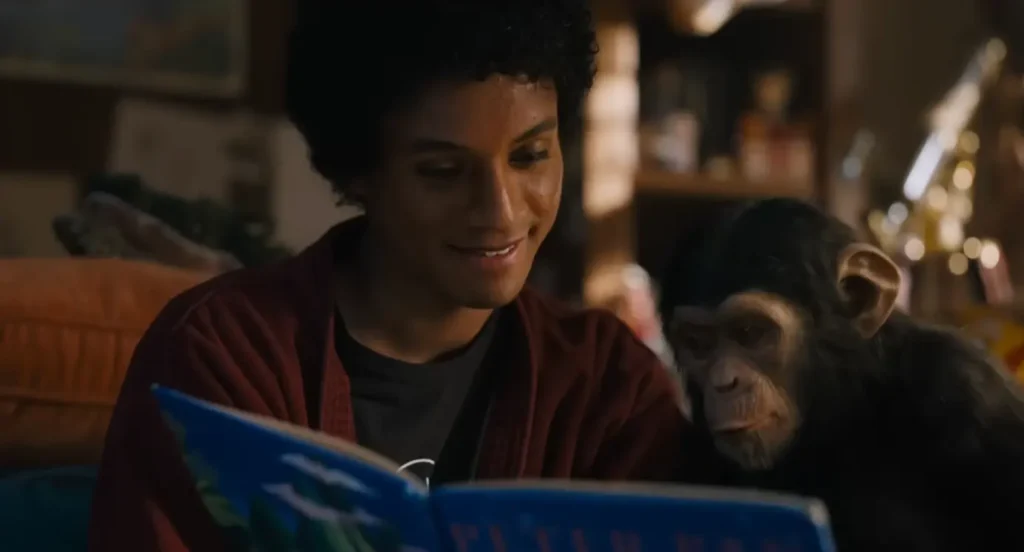
To cope with this trauma, Michael retreated into the persona of the boy who wouldn’t grow up. His affinity for wild animals—such as Bubbles the chimpanzee, llamas, and pythons—is framed not as eccentric celebrity behavior, but as a desperate search for companions who could not betray, exploit, or judge him. Similarly, his obsession with children is portrayed as an attempt to reclaim the childhood that was stolen from him by endless rehearsals.
Secret 5: The John Branca Bias
A significant point of contention among viewers and critics is the portrayal of John Branca. Branca is the current co-executor of the Jackson Estate and a lead producer of the film. Paris Jackson, Michael’s daughter, publicly criticized the film’s script, targeting the casting of an A-list actor like Miles Teller to play Branca. She argued that the producer was using the film to aggrandize himself and inflate his historical importance to Michael’s success. The film certainly paints Branca in an exceptionally flattering light, portraying him as the brilliant savior who rescues Michael from his father.
PART 5: Streaming Platforms, VOD, and Box Office Records
For audiences looking to dissect the film’s hidden details, choreography, and easter eggs from home, Lionsgate implemented an aggressive digital release strategy to capitalize on the film’s massive theatrical buzz.
Released theatrically on April 24, 2026, the film grossed nearly $40 million on its opening day, shattering the record for a biographical film previously held by Oppenheimer. By its third week, the film crossed the $890 million mark globally, firmly positioning it as the second highest-grossing film of the year, trailing only The Super Mario Galaxy Movie. The film eventually amassed over $901 million worldwide, threatening to dethrone Bohemian Rhapsody as the highest-grossing musical biopic in cinematic history.
While the film continued to perform strongly in theaters well into June, it was made available on Premium Video on Demand (PVOD) on June 9, 2026.
Current Streaming and VOD Availability
| Platform | Availability Status | Price (UHD/4K) |
|---|---|---|
| Apple TV | Available to Rent/Buy | $19.99 Rent / $24.99 Buy |
| Amazon Prime Video | Available to Rent/Buy | $19.99 Rent / $24.99 Buy |
| Fandango at Home | Available to Rent/Buy | $19.99 Rent / $24.99 Buy |
| YouTube Movies & TV | Available to Rent/Buy | $19.99 Rent / $24.99 Buy |
| BookMyShow Stream (India) | Available to Rent/Buy | ₹399 Rent / ₹999 Buy |
As of this report, Michael is not available to stream for free on any subscription-based platform (such as Netflix, Hulu, or Max). Because the film was produced and distributed by Lionsgate, historical release patterns indicate that the film will eventually make its exclusive streaming debut on the Starz network. However, given the film’s continued multi-million dollar revenue stream on PVOD platforms, Lionsgate is expected to delay the free streaming release until late 2026 to maximize transactional profits.
PART 6: Comprehensive FAQ: Answering the Internet’s Biggest Questions
To ensure the most thorough understanding of the film, here are the direct answers to the web’s most pressing questions regarding the Michael (2026) biopic.
Did Jaafar Jackson actually sing the vocals in the movie? The vocals in the film are a highly sophisticated technical hybrid. The audio engineering team blended original, remastered studio recordings of Michael Jackson with live, raw vocal performances by Jaafar Jackson and Juliano Krue Valdi (who plays young Michael). This blending technique was used to create a seamless auditory experience that sounds authentic to the live concert environment, allowing Jaafar’s heavy breathing and physical exertion during the dance routines to be heard over Michael’s flawless studio tracks.
Why does the Michael 2026 movie end in 1988? The film abruptly ends during the 1988 Bad World Tour at Wembley Stadium to capture Michael at the absolute peak of his global fame, creative autonomy, and physical prowess. Structurally, this allows the film to function as an uplifting, crowd-pleasing “rise to fame” story. Legally, ending in 1988 allowed the filmmakers to completely bypass the 1993 controversies, which they were prohibited from depicting due to a 1994 non-disclosure settlement with the accuser’s family.
Will there be a Michael Part 2? The film concludes with the title card “His Story Continues,” heavily implying a sequel. Given the film’s massive $901 million box office success, a sequel is highly likely from a financial standpoint. However, navigating the controversial 1990s and 2000s will require immense legal and narrative maneuvering by the Jackson Estate, and it remains to be seen how they will portray the darkest chapters of his life.
Why was Diana Ross cut from the Michael movie? Actress Kat Graham was cast as Diana Ross and filmed multiple scenes outlining her mentorship of the young Jackson 5. However, just weeks before the release, Graham confirmed her scenes were removed due to “certain legal considerations”. It is highly suspected that representatives for Diana Ross objected to how her complex relationship with Michael was portrayed on screen, forcing Lionsgate to scrub her from the final edit to avoid a massive defamation lawsuit.
Why is Janet Jackson not in the movie? Despite the rest of the Jackson siblings being featured, Janet Jackson is entirely omitted. Reports indicate she was asked to participate but declined following a private screening. Her refusal is allegedly tied to creative disagreements regarding the script’s accuracy, her anger over the exclusion of certain family truths, and ongoing interpersonal friction with her brother Jermaine Jackson, who served as a producer.
Does the movie address the child abuse allegations? No. The film’s timeline ends in 1988, five years before the first major allegations surfaced in 1993. Originally, the script attempted to address the 1993 scandal, but a legally binding settlement clause forced the studio to scrap those scenes, execute a $15 million reshoot, and rewrite the third act to avoid a devastating lawsuit.
Who choreographed the dances in the movie? While the film implies Michael instinctually created all of his choreography, historical purists have noted a significant omission. Michael Peters, the legendary choreographer who co-created the iconic routines for “Beat It” and “Thriller,” is relegated to a non-speaking background extra (the man in the white jacket). Critics have pointed out this revisionist history minimizes the contributions of Peters, a vital Black, queer artist who died of AIDS, in order to amplify the mythos of Michael’s solitary genius.
Final Thoughts: The Tragedy of the King
Michael (2026) operates as a spectacular, albeit heavily curated, monument to the greatest entertainer of the 20th century. By combining breathtaking musical recreations with a deeply unsettling examination of childhood trauma and parental abuse, the film succeeds in humanizing a figure who spent decades living as an untouchable, misunderstood deity.
The abrupt Michael 2026 movie ending explained reveals the ultimate, heartbreaking paradox of the pop star’s life: he achieved total global liberation and adoration on the stage, only to remain a prisoner to his own trauma, his enabling management, and the relentless, suffocating media machine off-stage. While the film’s glaring omissions, sanitized estate involvement, and legal compromises prevent it from being the definitive, objective truth, it remains a staggering cinematic achievement. It forces the audience to reconcile the undeniable genius of the art with the tragic, fractured reality of the artist, leaving the world waiting to see if “His Story Continues” will ever dare to step into the dark.
read also : Disclosure Day Ending Explained: The Definitive Breakdown of Spielberg’s 2026 Sci-Fi Masterpiece