If you are hunting for a definitive Disclosure Day ending explained, you have just stepped into one of the most intricately woven, philosophically profound, and geopolitically terrifying narratives in modern science fiction cinema. By taking the classic framework of extraterrestrial contact and filtering it through the lens of modern institutional paranoia, whistleblower culture, and existential dread, director Steven Spielberg has completely shaken up the thriller genre.
Moving away from the innocent wonder of his earlier alien encounters and the sheer physical violence of his mid-career invasion narratives, Spielberg and screenwriter David Koepp have crafted a 2-hour and 25-minute cinematic event that is overflowing with ambient dread. Here at memoria.film, the obsession lies in unraveling complex psychological mysteries and cinematic puzzle boxes. By applying a rigorous analytical lens to the fog of paranoia surrounding Daniel Kellner, Margaret Fairchild, and the shadowy Wardex corporation, this document will deconstruct every frame of the 2026 blockbuster.
Backed by producers Kristie Macosko Krieger and executive producers Adam Somner and Chris Brigham, this film moves away from the pure escapism of traditional science fiction. Instead, it leans heavily into modern horrors: the weaponization of classified intelligence, the manipulation of global media, the fragility of international geopolitics, and deep-seated societal trauma. The real monsters here are not necessarily the beings from the stars, but the human institutions that would rather risk nuclear annihilation than surrender their monopoly on the truth.
In this massive, comprehensive breakdown, the analysis is divided into exhaustive parts to cover every single detail required to master the film’s complex lore. This report will dissect the elite cast, analyze the historical evolution of the director’s science fiction framework, explain the shocking twists of the opening acts, unearth the darkest hidden secrets and theories, and provide a dedicated FAQ to answer the internet’s burning questions regarding the final frames of the movie.

The Evolution of Spielbergian Science Fiction
To fully grasp the magnitude of Disclosure Day, it is absolutely essential to contextualize the film within the legendary director’s 60-year career. As his 37th feature film and his 11th venture into the science fiction genre (his sixth to feature aliens), this project represents a culmination of a lifelong cinematic obsession. However, the tonal shift present in the 2026 release marks a radical departure from his previous works.
The historical progression of these thematic explorations demonstrates a filmmaker constantly recalibrating his understanding of humanity’s place in the cosmos. The following table illustrates this evolutionary trajectory:
| Film Title | Release Year | Thematic Core & Alien Representation | Societal Context |
|---|---|---|---|
| Firelight | 1964 | A malicious alien race invades an Arizona town to abduct humans for extraterrestrial zoos. | Cold War-era paranoia and early cinematic experimentation. |
| Close Encounters of the Third Kind | 1977 | Benevolent visitors communicating through music and mathematics. Explores obsession and the wonder of discovery. | Post-Watergate/Vietnam cynicism replaced by a desperate search for cosmic optimism. |
| E.T. the Extra-Terrestrial | 1982 | A highly sentimental, innocent exploration of empathy and childhood innocence. | A focus on fractured suburban families and the pure, uncorrupted perspective of youth. |
| War of the Worlds | 2005 | Ruthless, mechanical exterminators devoid of empathy. A bleak survivalist narrative. | Post-9/11 anxiety, terrorism allegories, and sudden, catastrophic urban destruction. |
| Kingdom of the Crystal Skull | 2008 | Interdimensional beings acting as ancient archeological deities. | A homage to 1950s B-movie pulp and Cold War nuclear anxieties. |
| Disclosure Day | 2026 | Extraterrestrials as catalysts for severe psychological, theological, and institutional disruption. | Modern crises of misinformation, global conflict (DEFCON 2), and institutional distrust. |
While Close Encounters of the Third Kind asked, “Is the government lying to us?”, Disclosure Day operates under the modern, cynical assumption that the public already knows the government is lying. The question is no longer about discovery; it is about the agonizing, terrifying process of integration. The filmmaker has transitioned from viewing aliens as magical saviors to viewing the concept of aliens as an inescapable, potentially destabilizing reality.

PART 1: The Setup and The Shocking Cast
To fully understand the nightmare unfolding across the United States—from the corporate black sites to the local news stations of Kansas City—the analysis must first deconstruct the deeply flawed human beings at the center of the story. This is not a simple tale of innocent victims being terrorized by a monster; the protagonists and antagonists alike are riddled with ideological fanaticism, moral ambiguity, and deep trauma.
The success of this ambient dread relies on an absolute powerhouse cast, carefully selected by casting director Cindy Tolan, executing performances that ground the fantastical elements in raw human emotion.
Emily Blunt as Margaret Fairchild
Emily Blunt delivers what critics have described as a Diane Keaton-esque, unhinged, and dizzying performance as Margaret Fairchild. Margaret is a local television meteorologist in Kansas City who harbors ambitions of becoming a serious news anchor. Her narrative role is fundamentally tied to her profession: she is a woman who makes a living predicting the natural atmosphere. When her mind is suddenly hijacked by an extraterrestrial signal—triggered by a cardinal flying into her apartment—she becomes the ultimate unpredictable variable.
Blunt is required to navigate extreme emotional whiplash, transitioning seamlessly from broad comedy to sheer panic, and ultimately to a state of profound, telepathic enlightenment. She gains the involuntary ability to speak fluent Russian, Korean, and an unearthly clicking language, functioning as the emotional and linguistic conduit for the alien presence. Blunt’s performance anchors the film’s exploration of how the human brain processes impossible cosmic data.
Josh O’Connor as Daniel Kellner
Josh O’Connor plays Daniel Kellner, a character frequently compared to a Julian Assange-style cybersecurity expert and whistleblower. Daniel is an idealist, a mathematical genius, and a former employee of the shadowy government contractor known as Wardex. Daniel’s psychological profile is rooted in logic, binary code, and a rigid moral compass. He has stolen a massive cache of hard drives containing definitive proof of alien contact, alongside a piece of highly advanced extraterrestrial technology.
Daniel is a man in over his head. His principles dictate that the truth belongs to the world’s seven billion people, yet he is entirely unequipped for the violent, kinetic consequences of his actions. His brain, rewired during a childhood abduction, allows him to intuitively understand complex extraterrestrial mathematics, making him the logical counterpart to Margaret’s emotional telepathy.
Colin Firth as Noah Scanlon
Colin Firth completely sheds his traditional, heroic British persona to play Noah Scanlon, the section chief and top executive at Wardex. Scanlon is the architect of the cover-up. He is not portrayed as a cackling villain, but rather as a weary, menacing corporate stooge who genuinely believes that humanity cannot handle the truth. Armed with his own piece of alien technology, Scanlon engages in psychological warfare, utilizing the device to remotely hack human minds and track his targets. Firth plays the role with a terrifying, bureaucratic calmness, representing the institutional inertia that suppresses human advancement in the name of global stability.
Colman Domingo as Hugo Wakefield
Colman Domingo provides a warm, benevolent heart to the center of the film as Hugo Wakefield. Hugo is a former Wardex operative who defected to lead a clandestine “Truth Movement”. Domingo has described his character as the closest thing the film has to a director self-insert—a visionary orchestrator who believes that humanity deserves a little more awe and marvel in their lives. Hugo operates from the shadows, possessing the third alien device and an immense wealth of knowledge regarding the extraterrestrial visitors. He acts as the spiritual guide for Margaret and Daniel, preparing the stage for the ultimate revelation.
Eve Hewson as Jane
Eve Hewson portrays Jane, Daniel’s new girlfriend, whose character introduces the film’s crucial theological dilemmas. Jane is a former nun who has not yet fully disclosed her past to Daniel. When she is kidnapped by Wardex operatives and subjected to remote mental hacking by Noah Scanlon, her faith and psychological resilience are tested. Jane’s inclusion in the narrative forces the audience to confront the theological disruption that would inevitably occur if humanity realized it was not the center of divine creation.
Wyatt Russell as Margaret’s Boyfriend
Providing essential levity in an otherwise suffocatingly tense narrative, Wyatt Russell plays Margaret’s boyfriend. He represents the bewildered, ground-level human perspective. When his girlfriend suddenly begins speaking in tongues and exhibiting telepathic abilities, his confused, overwhelmed reactions serve to highlight the sheer absurdity and terror of the situation from the viewpoint of an ordinary citizen.

PART 2: Disclosure Day Ending Explained (Act-by-Act Breakdown)
The sheer terror of this adaptation lies in its structure. The narrative drops the audience directly into the middle of a chaotic, escalating crisis without the safety net of lengthy exposition. The pacing builds relentlessly, transitioning from corporate espionage to supernatural pursuit, and finally culminating in a global broadcast. Let us break down the critical events that set up the ultimate endgame.
Act I: The Catalyst and The Cosmic Perspective
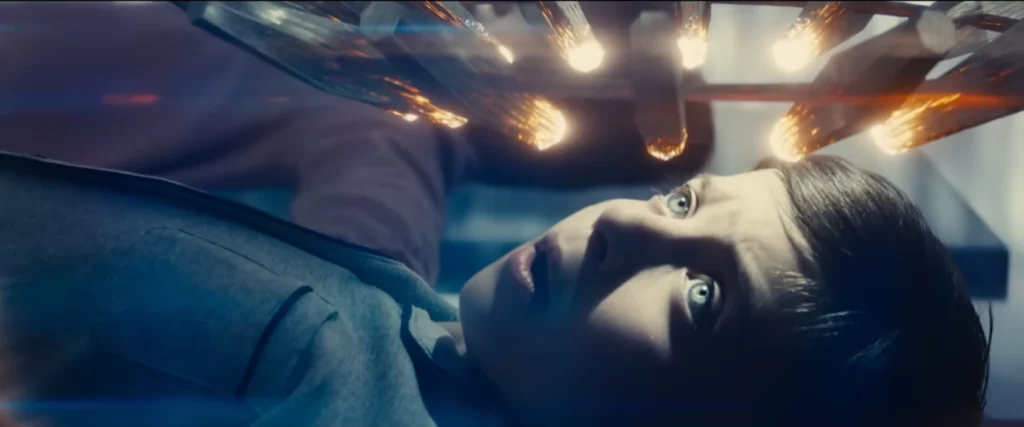
The film opens with an incredibly disorienting and aggressive visual sequence. Rather than showing stars or spacecraft, the opening shot places the viewer on the mat of a professional wrestling arena, looking up from the perspective of a wrestler whose face is being stomped by an opponent. This visceral, violent introduction is highly deliberate. It establishes humanity’s current state: obsessed with petty, staged violence, completely ignorant of the broader universe. As the camera pulls back, it reveals Daniel Kellner sitting meekly in the stands, clutching a backpack containing the greatest secret in human history.
The background context is equally grim. The United States is currently at DEFCON 2, simmering on the brink of World War III with North Korea. This geopolitical tension is not merely background noise; it is the fundamental justification for Wardex’s existence. The corporation argues that releasing proof of advanced extraterrestrial life into a world already teetering on the edge of nuclear annihilation would cause immediate, catastrophic societal collapse.
Daniel has stolen hard drives containing video evidence of Department of Defense experiments on aliens dating back to the 1947 Roswell crash, along with an alien “diving device”. These devices—resembling the psychic pods from Minority Report—allow the user to interface with alien frequencies, granting invisibility and telepathic abilities, but at a severe physical cost. As Daniel flees, Wardex retaliates by kidnapping his girlfriend, Jane, initiating a deadly game of cat and mouse.
Simultaneously, in Kansas City, the cosmic trigger is pulled. Margaret Fairchild is living an ordinary life when a cardinal flies into her apartment. This specific avian encounter acts as a biometric key, unlocking latent alterations in her brain. She arrives at her television studio and, live on air, loses the ability to speak English, transitioning rapidly through Russian and Korean before emitting guttural, non-human clicking sounds. This viral anomaly alerts Wardex that a second asset has been activated, drawing the corporate hunters toward the Midwest.
Act II: The Pursuit, The Train, and The Gingerbread House
The second act operates as a masterclass in kinetic, suspenseful filmmaking. Daniel, utilizing the stolen alien device to mask his movements, attempts to evade Wardex agents led by Noah Scanlon. Scanlon, possessing his own device, engages in terrifying psychological warfare, literally hacking into Jane’s mind to speak through her and track Daniel’s location.
The pursuit forces Daniel and Margaret onto a collision course. Their meeting confirms that they are “twin forces”—two halves of a biological equation engineered by the aliens decades prior. Their frantic escape culminates in a 10-minute set-piece frequently cited by critics as the film’s action highlight: the train sequence.

The Train Sequence
Pursued by Wardex operatives in black SUVs, Margaret and Daniel are forced to weaponize the alien diving device to create optical illusions—rendering a fire truck invisible to crash their pursuers—before scrambling aboard a moving train. What makes this sequence transcendent is its emotional framing. Before the chaos, the two share a moment of loose, funny connection, highlighting their shared humanity. After narrowly escaping death on the train, the director does not allow the audience to catch their breath; instead, the camera lingers on their sheer, agonizing panic, forcing the viewer to endure the visceral aftermath of adrenaline.
The Gingerbread House and Childhood Trauma
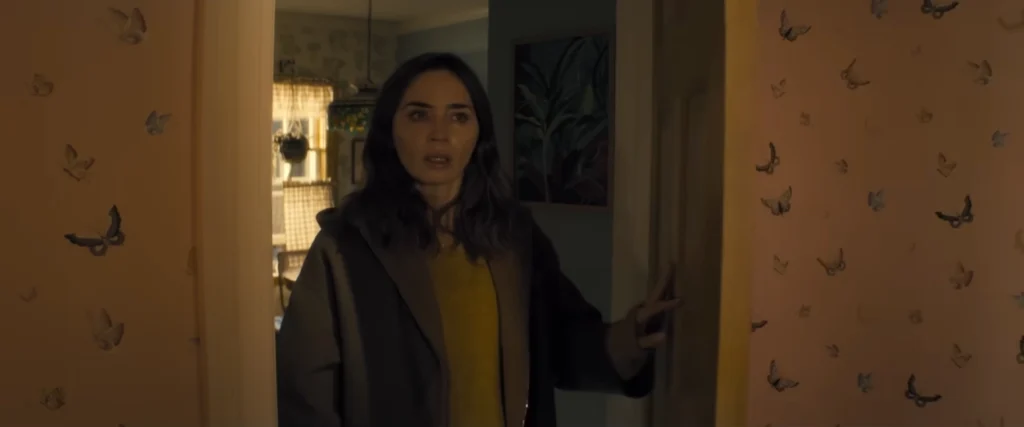
Guided by Hugo Wakefield’s underground network, the protagonists arrive at a secluded cabin deep in the woods. Bizarrely, Hugo has constructed an exact, flawless interior replica of Margaret’s childhood home. This setting acts as a psychological regression chamber. When Margaret utilizes the alien device inside this familiar environment, her suppressed childhood memories are violently unlocked.
Through a highly stylized, unsettling flashback utilizing intentional uncanny-valley CGI, the film reveals that both Margaret and Daniel were abducted as children. To prevent their young minds from shattering, the extraterrestrials manifested as comforting terrestrial animals: a cardinal, a deer, a raccoon, and a fox. During this encounter, the benevolent aliens performed neurological alterations. Daniel was modified to comprehend advanced, universal mathematics (pure logic), while Margaret was modified to possess extreme telepathic empathy (pure emotion). The aliens recognized that human communication is flawed; only by combining perfect logic with perfect empathy could humanity comprehend the cosmic truth without descending into madness.
Act III: The Siege and The Global Broadcast
The film’s third act shifts into a contained, high-stakes siege that was entirely withheld from the marketing campaign. Hugo, Daniel, and Margaret commandeer Margaret’s Kansas City television station to execute the ultimate plan: a global, simultaneous broadcast of the classified Wardex files.
As Daniel begins uploading the decryptions to the news servers—preparing to show the world the horrifying archival footage of deceased aliens and secret experiments—Wardex surrounds the building. Noah Scanlon orders a complete destruction of the local power grid, blowing the transformers and disabling the station’s backup generators. The studio is plunged into absolute darkness, seemingly ending the mission.
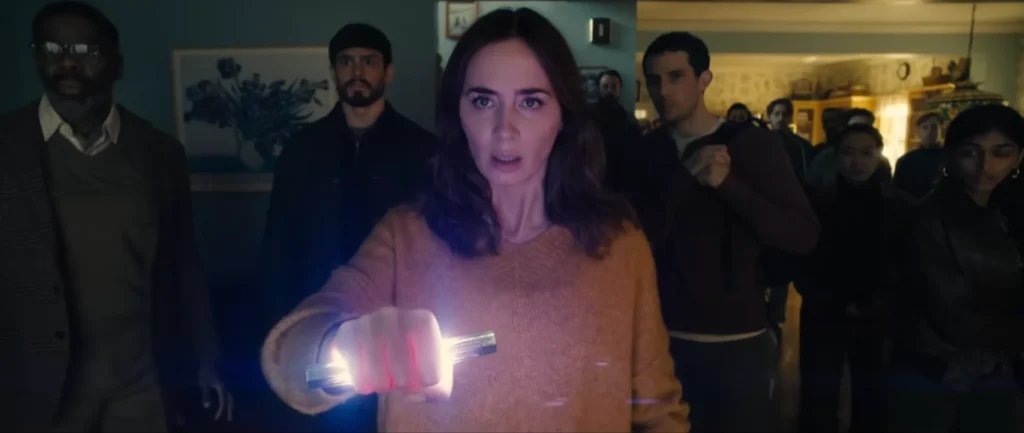
However, Jane arrives, fully embracing her role in the resistance, carrying the alien device Daniel had previously used. In an act of agonizing physical sacrifice, Margaret grips the diving rod and channels its immense, unearthly energy directly into the station’s infrastructure, powering the entire broadcasting grid with alien technology.
The broadcast goes live. Every television, smartphone, and digital screen on the planet is hijacked. The reaction of the global populace is not depicted as joyful awe; it is shown as profound existential nausea, terror, and paralyzed shock. In the control room, Noah Scanlon realizes he has lost. In a moment of devastating clarity, he does not fire his weapon. He simply sits down, watching his life’s work of secrecy dissolve into the ether, accepting that the world has irrevocably changed.
The Climax: In Vivo 17 and The 8-Bit Whisper
With the archival footage successfully transmitted, Hugo reveals his ultimate trump card. For five years, Hugo has been secretly harboring a living extraterrestrial, smuggled out of a Wardex black site. This entity, designated “In Vivo 17,” is massive, ancient, and deeply infirm, appearing far older than any alien seen in the archival footage.
In Vivo 17 steps onto the live broadcast stage, revealing itself to seven billion human beings. The creature approaches Daniel and Margaret. It leans down to Daniel and emits a rapid sequence of clicks and 8-bit binary tones. Because Daniel is the mathematical conduit, his brain instantly deciphers the complex data. However, Daniel lacks the empathetic capacity to translate this pure data into human emotion.
Daniel turns to Margaret, whispering the translation into her ear. Margaret, acting as the telepathic and emotional filter, absorbs the profound weight of the universe’s message. She turns to face the broadcasting camera, looking directly into the eyes of a terrified, fractured humanity teetering on the edge of World War III.
Margaret speaks a single word: “Listen.”.
The film instantly cuts to black, and the credits roll. The exact contents of the 8-bit whisper are deliberately left a mystery, cementing the film as a masterpiece of ambiguous, thought-provoking cinema.

PART 3: The Darkest Hidden Secrets & Theories
The narrative architecture of Disclosure Day is a dense puzzle box. By synthesizing background details, character tics, and throwaway lines of dialogue, several massive theories emerge regarding the true nature of the Wardex conspiracy, the theological implications of the aliens, and the ultimate meaning of the film’s enigmatic conclusion.
Theory 1: The DEFCON 2 Smokescreen and the Wardex Agenda
The film repeatedly references that the United States is at DEFCON 2, preparing for a potential nuclear exchange with North Korea. The surface-level narrative suggests Wardex is hiding the aliens to prevent further global panic during this crisis. However, a deeper geopolitical theory suggests that Wardex actively perpetuates global conflict to justify their secrecy and maintain their monopoly on advanced technology.
If humanity were to realize they are part of a vastly superior galactic community, terrestrial borders, petty dictatorships, and the military-industrial complex would instantly become obsolete. Noah Scanlon’s defeat at the end of the film is not just the failure to stop a broadcast; it is the realization that the geopolitical paradigm he dedicated his life to protecting has been rendered meaningless. The aliens represent an existential threat to human hierarchies of power.
Theory 2: The Theological Disruption and Jane’s Past
The inclusion of Jane, a former nun, is the key to unlocking the film’s profound theological subtext. Throughout the film, characters engage in earnest discussions about God, faith, and how religious institutions would collapse upon discovering extraterrestrial life. The theory posits that the aliens’ method of operation—manifesting as animals, subtly guiding human evolution, and selecting “prophets” like Margaret and Daniel—directly mimics divine intervention.
If human neural pathways were intentionally engineered by aliens, it shatters the anthropocentric belief that humanity is the pinnacle of divine creation. Jane’s struggle represents the painful, necessary transition from archaic terrestrial dogmas to a new, terrifyingly vast cosmic spirituality. The film implies that true faith requires a complete dismantling of human arrogance.
Theory 3: The Biological Rosetta Stone
Why couldn’t the aliens simply learn English or broadcast a radio signal? The “Rosetta Stone” theory explains the necessity of the “Twin Forces”. The extraterrestrials operate on a level of consciousness that perfectly fuses mathematics and empathy. Human brains, however, are fractured; highly logical individuals often lack deep emotional intuition, and highly empathetic individuals often struggle with cold, binary data.
The aliens abducted Daniel and Margaret to artificially split these traits. Daniel became the ultimate receiver of pure data (math), while Margaret became the ultimate transmitter of pure emotion (telepathy). By doing so, the aliens ensured that when the time for disclosure arrived, their message would not be corrupted by human misunderstanding. The process required both halves of the human equation to physically unite on the anchor desk to translate the 8-bit binary whisper into a concept humanity could truly feel.
Theory 4: Hugo Wakefield’s True Identity
Hugo Wakefield’s role as the orchestrator is highly suspicious. How did he know to recruit Daniel straight out of prison exactly eight years prior?. How was he able to construct a flawless, molecularly perfect replica of Margaret’s childhood home?. How did he successfully hide a massive, living extraterrestrial (In Vivo 17) from the most powerful surveillance corporation on Earth for five years?.
The dominant theory suggests that Hugo is not entirely human. He may be a human-alien hybrid, or a Wardex operative whose mind was so thoroughly integrated with the third diving device that he lost his human identity, becoming a terrestrial avatar for the extraterrestrial collective. His absolute serenity and omniscience suggest he has been in constant telepathic communion with In Vivo 17 for years, acting as the alien’s logistical proxy on Earth.
Theory 5: The Meaning of the Whisper
While actor Josh O’Connor has confirmed he knows the exact translation of the alien’s 8-bit whisper, he has refused to reveal it. However, cinematic clues provide the answer. Earlier in the film, Margaret’s involuntary weather broadcast included a translated phrase: “Don’t be afraid of what you don’t know”.
Considering the film takes place on the brink of World War III, the whisper is almost certainly an urgent plea for cosmic perspective. The aliens are telling humanity that the universe is ancient, vast, and delicate. Margaret’s command to “Listen” is an instruction for humanity to stop shouting over one another, to lower their nuclear arsenals, and to listen to the harmonious, unified frequency of the broader cosmos.
PART 4: The Craft of Ambient Dread
The thematic weight of the narrative is inextricably tied to the film’s masterful technical execution. Operating behind the camera are long-time Spielberg collaborators who understand precisely how to visually and auditorily manifest the profound anxiety of the script.

The Cinematography of Duality: Janusz Kamiński
Cinematographer Janusz Kamiński utilizes a visual language that heavily relies on claustrophobic framing, shadows, and reflections. Critics have noted the frequent use of reflections—combining two separate elements into a single frame—which visually reinforces the film’s motif of duality: Daniel and Margaret, logic and emotion, humanity and the extraterrestrial. Even in broad daylight, Kamiński’s signature lens flares do not evoke the wondrous, magical majesty of Close Encounters. Instead, the light fractures and obscures the characters’ vision, acting as a visual representation of the blinding, overwhelming, and terrifying nature of the truth.
The Auditory Landscape: John Williams
The legendary composer John Williams marks his 30th collaboration with the director for this project. At 94 years old, Williams made a highly deliberate, restrained choice regarding the film’s auditory landscape. Instead of utilizing overpowering, symphonic motifs that explicitly dictate the audience’s emotional response—as he famously did in Star Wars or Jurassic Park—Williams noted that he wrote the music “under the film to give it the slight nudge forward”.
This subtle, ambient approach to the score generates a continuous sense of unease. The music massages the tension during the relentless Wardex chase sequences and provides a haunting, nostalgic resonance that echoes the composer’s finest work without ever overpowering the delicate, human drama occurring on screen. The score acts as the subconscious pulse of a world waiting for the other shoe to drop.
Disclosure Day FAQ: Answering the Internet’s Biggest Questions
To ensure this ultimate Disclosure Day ending explained is complete, here are the direct, definitive answers to the web’s most pressing questions regarding the film’s intricate lore.
Is Wardex a real government agency? Within the film’s universe, Wardex is not a direct branch of the United States military; it is a highly secretive, non-governmental corporate contractor. The acronym stands for Watch, Recon, Develop, Extract. This distinction is critical to the film’s themes, highlighting the modern anxiety that world-altering secrets and technologies are held not by elected officials accountable to the public, but by profit-driven private entities operating in the shadows.
What exactly are the “Diving Devices”? The diving devices are cylindrical alien artifacts. Only three are known to exist on Earth, possessed respectively by Noah Scanlon, Daniel Kellner, and Hugo Wakefield. Direct physical contact with the rods allows the human user to tap into vast reserves of extraterrestrial energy and psychic potential. They grant the user temporary invisibility by bending light, allow for telepathic intrusion into another person’s mind, and can generate immense physical power to restore electrical grids. However, utilizing the rods exacts a massive physical and mental toll on the human user, causing severe burns, psychological strain, and long-term neurological damage.
Why did the aliens appear as animals during the childhood abductions? During the flashback sequences in the Gingerbread House, the extraterrestrials manifested to young Margaret and Daniel as a cardinal, a deer, a raccoon, and a fox. The psychological profile of the aliens indicates they are benevolent but hyper-advanced. To prevent the children’s developing minds from completely shattering upon perceiving a cosmic entity, the aliens projected themselves as familiar, non-threatening terrestrial creatures. The appearance of the cardinal in Margaret’s apartment decades later served as a biometric trigger, designed to awaken her dormant telepathic abilities once she reached adulthood.
What did In Vivo 17 whisper to Daniel at the end of the film? The exact translation of the 8-bit binary whisper is deliberately withheld from the audience. However, contextually, it is an intervention. Given the imminent threat of World War III (DEFCON 2) hanging over the narrative, the whisper is a message of cosmic peace and perspective. Margaret’s command to “Listen” is an instruction for humanity to cease its petty, self-destructive violence, abandon its nuclear arsenals, and recognize its place within a harmonious, unified galactic community.
How does this movie connect to Close Encounters of the Third Kind? While the film is wholly original and features no recurring characters or direct plot continuation, screenwriter David Koepp refers to it as a “spiritual bookend” to the 1977 classic. Close Encounters was born out of the 1970s paranoia of Watergate, asking, “Is the government lying to us?”. The 2026 film operates in a modern era of absolute cynicism where the public explicitly knows they are being lied to. Therefore, the narrative shifts from the wonder of proving aliens exist to the logistical, psychological, and sociological nightmare of navigating a post-truth world where undeniable evidence finally shatters the established paradigm.
A Final Thought on the Masterpiece
The brilliance of this cinematic achievement lies in its unyielding commitment to exploring the psychological devastation of profound realization. By substituting physical planetary destruction with the slow, agonizing erosion of institutional lies, the narrative creates a masterclass in ambient dread and speculative sociology. The characters do not conquer the aliens with laser cannons; they merely survive the agonizing burden of the truth. As the screen fades to black on Margaret’s command to “Listen,” the audience is left to grapple with the terrifying, beautiful reality that the monster outside the door is merely human hubris, and the stars above are waiting for humanity to finally pay attention.