The Death of Robin Hood Ending Explained: The Brutal Collapse of a Myth
The Death of Robin Hood ending explained serves as the critical entry point to unlocking the grim, uncompromising, and deeply moving cinematic labyrinth constructed by writer-director Michael Sarnoski. Released on June 19, 2026, by A24, the film dismantles centuries of swashbuckling folklore to expose the rotting core of a man whose mythical altruism was nothing more than a fabricated shield for a lifetime of sociopathic violence.
Michael Sarnoski, the filmmaker who brought an unexpected tenderness to the Nicolas Cage-led thriller Pig and expanded blockbuster horror with A Quiet Place: Day One, has turned his auteurist lens toward English folklore. In doing so, he strips away the verdant greens of Sherwood Forest, the romantic heroics of Errol Flynn, the noble charm of Kevin Costner, and the playful innocence of Disney’s animated fox. What remains is a portrait of a broken, feral man.
As theaters fill with audiences seeking the bright escapism of Toy Story 5 this summer weekend, The Death of Robin Hood stands as a stark, counter-programming monument—a film that asks what happens when a legend outlives its utility, and a killer must finally face the ghosts of his own making.
How Does Robin Hood Actually Die?
How does Robin Hood actually die in this dark adaptation? It isn’t a glorious death on the battlefield. He is quietly poisoned. Stripped of his legendary status and betrayed by those completely trusted within his inner circle, he bleeds out alone. The writers entirely destroyed the romantic myth of the hero, opting for a brutally realistic, politically motivated assassination.
The Demise of a Mythological Hero: Production and Context
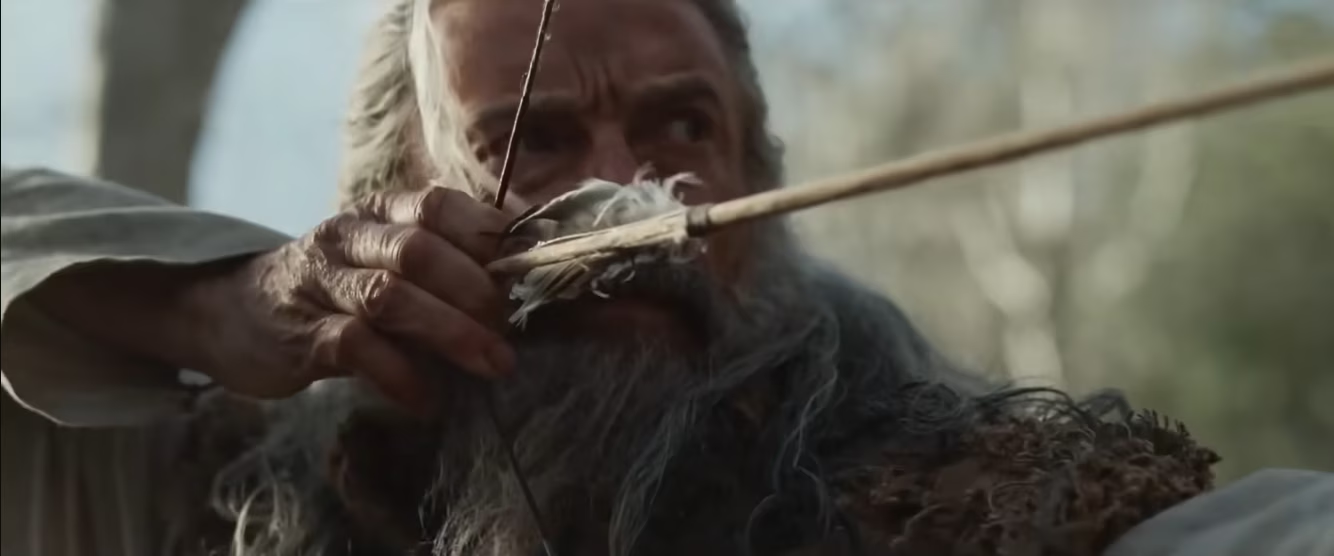
The film operates as a severe revisionist Western translated into the mud and blood of 13th-century Britain. It repositions Robin Hood as an aging, battle-scarred mass murderer grappling with the insurmountable weight of his karmic debts. Decades of violence have left him not as a celebrated hero of the underclass, but as a hunted animal, forced into isolation to avoid the unending stream of vengeance-seekers whose families he destroyed.
Produced on a modest $20 million budget and shot entirely on 35mm film across the harsh, wind-swept landscapes of Northern Ireland, the 122-minute feature is an elegiac meditation on mortality and the cyclical nature of violence. Sarnoski draws direct inspiration from the 17th-century anonymous ballad “Robin Hood’s Death,” an obscure piece of folklore where the titular outlaw meets a quiet, unceremonious demise in a bed, bled to death by a relative.
Box Office Strategy and Distribution Pipeline
The distribution, release strategy, and viewing availability of the film follow the traditional theatrical-to-streaming pipeline typical of prestige A24 releases, positioned as dark, adult-oriented counter-programming in a crowded summer market.
- Acquisition & Premiere: A24 acquired the US distribution rights for $4 million during a highly competitive bidding war at the Marché du Film. The film held its world premiere at the 73rd Sydney Film Festival on June 12, 2026.
- Theatrical Release: Released exclusively in US theaters on June 19, 2026. International rollouts follow, with the UK and Ireland release scheduled for September 3, 2026.
- Streaming & VOD: Currently available only in cinemas. Based on A24’s established output deals, the film will transition to Premium Video on Demand (PVOD) approximately 45-60 days post-theatrical window, subsequently becoming available on platforms such as Max and Apple TV+.
- Box Office Projections: Opening weekend tracking places the film at a modest $3.3M to $8M domestically, serving as direct counter-programming to Disney/Pixar’s behemoth Toy Story 5, which is tracking to open between $150M and $175M on the same weekend.
The Faces of 13th Century Despair: Cast Deconstruction
Sarnoski assembled a powerhouse cast of character actors to ground the grim reality of 13th-century England. The ensemble completely disappears into the muck, grime, and psychological weight of the period setting.
| Actor Name | Character Name | Narrative Role & Thematic Purpose |
| Hugh Jackman | Robin Hood / Randolph | An aged, battle-worn outlaw who built a false legend to hide his history as a murderous brigand. He seeks an end to his cycle of violence, replacing charm with feral exhaustion. |
| Jodie Comer | Sister Brigid | The pragmatic, deeply empathetic prioress. She unknowingly heals the man who slaughtered her family, serving as the ultimate test of forgiveness and cosmic mercy. |
| Bill Skarsgård | Little John / Edward | A sociopathic outlaw who attempts to steal a farmer’s life but brings ruin upon himself, representing the inescapable nature of past sins. |
| Murray Bartlett | The Leper / Tiestto | A heavily bandaged resident who acts as the island’s moral compass. Secretly a survivor of Robin’s past atrocities, proving the cycle of violence can be halted through forgiveness. |
| Noah Jupe | Arthur / Godwyn | A young survivor of a farm massacre who tracks Robin seeking revenge. He represents the unending, generational cycle of “blood debts.” |
| Faith Delaney | Little Margaret | Little John’s traumatized, non-verbal daughter. Robin inadvertently steps into a paternal role to protect her. |
| Jade Croot | Wainwright | A young, desperate scavenger in the film’s brutal opening. She attempts to assassinate Robin, establishing his ruthless survival instincts. |
Act-by-Act Plot Breakdown: The Architecture of Decay
To understand the tragic trajectory of the film, it is essential to break down the narrative into its core segments. Each act functions differently in tone, pacing, and visual language, reflecting Robin’s internal deterioration and eventual surrender.
Act I: The Brutal Reality and the Collapse of Myth
The film opens in the unforgiving winter of 1247 AD. The visual framing immediately establishes a sense of sprawling isolation, shot by cinematographer Pat Scola in a wide 2.39:1 aspect ratio. The color palette is devoid of warmth, relying on desaturated blues, grays, and sickly yellows to convey a world stripped of comfort.
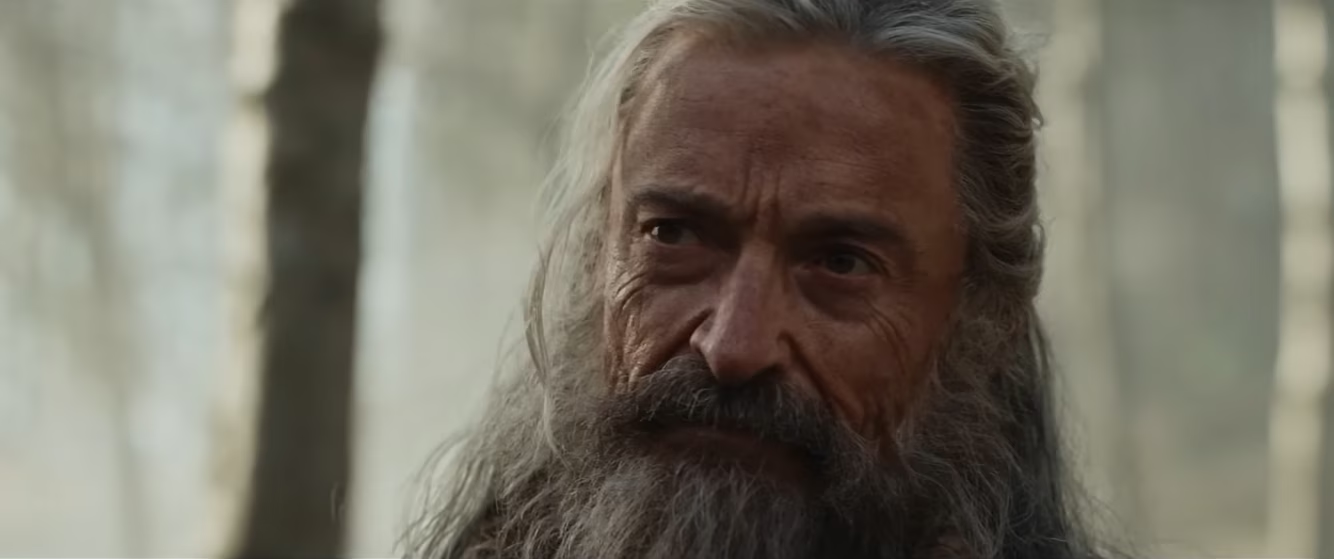
A young, starving scavenger named Wainwright stumbles upon an aged, feral man tending a fire in the wilderness. Believing the local legends of a noble thief who protects the destitute, she thinks she has found the heroic Robin Hood. The man coldly shatters her illusion, informing her that the stories of stealing from the rich to feed the poor are “lies upon lies.” He describes himself as a “murderous brigand” who robbed and killed simply for the thrill and the profit. When Wainwright later attempts to assassinate him in his sleep to claim the bounty on his head, Robin dispatches her with terrifying, practiced efficiency. He stabs her in the neck and buries her in a hillside already littered with the graves of those who have tried to kill him—a visual testament to the unending cycle of his blood debts.
Robin’s grim isolation is interrupted by the arrival of his former companion, Little John, who now goes by the pseudonym Edward. John had attempted to abandon the outlaw life by murdering a farmer, stealing his identity, and claiming the man’s wife, Margaret, and their farm as his own. However, the deceased farmer’s family uncovers the deception, reclaims their land, and murders John’s stolen wife. John recruits a reluctant, death-seeking Robin for a revenge mission to take the farm back.
What follows is a horrifying, mud-soaked massacre devoid of heroism. The combat is grisly, evoking the visceral brutality of Robert Eggers’ The Northman and Alejandro G. Iñárritu’s The Revenant. In the chaos, Robin ruthlessly shoots a fleeing child through the eye with an arrow—an act of sociopathic survival that completely alienates him from traditional cinematic heroism. Robin sustains life-threatening injuries during the skirmish, taking a brutal, bone-crushing blow from a mace. John drags Robin’s broken body away, abandoning him at an isolated island priory before fleeing from the unending pursuit of his own enemies.
Act II: Purgatory, Healing, and the Island Priory
As Robin arrives at the island sanctuary, Sarnoski drastically alters the film’s visual language. The aspect ratio constricts from the sprawling 2.39:1 to a claustrophobic 1.66:1, creating an intimate, purgatorial atmosphere. The island serves as a liminal space between life and death. Robin adopts the alias “Randolph” and falls under the care of Sister Brigid, a pragmatic, deeply empathetic healer who operates the priory as a refuge for orphans, the sick, and societal outcasts.
This segment intentionally slows the pacing to a meditative crawl. Robin undergoes excruciating medieval medical treatments to purge the infection from his wounds. Sarnoski focuses heavily on the visceral, sensory details: cauterization with hot irons, leeches, and the slow draining of blood into bowls. As Robin physically heals, Sister Brigid forces him to integrate into the commune’s daily life. He is tasked with setting traps and hunting rabbits sustainably, a stark contrast to his past gluttony for senseless violence.
During his convalescence, Robin strikes up an unexpected kinship with two residents. The first is a heavily bandaged Leper named Tiestto, a man hiding a disfigured face who serves as the island’s gentle moral center. The second is Little Margaret, Little John’s traumatized, non-verbal daughter, who arrives at the island after her father is ultimately hunted down and killed by the families he wronged. Robin unwittingly steps into a paternal role, crafting a bow for the girl, coaxing her to eat, and teaching her how to skin a rabbit. This dynamic introduces a flicker of humanity into Robin’s hollowed-out soul, complicating his desire for a quick death.
Act III: The Reckoning and the Surrender
The fragile peace of the priory is shattered by the arrival of a battered young man claiming the name Arthur. Robin recognizes the boy’s severe facial injuries and realizes he is actually Godwyn, a survivor of the farm massacre from the first act. Godwyn has tracked them to the island to murder Little Margaret in retribution for her father’s crimes.
Instead of executing the boy to protect the girl—which would be his default instinct—Robin takes Godwyn across the river, away from the sanctuary. He explains the agonizing, never-ending curse of the “blood debt,” warning the boy that a life of vengeance only leads to a feral existence on the moors. He orders Godwyn to return to his surviving family and end the cycle of violence. Godwyn, terrified but understanding the wisdom in the monster’s words, complies and leaves.
Robin is then summoned to the bedside of the dying Leper. In a devastating reveal, Tiestto removes his bandages to show a severed ear, revealing himself as a man Robin mutilated decades prior. The Leper forgives Robin, reminding him of a cruel joke Robin made during the attack: that they would share a drink “in another life.” The Leper states that this peaceful existence at the priory is that other life. He begs Robin to remain as the protector of the priory, but strictly forbids him from ever revealing his true identity to Sister Brigid.
Unable to live with the hypocrisy of his newfound sanctuary, Robin disobeys the Leper’s dying wish. He approaches Brigid and confesses. He reveals that years ago, he was the bandit who locked her husband and children in their home and burned them alive. The confession irrevocably shatters the unspoken bond between them, setting the stage for the film’s tragic, intimate climax.
Critical Review and Nuanced Analysis
The Death of Robin Hood is a masterclass in atmospheric dread and character deconstruction, earning a highly divisive but deeply respectful critical reception. Holding a Rotten Tomatoes score in the mid-60s, the film polarized audiences. Critics expecting a swashbuckling summer adventure found themselves alienated by the punishing, methodical drama. Reviewers like Jake Coyle found the film “oppressively dour” and “comically misjudged,” comparing it to insisting Paddington Bear sits on a throne of lies. Mashable’s Kristy Puchko labeled it an “unpleasant and cynical slog.”
Conversely, proponents of the film herald it as a masterpiece of revisionist cinema. The first thirty minutes are universally praised as a kinetic, blood-soaked marvel of action choreography. Sarnoski intentionally starves the audience of this adrenaline for the remaining ninety minutes, forcing viewers to sit with the unglamorous, lingering trauma of violence.
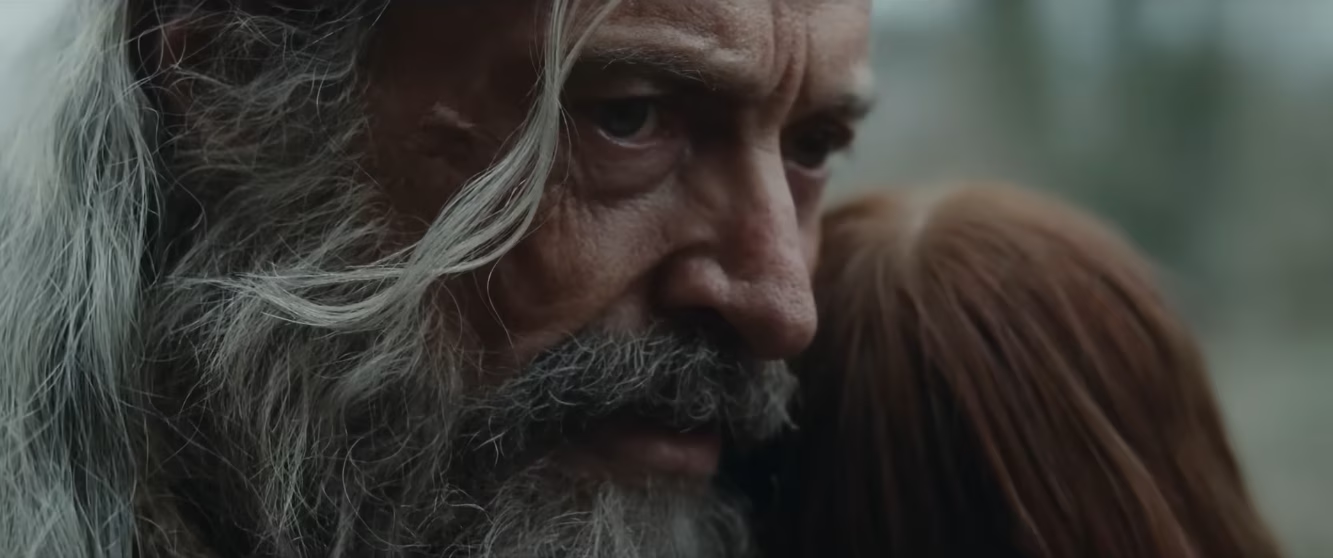
Hugh Jackman delivers what is arguably the best performance of his career since Logan. Stripped of his usual charismatic bravado, his Robin is cold, feral, and weighed down by decades of sociopathy. Jackman conveys a lifetime of regret not through explosive monologues, but through the exhausted slump of his shoulders and the haunted vacancy in his eyes. Jodie Comer grounds the film with profound grace, carrying the thematic weight of mercy, cosmic balance, and profound grief without ever reducing Sister Brigid to a simplistic saintly archetype. While the sluggish pacing of the second act challenges the viewer’s endurance, the film’s commitment to examining the psychological rot of a killer makes it a profoundly mature piece of cinema.
Secrets, Theories, and Unique Cinematic Insights
Beyond the surface narrative, The Death of Robin Hood is a dense tapestry of philosophical allegories, visual metaphors, and auteurist signatures. Delving into the subtext reveals a film obsessed with the architecture of human cruelty and the mechanics of myth-making.
The Imperial Boomerang Theory
A prominent sociological theory applied to the film by cultural critics is the concept of the “Imperial Boomerang”—the idea that the violent methodologies used to conquer, terrorize, and pillage abroad inevitably return to destroy the conqueror at home. Robin and John lived by the sword, taking what they wanted through sheer physical dominance and intimidation. The film meticulously demonstrates how this philosophy is fundamentally unsustainable. The descendants of their victims multiply over the decades, creating an unending wave of assassins. Robin’s physical deterioration and his inability to find peace is a direct manifestation of this boomerang effect; his body and his world are literally breaking down under the accumulated weight of the violence he exported into society.
The Auteur Signature: The “Already Dead” Protagonist
Michael Sarnoski has quickly developed a recognizable thematic signature across his filmography (Pig, A Quiet Place: Day One, and now The Death of Robin Hood). Sarnoski is fascinated by protagonists who are, for all intents and purposes, spiritually dead before the opening credits roll. Jackman’s Robin is a hollow vessel, marching through the moors simply out of survival instinct, devoid of joy, ambition, or hope. The narrative arc of Sarnoski’s characters is rarely about saving their lives; it is about finding a meaningful, dignified way to finalize their deaths. Robin’s journey is not one of survival, but of securing the moral permission to stop surviving.
Bloodletting as Karmic Absolution
The recurring visual motif of bloodletting serves as the film’s central spiritual allegory. Medically, the 13th-century practice was believed to purge the body of “bad blood” and balance the humors. Thematically, Sarnoski uses the procedure to represent Robin’s desperate attempt to bleed out his sins. Robin cannot seek forgiveness from a God he does not believe in, nor can he resurrect the hundreds of people he has killed. The only tangible atonement available to him is the physical draining of his own corrupted life force. When Brigid finally allows him to bleed to death, it is the ultimate fulfillment of this karmic purge. He empties his corrupted blood into the earth, returning to the soil the life he so violently took from it.
The Paradox of the Lie
The film concludes on a fascinating moral paradox regarding truth and storytelling. For two hours, Sarnoski ruthlessly strips away the lies of the Robin Hood myth, exposing the ugly truth of the man. He forces the audience to confront the sociopathy required to be an outlaw. Yet, in his final moments, Robin chooses to perpetuate a lie. By telling Little Margaret the fabricated, heroic version of Little John’s life, Robin acknowledges that while myths are historically false, they are psychologically vital. He burdens himself with the ugly truth so that the child can survive on the comfort of a lie. It is a profound commentary on why legends endure: civilization requires the illusion of nobility to prevent itself from collapsing into despair.
Auditory Isolation
The auditory landscape crafted by composer Jim Ghedi perfectly mirrors the visual purgatory. Ghedi relies heavily on mournful strings and isolated bagpipes, deliberately stripped of bombastic orchestral heroics. The sound design utilizes harsh wind foley and visceral, bone-crunching impacts during the action sequences to ensure the violence never feels entertaining, only exhausting.
The Death of Robin Hood Ending Explained: A Detailed Breakdown
To comprehensively analyze the film’s haunting conclusion, one must dissect the psychological metamorphosis of both Robin and Sister Brigid during the climax. The ending eschews grand, cinematic battles for a hushed, devastating intimacy that forces the audience to confront the extreme limits of forgiveness, the ethics of assisted suicide, and the utility of mythological lies.
The Confession and the Choice of Mercy
Following Robin’s confession that he is the architect of Brigid’s unimaginable grief—having burned her husband and children alive—the sanctuary of the priory shatters. When Robin later requests his scheduled bloodletting treatment to manage his pain and infection, the tension reaches its zenith. Brigid slices his vein with her razor, and the camera lingers uncomfortably on her face as she wrestles with the overwhelming urge to let the man who destroyed her life simply bleed out.
In the film’s most profound thematic pivot, Brigid steps back from the abyss of revenge. She realizes that executing Robin would simply restart the endless cycle of blood debts. Furthermore, in a heartbreaking rationalization of her own trauma, she acknowledges a twisted cosmic balance: Robin’s monstrous act inadvertently forced her into a life at the priory, where she ultimately found purpose in saving countless other lives. Refusing to let Robin’s darkness corrupt her light, she moves to apply pressure and stop the bleeding.
Assisted Suicide and the Transformation of Violence
However, as Brigid attempts to bandage the wound, Robin physically stops her hand. He refuses to be saved. He asks her to finish the job she started. The realization dawns on the audience and on Brigid: Robin is not being murdered; he is committing a form of assisted suicide, and he needs her complicity to achieve it.
Robin understands that he is fundamentally a creature of violence. He knows that as long as he breathes, the ghosts of his past will eventually find him, perpetually endangering Brigid, Margaret, and the orphans. By choosing to bleed out quietly in the sunlit bedroom, Robin claims ownership of his death, transforming it from an act of violent retribution into a consensual act of mercy and self-sacrifice. Sarnoski noted in interviews that the slow intimacy of bloodletting felt like the appropriate, quiet end for a man who lived entirely in the loud chaos of war.
The Arrow of Release and the Preservation of the Myth
As Robin’s life literally drains into the basin beneath his bed, Little Margaret enters the room. To shield the child from the gruesome reality of his suicide, Robin tucks his bleeding arm beneath the sheets, sacrificing his own comfort to protect her innocence.
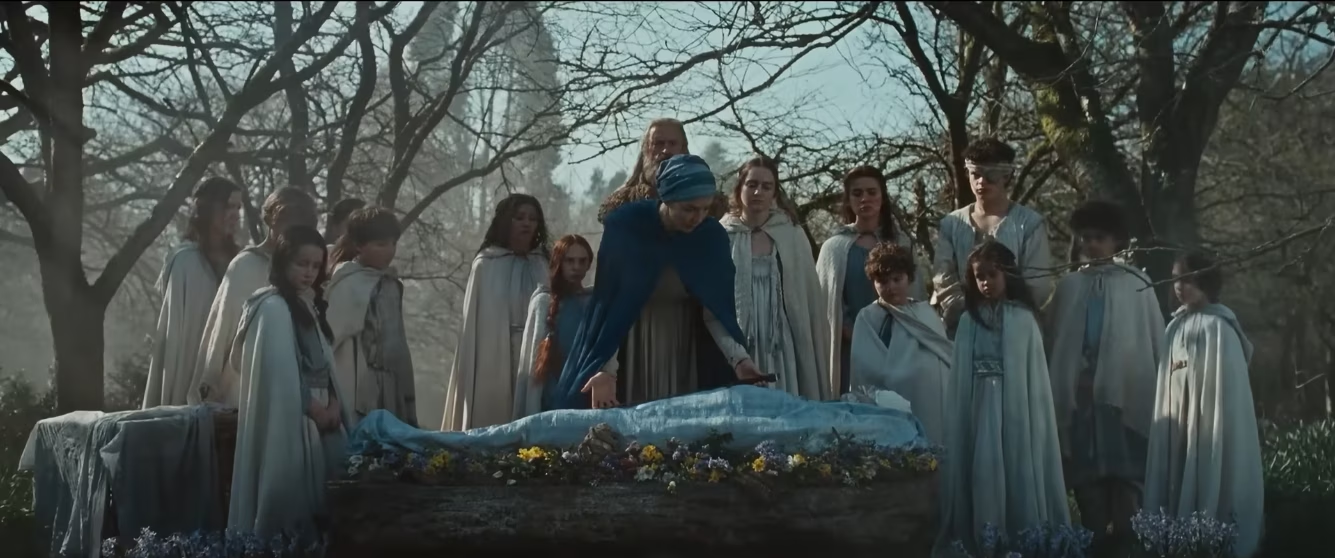
In his final moments, Robin hands Margaret the bow he crafted for her. He instructs her to stand at the window, notch an arrow, and aim toward the horizon. He imparts a final piece of wisdom: firing the arrow is not about “letting go” of the string, but about releasing the heavy burdens one holds onto. As Margaret releases the arrow into the sky, Robin exhales his final breath. His soul is visually and thematically tethered to the flight of the projectile, finally escaping the rotting, violent vessel of his body and finding peace in the ether.
Extensive Audience Q&A: Unlocking the Secrets of the Film
To provide the ultimate guide to the film and address the fragmented discussions across internet forums and critical circles, here is an exhaustive analysis of the audience’s most pressing questions.
Q: Is the core concept of the film connected to a real historical text?
A: Yes. The film is heavily inspired by a 17th-century folklore ballad titled “Robin Hood’s Death.” In the original text, an aging Robin is intentionally bled to death by a relative seeking revenge. Sarnoski adapts this by modernizing the psychology, changing the betrayal into a complex, consensual mercy killing.
Q: Why did the aspect ratio change after the first 30 minutes?
A: Sarnoski shot the brutal opening act in a wide 2.39:1 aspect ratio to capture the sprawling reality of the wilderness. When Robin is taken to the priory, the ratio shrinks to 1.66:1. This constriction mirrors Robin’s transition from a roaming myth into a confined, intimate purgatory.
Q: Was Robin Hood actually a bad person in the movie?
A: Unquestionably. The legends of him stealing from the rich to give to the poor were elaborate lies he spread to mask his true nature. He was a self-serving, murderous brigand who killed innocents without remorse.
Q: Why didn’t Maid Marian appear in the film?
A: Sarnoski bypasses the romanticized 16th-century additions to the Robin Hood mythos, opting to draw from the earliest, harshest yeoman ballads where Marian had not yet been introduced. In this grim universe, Robin never loved anyone.
Q: Why did Sister Brigid ultimately kill Robin Hood if she decided to forgive him?
A: Brigid initially intended to kill him out of revenge, but stopped herself, choosing mercy. It is Robin who prevents her from staunching the bleeding. It is an assisted suicide; dying quietly is the only way he can protect the priory from the enemies that will inevitably track him down.
Q: Why does Robin tell Margaret a fake story about her father as he dies, despite hating lies?
A: Robin chooses to pass the heroic lie onto Margaret to protect her innocence, ensuring she remembers her father as a merry adventurer rather than a psychopath. It highlights a core theme: society requires the illusion of nobility to endure the harshness of reality.
Q: Is there any thematic connection to Hugh Jackman’s performance in Logan?
A: The parallels are striking. Both feature Jackman playing an aged, violent anti-hero grappling with physical deterioration and the protection of a young surrogate daughter. However, while Logan dies a heroic death in battle, Robin Hood dies a quiet, unglamorous death in a bed.
Q: What are the “entropy” themes Sister Brigid discusses?
A: Brigid discusses entropy to explain the balance of chaos and order. She suggests that while the universe allows for horrific, senseless chaos (like Robin killing her family), it also miraculously allows for order, beauty, and healing (like the priory). It is her way of making peace with cosmic unfairness.
Q: Does the film contain any post-credits scenes?
A: No. The film ends definitively with the title card following Robin’s death, respecting the solemnity of the narrative.
Q: Will there be a sequel?
A: Highly unlikely. The definitive death of the protagonist, the indie nature of the A24 production, and the enclosed thematic narrative leave no room for continuation.
By dismantling the legend piece by piece, The Death of Robin Hood achieves something far more profound than a standard action epic. It forces the audience to examine the anatomy of a myth and the staggering human cost required to build one. Through Hugh Jackman’s haunting performance, Jodie Comer’s quiet resilience, and Michael Sarnoski’s uncompromising direction, the film cements itself as a staggering cinematic achievement regarding the weight of human consequence.
Read also: [Disclosure Day Ending Explained: The Definitive Breakdown of Spielberg’s 2026 Sci-Fi Masterpiece]