Is Christopher Nolan’s $25 IMAX ticket worth the hype, or are you just desperately searching for the odyssey ending explained because the sound mix blew your eardrums out? Sitting in the third row on a Thursday night, feeling the 70mm bass rattle my actual teeth, I realized something. Nolan just made a 2026 horror movie disguised as a Greek epic.
And it is a messy, deeply uncomfortable masterpiece.
Nolan took Homer’s 3,000-year-old foundational poem, stripped out the romanticized heroism, and turned it into an unforgiving commentary on the violent collapse of civilization. But packing all of that into three hours means some things got brutally butchered along the way. Let’s break down exactly what happened.
What Exactly Happens to Barnaby Nolan?
What happens to Barnaby Nolan? He meets the exact pathetic fate he deserves. Despite his endless manipulations and desperate attempts to outsmart the system, Barnaby is completely cornered by his own greed. He doesn’t get a glorious final stand or a redemption arc; he gets abruptly removed from the board in a shockingly cold, deeply humiliating manner.
The Trojan Horse Was a War Crime
Forget the sanitized, heroic versions of the Trojan War you saw in history class. Nolan opens the film not with a glorious battle, but with Travis Scott playing a bard, thumping a gold-tipped staff.
Yeah. Travis Scott. Actually, it works. It perfectly mimics the repetitive, rhythmic nature of ancient oral storytelling.
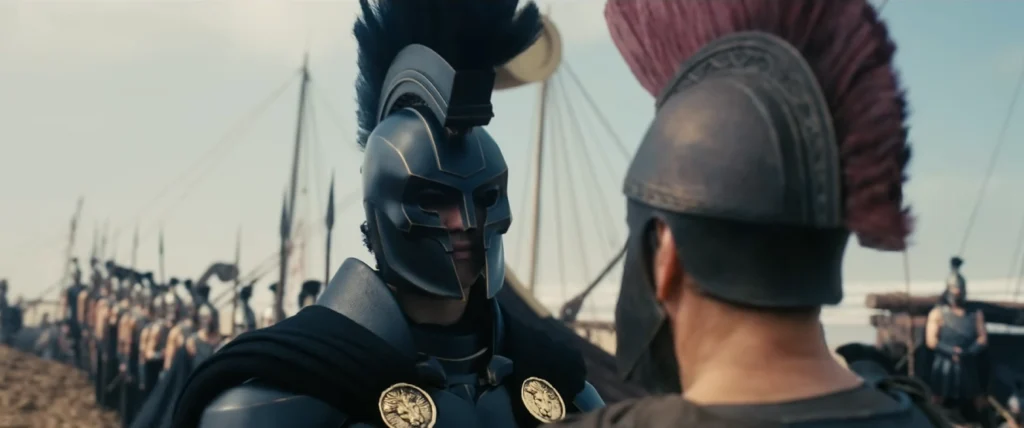
Then we see Troy. The Trojans are not the bad guys here. They find the massive wooden horse on the beach and treat it with absolute reverence. They roll it on shaved logs to avoid scratching it, believing it to be a genuine peace offering to Athena. They bring it into their walls—a practical 2.5-acre set built in Morocco, lit by these mesmerizing “pyrahedron” LED devices instead of standard torches.
Inside the horse? Menelaus (Jon Bernthal) and Odysseus (Matt Damon) are literally sitting in their own excrement for days. They slip out in the dead of night like a virus invading a healthy host.
And the slaughter that follows is sickening.
Nolan directly links this to Oppenheimer. We hear the exact same horrifying screams from the Los Alamos gym scene mixed into the audio as Troy burns. Odysseus didn’t win a war. He committed a mass atrocity that broke Zeus’s law of hospitality forever. He sacrificed young Sinon (Elliot Page) just to sell the lie. This isn’t a story of triumph. It is the story of a man who realized he is the monster.
A Practical Horror Show (And Why the Pun Got Cut)
Once Odysseus and his crew hit the sea, the film completely shifts genres.
We get practically-rendered, terrifying monsters. Nolan skips the shiny CGI overload. When the crew gets trapped in a cave by the Cyclops, Polyphemus, it is pure nightmare fuel. They built a 60-foot animatronic puppet for the sleeping giant. Bill Irwin puppeteers the beast, biting the head and arm off a screaming soldier in a shot that mirrors the famous painting of Saturn devouring his son.
But die-hard Homer fans are furious. Nolan completely cut the iconic “I am Nobody” pun.
Honestly? Thank god. It would have been wildly campy in a movie this dark. Instead, Odysseus blinds the Cyclops after they have already escaped, an act of pure, arrogant revenge that earns him the wrath of Poseidon.
And do not even get me started on Circe’s island. Samantha Morton plays the witch who turns men into pigs. She doesn’t just wave a wand. She literally molds their faces like wet clay with her bare hands, stretching their ears into snouts in a sequence of Rick Baker-style practical body horror. It is deeply unsettling.
The Ithaca Frat House
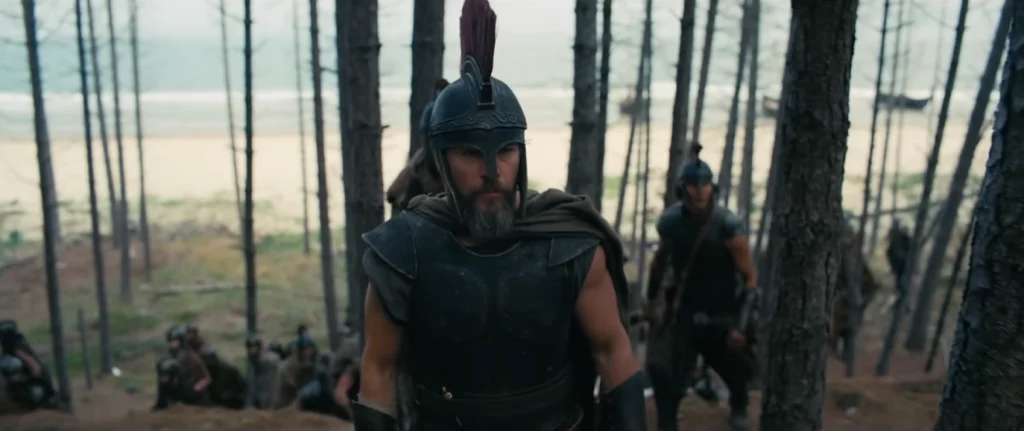
Meanwhile, back at the castle (shot at a 15th-century Sicilian fortress where the crew literally had to hike equipment up a 1,000-foot hill), things are falling apart.
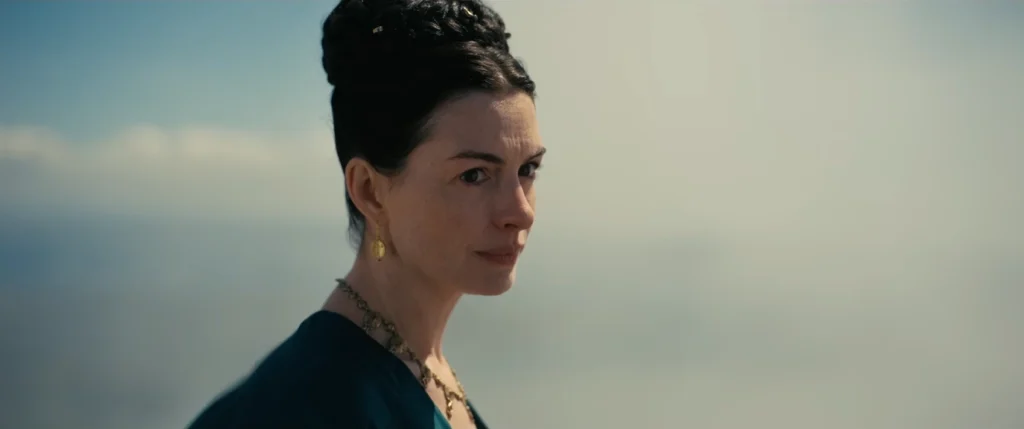
Anne Hathaway’s Penelope is trapped behind a translucent screen, weaving and unweaving a burial shroud to stall for time. She is surrounded by 108 suitors acting like unhinged frat boys. Robert Pattinson plays Antinous, the leader of the suitors, and he absolutely eats up the scenery as a draft-dodging, entitled sociopath.
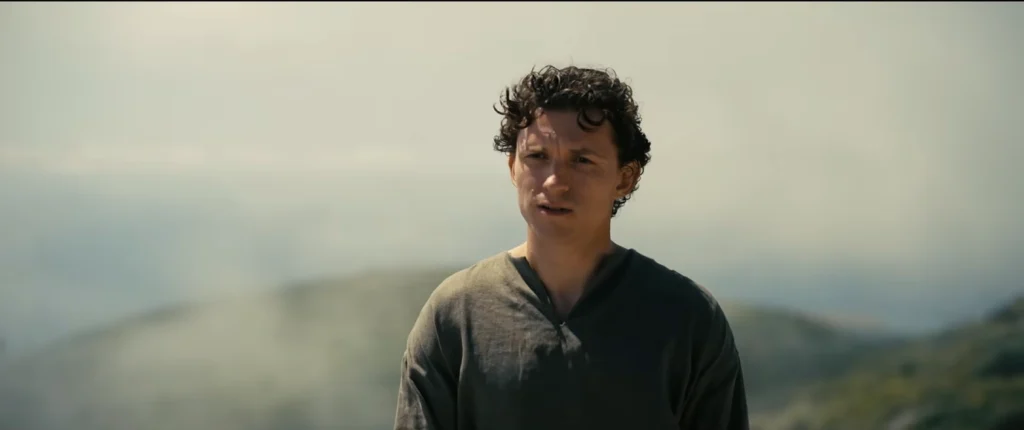
Tom Holland plays Telemachus, the son waiting for a “daddy” he never knew. And yes, the cast is using flat, modern American accents. Hearing Pattinson taunt Holland with the word “daddy” in a Greek myth feels bizarrely modern, but it reinforces the idea that this is a contemporary, Americanized translation of a collapsed empire.
Why The Icelandic Underworld Will Haunt You (Or: Agamemnon’s Marital Advice)
You would assume a massive $80 million Hollywood epic would render Hades as a fiery, CGI-soaked hellscape.
You would be completely wrong.
Nolan dragged his entire crew to Iceland in June, exploiting the eerie, perpetual twilight of the midnight sun to create a desolate, freezing Underworld. It is absolutely miserable to look at, and it perfectly reflects the psychological state of our “hero.”
Here, Odysseus digs a trench, fills it with sacrificial livestock blood, and waits for the ghosts of his fallen comrades to rise from the black dirt. It plays out less like a magical séance and more like an incredibly depressing HR exit interview. Sinon (Elliot Page) rises up just to remind Odysseus that his “noble lie” at Troy was actually just a cowardly betrayal.
Then comes Agamemnon (Benny Safdie).
The king who sacrificed his own daughter to win the war didn’t get a hero’s welcome. He tells Odysseus that his wife, Clytemnestra (Lupita Nyong’o), washed him in his bed and then murdered him in cold blood. Agamemnon’s ghost gives Odysseus one terrifying piece of advice: do not walk through your front door expecting a parade. Come in disguise.
The Sirens, Dog-Heads, and a Desperate Craving for Beef
Is the Siren sequence a seductive, aquatic hallucination? Not exactly.
The soundtrack here is dominated by the Aulos—an authentic, ancient double-reed pipe that screeches through the theater speakers. Himesh Patel’s Eurylochus jams beeswax into the crew’s ears—looking weirdly like a guy putting in his AirPods on a noisy subway commute—while Odysseus is lashed to the mast.
The Sirens do not seduce him with lust. They weaponize his PTSD. Eurylochus later delivers a chilling monologue, describing the Siren song as a “delicious itch” that tells you exactly what you cannot have, whispering that Odysseus secretly doesn’t actually want to go home.
It is a psychological gut-punch.
And then everything goes to hell. They sail straight into Scylla—depicted here as horrifying, serpentine dog-heads snapping out of a cave to rip the crew off the deck. Starving, exhausted, and pushed beyond their breaking point, the surviving men openly defy Odysseus and slaughter the sacred Sun Cattle.
Zeus does not forgive. A massive, violent storm literally chops the ship in half. Everyone drowns except Odysseus, who washes up on Ogygia, where Charlize Theron’s Calypso essentially sedates him with amnesiac lotus flowers for seven years.
The Truth About Zendaya’s Athena
For two hours, you watch Zendaya pop up as the goddess Athena, exclusively appearing to Odysseus through clever, in-camera “Texas switch” panning shots.
I thought Nolan was just giving his leading man a magical Jiminy Cricket.
Wow, was I naive.
The film drops a sickening twist regarding her identity. The reason Athena looks like Zendaya is because she isn’t really taking a divine form at all. She is wearing the face of a young, innocent Trojan girl that was slaughtered on the steps of Athena’s temple during the Greek invasion.
Every time Odysseus talks to the “goddess of wisdom,” he is actually just hallucinating the ghost of a civilian his men butchered. The “people from the sea” that everyone fears are bringing the collapse of the Bronze Age? It’s them. Odysseus realizes he is the monster who broke the world.
The Ithaca Bloodbath (And the Best Good Boy in Cinema)
Odysseus finally reaches Ithaca in the disguise of a beggar.
Before we get to the slaughter, we need to talk about Argos. The incredibly old hunting dog—played by a rare Podengo—is lying outside the palace. Despite the dirt, the beard, and the 20 years of aging, the dog instantly recognizes his master. Argos gives one weak, pathetic wag of his tail, and then immediately dies.
I am not too proud to admit I openly wept in my IMAX seat.
Inside the palace, Penelope lays a trap. She challenges the drunken, abusive suitors to string Odysseus’s impossibly heavy hunting bow and shoot an arrow through 12 axes. Robert Pattinson’s Antinous refuses to even try, terrified of humiliating himself.
The “beggar” steps up.
He plays dumb for a second, fumbling with the wood, just to get Penelope to turn her back. Then he effortlessly strings it. Thwack. The three-note musical motif of the film rings out from the bowstring. Penelope recognizes the sound instantly.
Before the suitors can even blink, Odysseus shoots Polybus straight through the neck.
What follows is an absolute massacre. Melanthius (Logan Marshall-Green) tries to drop weapons to the suitors from an overhead armory—straight out of Bane’s playbook in The Dark Knight Rises—but Telemachus brutally cuts him down. Odysseus corners Antinous, violently shoving the wooden draft lot into the suitor’s mouth before executing him, spitting: “I gave you back your shame”.
The Mic-Drop Exit
Does Odysseus reclaim his throne, put on a crown, and rule peacefully into his twilight years?
Please. This is a Christopher Nolan movie.
Odysseus and Penelope realize they are too broken, too changed, and too haunted to ever sit in that palace again. They leave the crown to Tom Holland’s Telemachus. Hand in hand, the aging king and queen board the fastest ship they can find and sail blindly into the unknown West.
The screen cuts to black on a lingering vision of the Trojan Horse being completely consumed by fire.
No grand speeches. No closure. Just the ashes of an empire they burned to the ground.
Did we actually miss any hidden details in Christopher Nolan’s 2026 Homeric nightmare? You really think a director this famously obsessive spent years engineering an R-rated IMAX epic without burying a dozen psychotic, hyper-specific Easter eggs in the background?
Sitting through the end credits while the theater cleaners glared at me, I realized just how much of this film’s brilliance is hidden in plain sight. Let’s dig into the missing pieces.
The Twin Sister Twist and the “Swan Egg” Casting Outrage
The internet threw a massive, predictable tantrum over Lupita Nyong’o playing Helen of Troy. Online trolls complained about historical accuracy, completely ignoring the fact that in Greek mythology, Helen literally hatched from a swan egg.
Nolan completely ignores the noise. He actually doubles down. Nyong’o does not just play Helen; she secretly plays her twin sister, Clytemnestra (Agamemnon’s wife), as well.
But Helen’s introduction is brutal. We meet her at the wedding feast of her daughter Hermione and Achilles’ son, Neoptolemus. Menelaus (Jon Bernthal) forcefully grabs Helen’s face, revealing a massive, ugly scar. He mutilated her to punish her for absconding with Paris, bitterly joking that her face now launches “maybe 500” ships instead of a thousand.
A 115-Foot Viking Ship and a Neolithic Cheese Cave
Hollywood directors shoot on sterile soundstages with blue screens. Nolan rented the Draken Harald Hårfagre—the world’s largest modern Viking longship, measuring 115 feet—and actually sailed it through the Mediterranean’s Aeolian Islands.
That horrifying Cyclops sequence? That was not a set.
They hauled the crew into Nestor’s Cave in the Peloponnese region of Greece—an actual Neolithic site with a 95-foot vaulted ceiling. The bizarre sacks hanging on the cave walls are not just set dressing. They are wicker racks of sheep’s milk cheese, honoring the historical origin of Feta cheese.
Because of course Nolan cares about the historical accuracy of cheese in a movie featuring a 60-foot cannibal monster.
The Forgotten Casualties and Mia Goth’s Creepy Cameo
The supporting cast is treated like highly-paid cannon fodder.
- Will Yun Lee plays Anki. He is the poor bastard who actively rips the beeswax out of his ears and willingly swims to his death toward the Sirens.
- Jovan Adepo plays Elpenor, the crewman who translates for the goat herder before getting violently thwacked against the cave wall by the Cyclops.
- Josh Stewart (who voiced the robot CASE in Interstellar) returns to a Nolan set just to play Antipotes.
- Barnaby Nolan (presumably Chris’s relative) pops up as a terrifying, steel-armored child belonging to the Lestrygonians—the giant cannibals who trap the Greeks in magical tree cages.
And then there is Mia Goth. She briefly appears as Penelope’s handmaiden, delivering a performance so deeply unsettling and memorably “Mia Gothian” that you instantly assume she is planning a murder.
The Musical Bowstring and the Pig Scar
Composer Ludwig Göransson didn’t just write a score. He weaponized ancient history.
He brought in Rosa Fragorupti to play the Lyre. But the genius lies in the film’s three-note musical motif. The third note is literally the sound of Odysseus plucking his bowstring.
It all connects back to a wildly specific physical detail. Early in the film, a young Odysseus goes on a hunt and his leg is brutally gored by a wild hog. We see the nursemaid Eurycleia (Kate Fuglei) stitch the nasty wound. Two decades and three hours of screen time later, that exact scar is how Eurycleia recognizes the filthy beggar as the King of Ithaca when she washes his feet.
Every detail is a trap.
We never even fully see Agamemnon’s face in the entire movie. Benny Safdie just looms in the background like a walking corpse. A cursed king wearing black chrome armor, forever haunted by the daughter he murdered just to get a favorable wind.
read more : Lucky Ending Explained: Why Apple TV’s New Heist Thriller Will Ruin Your Sleep