In the Grey ending explained: unraveling the tactical complexities, corporate betrayals, and explosive conclusions of Guy Ritchie’s latest cinematic venture requires a forensic approach to modern action storytelling. If you are hunting for a definitive analysis of this 2026 action-thriller, you have just stepped into one of the most intricately woven, tactically profound, and corporately ruthless narratives in modern cinema. By taking the classic framework of the extraction heist and filtering it through the cold, calculated lens of international corporate law, asset management, and white-collar extortion, director Guy Ritchie has completely shaken up the thriller genre.
Moving drastically away from the street-level British gangsters of his early career and the straightforward military machismo of his mid-career outputs, Ritchie—acting as writer, director, and producer alongside Ivan Atkinson and John Friedberg—has crafted a 97-minute cinematic event that is overflowing with methodical, ambient tension. Released widely in North America on May 15, 2026, by Black Bear Pictures and Toff Guy Films, the film leans heavily into the modern horrors of unregulated capitalism: the weaponization of legal loopholes, the manipulation of global supply chains, the fragility of international business empires, and the deep-seated corruption of Wall Street asset managers.
The real monsters in this narrative are not necessarily the gun-toting cartel bosses operating from fortified private islands, but rather the human institutions operating in high-rise New York offices who would rather risk international warfare than surrender their monopoly on wealth. The title itself—In the Grey—refers to that precise operational theater: the razor-thin margin between the moral and the immoral, the legal and the illegal, the black and the white.
In this massive, comprehensive breakdown, the analysis is divided into exhaustive parts to cover every single detail required to master the film’s complex lore. This report will dissect the elite ensemble cast, analyze the historical evolution of the director’s heist framework, meticulously explain the shocking tactical twists of the opening acts, unearth the darkest hidden secrets and theories, and provide a dedicated FAQ to answer the internet’s burning questions regarding the final frames of the movie.
The Evolution of Ritchie’s Action Framework
To fully grasp the magnitude of In the Grey, it is absolutely essential to contextualize the film within the legendary director’s evolving 30-year career. While Ritchie has always been fascinated by men and women operating outside the parameters of the law, the tonal shift present in this 2026 release marks a radical departure from his previous works. The historical progression of these thematic explorations demonstrates a filmmaker constantly recalibrating his understanding of criminality in the modern, hyper-connected era.
The following table illustrates this evolutionary trajectory, highlighting how the director’s focus has shifted from the streets to the boardroom:
| Film Title | Release Year | Thematic Core & Criminal Representation | Societal Context & Evolution |
| Lock, Stock and Two Smoking Barrels | 1998 | Bumbling, street-level thieves navigating a chaotic, interconnected London underworld. | Working-class desperation and the gritty reality of low-level, analog crime. |
| Snatch | 2000 | Highly stylized, fast-paced intersections of various criminal factions over a single valuable asset. | The globalization of underground economies (diamonds, illegal boxing) and chaotic opportunism. |
| Wrath of Man | 2021 | A bleak, humorless, and hyper-violent revenge narrative centered on cash-in-transit robberies. | Post-pandemic cynicism, focusing on militarized tactical precision over stylized dialogue. |
| The Gentlemen | 2019 | The gentrification of the drug trade, focusing on aristocrats and billionaires fighting over weed empires. | The corporatization of illegal substances and the clash of old aristocratic money versus new money. |
| In the Grey | 2026 | Heist mechanics applied to international law, shell companies, and corporate debt recovery. | Modern crises of corporate impunity, Wall Street corruption, and the privatization of military force. |
While his earlier classics asked simple questions like, “Who has the diamond?” or “Where are the antique shotguns?”, In the Grey operates under the modern, deeply cynical assumption that the public already knows the billionaires have all the money. The core dramatic question is no longer about stealing physical cash from a heavily guarded vault; it is about the agonizing, terrifying process of crippling a financial empire through legal injunctions, targeted sabotage, and psychological warfare.
The director has transitioned from viewing heists as kinetic smash-and-grab operations to viewing them as surgical, bureaucratic warfare. The violence in this film is merely a punctuation mark at the end of a long, legally binding sentence.
PART 1: The Setup and The Shocking Cast
To fully understand the nightmare unfolding across the globe—from the oil rigs of a remote private island to the towering executive offices of Spencer Goldstein in New York—the analysis must first deconstruct the deeply flawed human beings at the center of the story. This is not a simple tale of innocent victims being terrorized by a monster; the protagonists and antagonists alike are riddled with monetary fanaticism, extreme moral ambiguity, and a chilling detachment from the consequences of their actions.
The success of this ambient dread relies entirely on an absolute powerhouse ensemble cast, carefully selected by casting director Daniel Hubbard, executing performances that ground the fantastical tactical elements in raw, cynical human emotion.
Eiza González as Rachel Wild
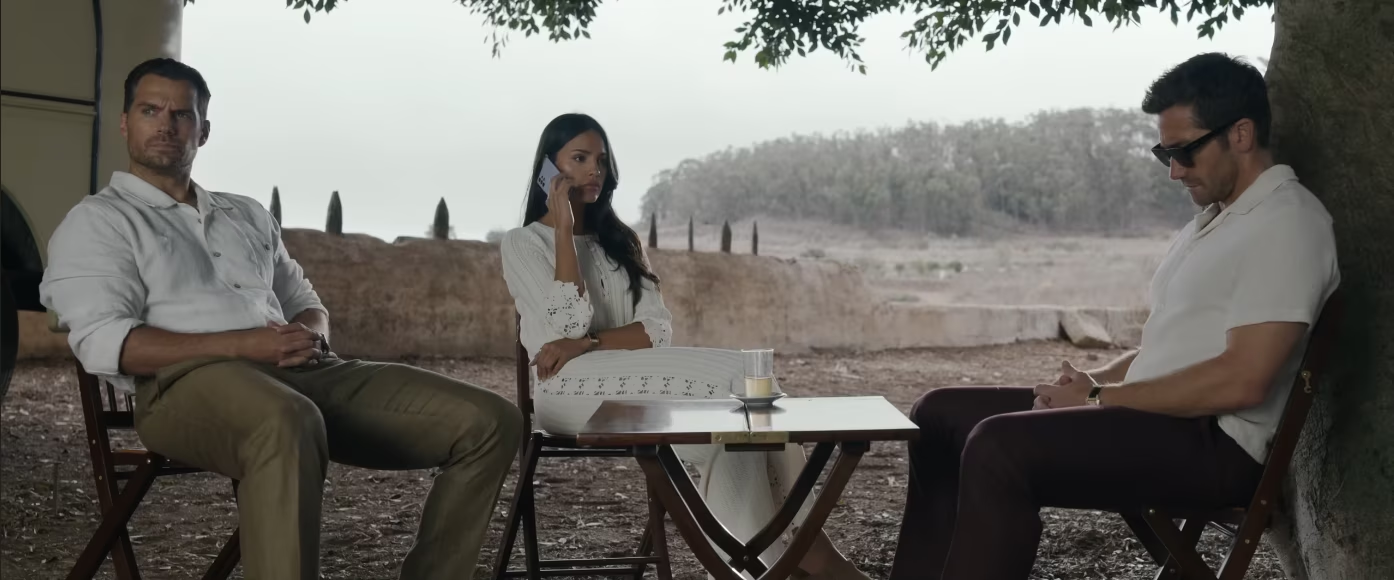
Eiza González delivers what critics have universally described as a chillingly composed, razor-sharp, and commanding performance as Rachel Wild. Rachel is an elite, highly specialized lawyer whose explicit job is to chase down those who hide their massive debts through legal loopholes, offshore accounts, and proxy shell corporations. Her narrative role is fundamentally tied to her profession: she is a woman who makes a living weaponizing the legal system against those who believe they are above it.
When her mentor and partner, Braxton, is executed on Salazar’s island at the beginning of the film, she does not seek immediate, bloody physical vengeance. Instead, she seeks total financial annihilation. González is required to navigate extreme professional detachment, transitioning seamlessly from tense, high-stakes boardroom negotiations with Wall Street executives to surviving intense, paramilitary sieges in tropical jungles. She acts as the strategic brain of the operation, representing the ultimate apex predator in the corporate food chain. Her emotional restraint is her ultimate weapon.
Jake Gyllenhaal as Bronco Beauregard
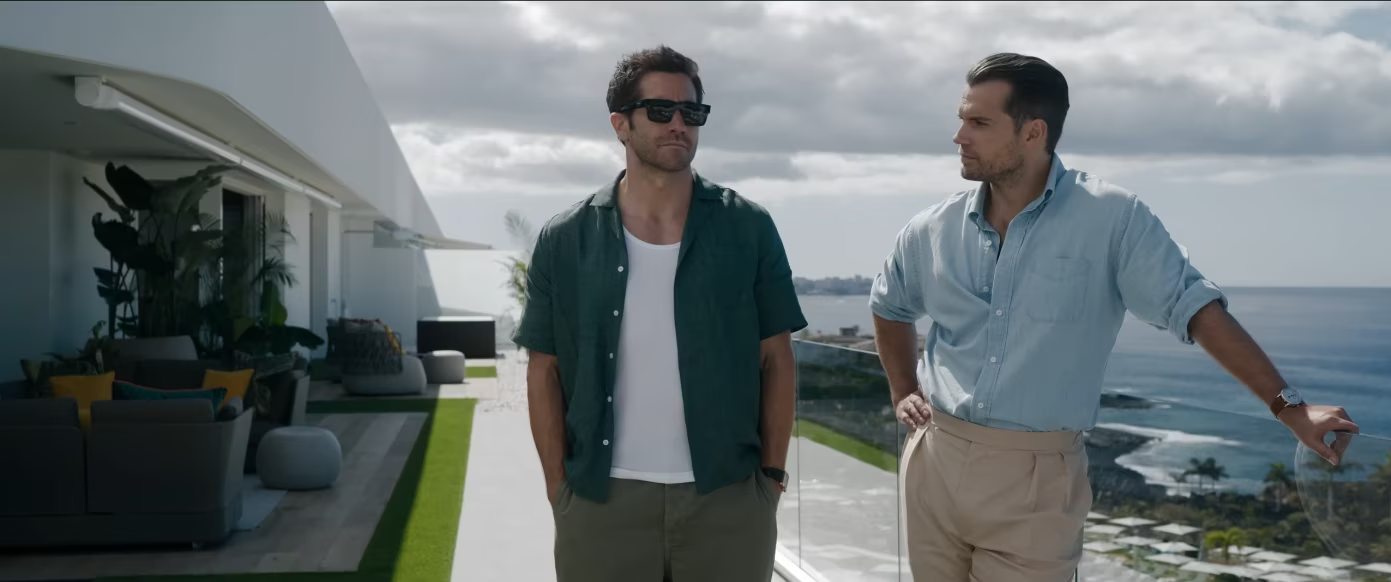
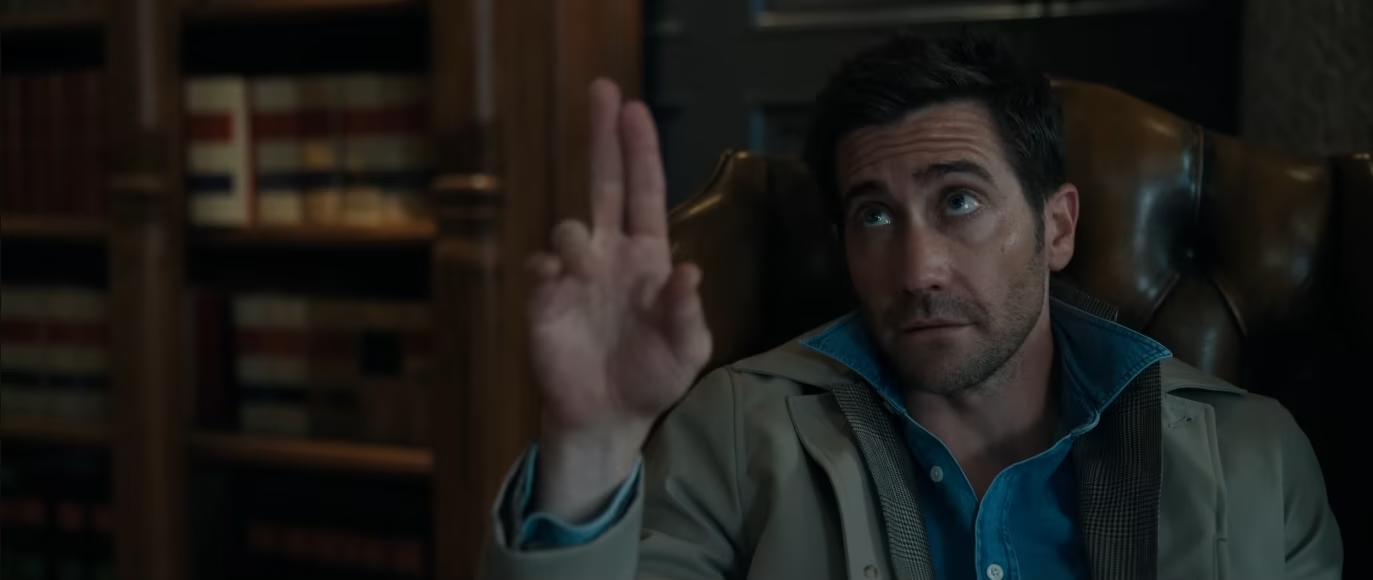
Jake Gyllenhaal plays Bronco Beauregard, a character operating as the heavy tactical hammer to Rachel’s precise legal scalpel. Bronco heads a specialized field team that executes extractions, physical intimidation, and asymmetrical sabotage. Gyllenhaal infuses the role with a masterful blend of unhinged charisma, dark humor, and lethal precision. Bronco is not merely a blunt military instrument; he is an architectural mastermind of chaos. He designs elaborate, devastating traps like the “Banana Pie” (a concealed road trap that swallows vehicles whole) and orchestrates microscopic forensic disruptions on massive industrial oil rigs.
His loyalty to Rachel is absolute and unquestioning, born from a mysterious past event where she broke him out of a brutal prison in Chiang Mai, Thailand. Gyllenhaal’s performance anchors the film’s deep exploration of how raw military expertise is utilized, and often exploited, in the private sector.
Henry Cavill as Sid
Henry Cavill completely sheds his traditional, heroic blockbuster persona (such as his iconic turn as Superman) to play Sid, the covert operations specialist handling corruption, high-level bribery, and clandestine surveillance. If Bronco is the hammer, Sid is the ghost. Cavill plays the role with a terrifying, bureaucratic calmness, seamlessly blending into high-society Saudi Arabian backgammon games one moment, and blending into the background of heavily fortified police stations the next.
Critics and audiences alike have widely praised the dynamic between Cavill and Gyllenhaal. The film actively avoids the cliché of injecting a forced romantic subplot between the male leads and Rachel. Instead, their dynamic is replaced by a deeply forged, brotherly loyalty, underpinned by a touch of engaging, sometimes homoerotic banter that elevates the tension and humanity of their impossible missions. Cavill’s restrained performance proves that true cinematic intimidation does not always require shouting.
Rosamund Pike as Bobby Sheen
Rosamund Pike provides a venomous, corporate counterpart to the physical threats of the film as Bobby Sheen. Bobby is a high-ranking executive at Spencer Goldstein, the incredibly powerful Wall Street capital management firm that originated the bad loan. Pike plays the role with a brilliant sociopathic detachment, representing the institutional inertia that suppresses human morality in the name of quarterly profit.
She is dismissive, arrogant, and ultimately treacherous, highlighting the film’s core underlying theme: the men and women in the tailored suits in New York skyscrapers are infinitely more dangerous, unaccountable, and untrustworthy than the drug lords operating on remote islands. Pike’s ability to convey absolute ruthlessness with a mere shift in her posture makes her the true overarching antagonist of the narrative.
Carlos Bardem as Manny Salazar
Carlos Bardem portrays Manny Salazar, the ruthless despot and billionaire debtor who flatly refuses to repay his billion-dollar loan. Salazar is an international chameleon, moving effortlessly through hundreds of pseudonyms and hiding his vast wealth through impenetrable layers of proxy corporations.
While some film reviewers felt the character lacked a physically imposing, traditional cinematic menace, Bardem plays Salazar brilliantly not as a frontline brawler, but as an insulated, entitled billionaire who genuinely believes his money makes him a god. His heavy reliance on his red-bearded security chief, Axel Olsen (played with brutal efficiency by Game of Thrones alum Kristofer Hivju), and his nervous lawyer, William Horowitz (Fisher Stevens), highlights his complete disconnect from the actual violence he perpetuates. Salazar is dangerous precisely because he believes he is untouchable.
Supporting Tactical Crew
The ensemble is rounded out by a highly competent supporting cast representing Rachel’s technical and tactical infrastructure:
- Jason Wong as Gucci Reyes: The tech operator who manages drones, hacks security feeds, and provides real-time digital overwatch.
- Kojo Attah as Andre Baker: The explosives expert whose meticulous planning and ultimate sacrifice become the emotional core of the film’s final act.
- Emmett J. Scanlan as Mick Dunne: The aviation specialist tasked with operating the high-risk gyrocopter extractions.
- Christian Ochoa Lavernia as Jonathan Moreno: The wheelman responsible for ground transport and evading the island’s corrupt police force.
PART 2: The Narrative Architecture (Act-by-Act Breakdown)
The sheer, suffocating terror of this narrative lies in its structure. The film drops the audience directly into the middle of a chaotic, escalating financial war without the safety net of lengthy exposition. The pacing builds relentlessly, transitioning from corporate espionage to supernatural-levels of tactical pursuit, and finally culminating in a deadly island extraction. Let us meticulously break down the critical events that set up the ultimate endgame.
Act I: The Debt, The Execution, and The Pitch
The film opens with a masterclass in kinetic, suspenseful filmmaking, utilizing a disorienting execution sequence that immediately establishes the stakes. We are introduced to Braxton, Rachel’s mentor and a seasoned debt recovery agent. Braxton has miraculously successfully negotiated the return of a massive $1 billion debt from Salazar on his private, heavily fortified island.
Believing he has won the ultimate game of corporate chicken, Braxton calls Bobby Sheen at Spencer Goldstein in New York to secure his 5% commission and gloat about the victory. However, in a brutal, quiet demonstration of Salazar’s true nature, his head of security, Axel Olsen, asks to pull the car over for a bathroom break. In a flash of suppressed violence, Olsen quietly executes Braxton’s bodyguard, Gerald, and then hunts down Braxton himself, leaving him dead in the tropical dirt.
Salazar then takes the recovered check, calls Bobby Sheen directly, declares the contract null and void, and casually threatens to murder anyone else the firm dares to send. This geopolitical tension is not merely background noise; it is the fundamental justification for Rachel Wild’s existence and the inciting incident of the plot.
Enter Rachel Wild. She crashes Bobby Sheen’s office in New York, completely uninvited. In a brilliantly written, rapid-fire negotiation scene that sets the tone for the entire film, Rachel capitalizes on the Wall Street firm’s utter desperation. She explicitly knows that going at Salazar physically is suicide; Braxton tried to blackmail Salazar with a few hidden assets and ended up with a bullet in his head. Rachel demands a staggering 20% commission to recover the funds. Bobby, appalled, counters with 5%. They fiercely negotiate and finally settle on a 10% cut of whatever is recovered, plus a non-negotiable $10 million upfront fee.
This 10% figure is the thematic bedrock of the entire film; it is not just a fee, it is an unbreakable principle of the underworld, a binding contract of honor among thieves.
Act II: The Asymmetrical Squeeze (Legal and Illegal)
The second act operates as a meticulous procedural deconstruction of a billionaire’s empire. Rachel initiates a brilliant two-track strategy: one strictly legal (utilizing courts and injunctions), and one highly illegal (utilizing Bronco and Sid).
First, Rachel and Bronco arrange a meeting with Salazar’s infamous lawyer, William Horowitz, under the guise of being wealthy investors. The facade drops immediately. After Bronco physically intimidates Horowitz’s security guard—promising to scrape him off the walls if he intervenes—Rachel drops her business card, promising total financial ruin if Salazar does not immediately pay the billion dollars. When Horowitz predictably refuses, the team goes to work.
The Financial Bleeding: Death by a Thousand Cuts The execution of the sabotage is where Ritchie’s script truly shines, relying on extreme intelligence and logistical disruption over brawn. They attack Salazar’s cash flow simultaneously across the globe:
- The Saudi Hotel Discrepancy: Sid and tech operator Gucci deploy to Jeddah, Saudi Arabia. Salazar has official approval to build a 130,000 square-foot luxury hotel, but is illegally expanding the blueprint to 150,000 square feet. Sid anonymously tips off the Saudi authorities about the discrepancy. The ministry immediately shuts down the massive construction site. Salazar starts bleeding $4 million a week in regulatory penalties.
- The Impounded Steel: While at the construction site, Sid physically bribes a port superintendent with $25,000. The official immediately reports that 20,000 tons of Salazar’s imported steel is impounded because the shipping paperwork does not match the cargo. With 2,000 construction workers sitting completely idle on full pay, Salazar burns an additional $5 million every single week.
- The Oil Rig Failsafe: Bronco and explosives expert Baker infiltrate Salazar’s massive, $200,000-a-day oil rig located right off the coast of his own private island. Rejecting a loud, obvious explosion that would just trigger insurance payouts, Bronco opts for an invisible, psychological blow. Baker plants a tiny 25-gram “jackal and hide superfuse” device inside the 200,000-ton rig that quietly triggers a deeply buried failsafe malfunction. When anonymous tips bring safety inspectors to the site, the rig gets shut down on the spot. It cannot drill, it cannot move, and Salazar starts bleeding $500,000 every single day in lost revenue.
The Wolfgang Con and the Faraday Cage Breach Despite the bleeding, they cannot recover the billion dollars unless they find where the liquid assets are hidden. The key is Wolfgang Close, Salazar’s Harvard-educated, German-Arab mastermind accountant who orchestrates the entire financial empire from a fortified, signal-blocking Faraday cage office in Jeddah.
Discovering through surveillance that Wolfgang has an enormous ego, a passion for 1950s esoteric sculptures, and a love for high-stakes backgammon, the team formulates a trap. Sid infiltrates an elite party as a wealthy investor. Sid repeatedly beats Wolfgang at backgammon using loaded dice, eventually winning over £200,000. However, Sid refuses to take a single penny of the winnings. This psychological manipulation completely hooks Wolfgang, whose ego cannot handle being in debt to a stranger.
Sid intentionally loses a final match and offers a “gift” as a token of repayment: a beautiful 1950s sculpture. Wolfgang is delighted and takes it into his office. What he does not know is that the sculpture contains a microscopic bug, a camera, and a signal-transmitting device. The impenetrable Faraday cage is breached. Hacker Clover immediately downloads Salazar’s entire financial blueprint—names, shell companies, offshore accounts, everything.
Armed with the raw data, Rachel mercilessly weaponizes the international court system. In rapid succession, she files international attachment orders, freezing Salazar’s biggest entities: Skyilk Chemical Manufacturing ($1.1 billion in turnover), Primoar Telecom ($800 million in assets), and Archon Digital ($385 million in cash reserves). Every objection from Horowitz is overruled. Salazar’s empire is collapsing brick by brick.
Act III: The Island Preparation and The Failed Parley
Salazar, bleeding tens of millions of dollars and publicly locked out of his prized private jet and luxury yacht, is finally forced to call a face-to-face meeting on his island. Rachel, fully aware that the island is a deadly fortress controlled by Salazar’s private army and paid-off police force, absolutely refuses to go without a meticulous extraction plan.
The tactical preparation montage that follows is widely cited by critics as the film’s strongest, most engaging sequence. Bronco, Sid, Baker, aviation specialist Dunn, and wheelman Moreno map out three distinct, highly rehearsed extraction routes :
- East Evac: Driving motorcycles through the congested city and down into massive, subterranean storm drains to lose pursuing police cruisers.
- North Evac: The absolute fastest option, utilizing two radar-evading gyrocopters hidden in a hangar north of the island, timed repeatedly to launch in under 3 minutes.
- West Evac: The absolute last resort contingency. A desperate sprint through a tunnel from their safehouse, leading to a massive 300-foot ravine, requiring a dangerous zipline crossing to hidden ATVs. This route is protected by a concealed, engineered road trap the team affectionately calls the “Banana Pie”.
To prepare for absolute worst-case scenarios, Bronco fakes a severe heart attack in the hotel lobby to steal a master skeleton key, while Sid intentionally gets himself arrested (by drenching himself in alcohol and urinating on a police officer’s shoe in public) just to mentally map the interior layout of the local jail.
Rachel finally meets Salazar in his penthouse. He offers $350 million, then $400 million, and finally $800 million. Rachel remains entirely unmoved, demanding the full billion dollars. In brutal retaliation for her stubbornness, Salazar’s men attempt to assassinate Rachel at a local cafe shortly after the meeting.
In a blistering, highly suppressed firefight that erupts in seconds, Bronco, Sid, and Baker eliminate 14 of Salazar’s elite men from multiple angles without taking a single scratch, pulling Rachel out the back door.
Realizing he is completely outmatched legally, financially, and now tactically, Salazar finally capitulates. Facing Rachel’s threat to hand his entire financial ledger over to every investor he has ever screwed, he agrees to pay the full $1 billion debt to Spencer Goldstein, provided his frozen assets, jet, and yacht are immediately returned. Rachel confirms the deal with Bobby Sheen. The job appears done.
Act IV: The Double Cross and The Siege
Three months later, the true thematic core of the film reveals itself in a shocking twist. Rachel, isolating in a remote desert compound, realizes Spencer Goldstein has completely cut communication and refused to pay her $100 million commission (the agreed 10%). Even worse, Bobby Sheen explicitly reneged on the secondary deal with Salazar, keeping the recovered billion dollars but refusing to unfreeze his yacht and plane.
Salazar, absolutely furious at the betrayal and humiliation, does the only thing he can: he kidnaps Rachel, threatening to mail her to Spencer Goldstein piece by piece until his assets are released. Salazar operates under the logical assumption that the Wall Street firm cares about their operative. He is dead wrong. When Bronco and Sid confront Bobby Sheen in her New York office by her treadmill, she coldly claims the kidnapping is a “State Department issue” and refuses to intervene or release the assets.
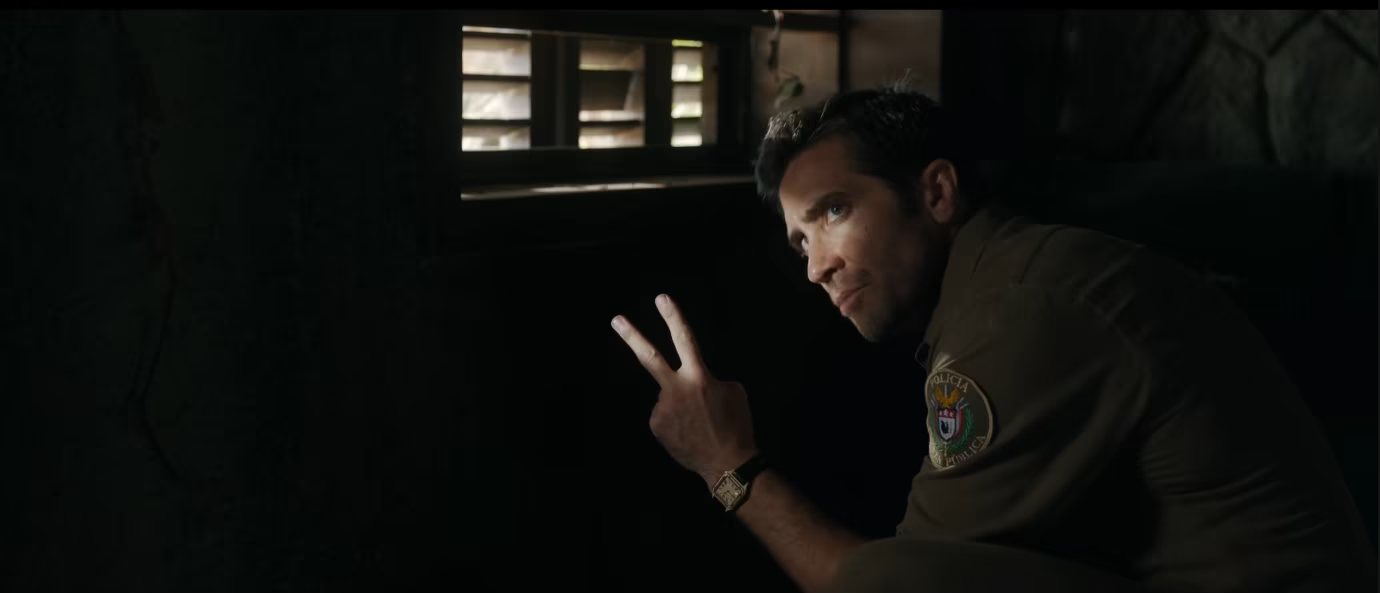
The boys immediately launch a rogue, unsanctioned rescue mission. Disguised as police officers, they infiltrate the island jail, disarm the guards, and free Rachel. What follows is the explosive, high-octane climax that traditional Guy Ritchie action fans were waiting for.
The Extraction and The Sacrifice: Everything immediately goes wrong. The primary North Evac route is compromised; Salazar’s men locate the hangar and destroy the gyrocopters with a drone strike, killing Dunn in the explosion. The team desperately falls back to the West Evac route. Pursued by dozens of heavily armed mercenaries and corrupt police, they trigger the “Banana Pie” trap. The concealed trap door opens, swallowing an entire enemy vehicle whole into the earth.
Trapped at the heavily fortified safehouse, Baker makes the ultimate sacrifice. As Salazar’s men swarm the perimeter, Baker refuses to leave via the escape tunnel. Knowing the enemy will follow them and slaughter the team, he stays behind to manually trigger the network of explosives he wired into the compound. Over the radio, he tells Bronco to “get Mom off the island” before blowing the entire villa to ashes, killing dozens of mercenaries and himself.
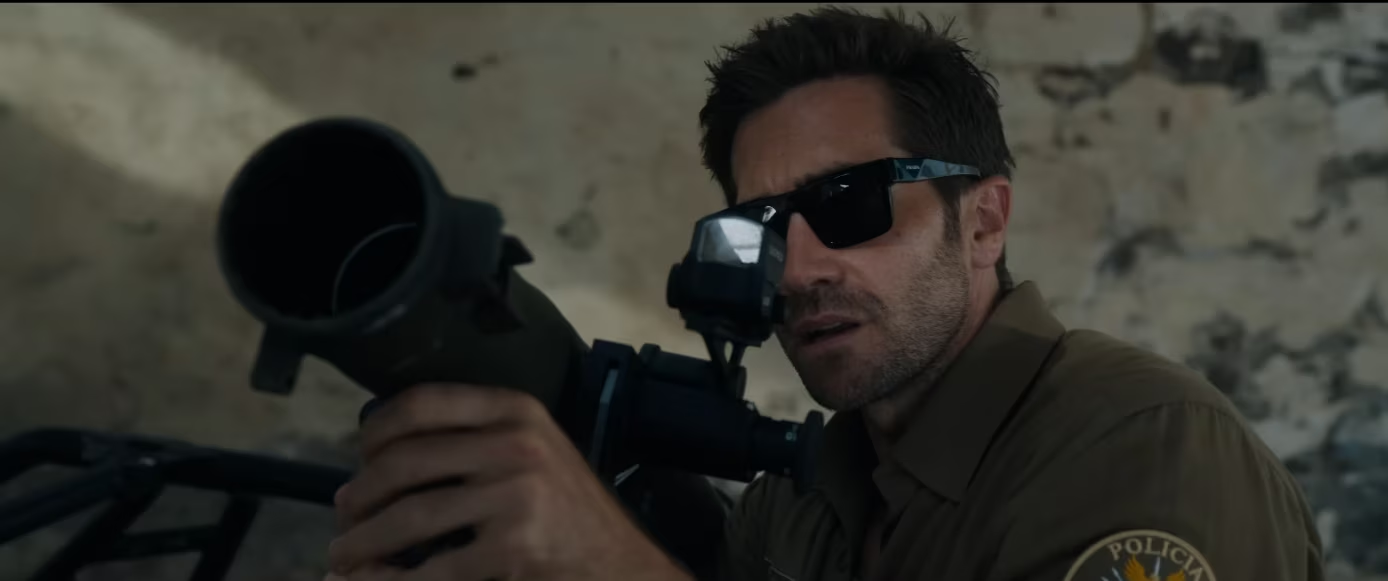
The surviving team members use the zipline to cross the 300-foot ravine. As they race toward the extraction boat in the harbor, Olsen attacks them from a helicopter overhead. In a moment of raw, kinetic vengeance, Bronco and Sid use a pre-staged rocket launcher to completely vaporize Olsen’s helicopter in mid-air. Rachel is safely put on the boat with Gucci and Moreno, but Bronco and Sid refuse to leave the island. They have unfinished business.
The Climax: The Miami Shipping Container
The film’s denouement occurs back in New York City, creating a stark contrast to the tropical violence. Rachel calmly walks into Bobby Sheen’s executive office. Bobby smugly asserts that Salazar has simply “disappeared” and assumes she has won the ultimate game, keeping the billion dollars, the seized assets, and Rachel’s commission.
However, a rapid flashback reveals the true nature of Bronco and Sid’s unfinished business on the island. They did not stay behind to assassinate Salazar; they stayed to abduct him. Disguised as paramedics in the chaos following the explosions, they sedated the billionaire, wheeled him out of his hotel in an ambulance, sealed him inside a metal shipping container, and mailed him directly to the FBI headquarters in Miami with a detailed message explaining exactly who was inside.
Rachel coldly explains the checkmate to Bobby. Salazar is now in federal custody. Facing a lifetime in an undisclosed black site, Salazar has every incentive in the world to testify that Spencer Goldstein knowingly funded a global criminal organization. The protective corporate veil is pierced. Furthermore, because Bobby Sheen was the executive whose signature was on all the contracts, the board of directors will undoubtedly offer her up to the Department of Justice as the sacrificial lamb to save the firm.
Bobby pales as her private emergency phone begins to ring. Rachel walks out of the office without looking back, having successfully recovered her money, destroyed her enemies, and weaponized the corrupt system against its own creators. The film instantly cuts to black, and the credits roll.
PART 3: The Darkest Hidden Secrets & Deep-Dive Theories
The narrative architecture of In the Grey is a dense, highly rewarding puzzle box. By synthesizing background details, character decisions, and throwaway lines of dialogue, several massive theories emerge regarding the true nature of the corporate conspiracy, the tactical misdirections, and the ultimate thematic meaning of the film’s enigmatic conclusion.
Theory 1: The 10% Principle and Corporate Psychopathy
A major question among audiences is: Why did Spencer Goldstein refuse to pay Rachel? A massive corporation managing hundreds of billions of dollars could easily afford a $100 million commission. The dominant theory suggests that Bobby Sheen’s refusal was not merely about saving money; it was a profound ideological assertion of dominance.
Spencer Goldstein operates under the arrogant belief that independent contractors like Rachel are disposable tools. By withholding her pay and keeping Salazar’s assets, Bobby was attempting to prove that the “grey” market ultimately answers to the “white” market (Wall Street). What the ending actually says is thematically coherent: Rachel does not win by beating Salazar in a gunfight. She wins by turning the system against itself. When Spencer Goldstein violated the 10% principle, they transformed a neutral business partner into an existential threat. The film’s final irony is that the most dangerous thing you can do to a woman who operates entirely without rules is try to bind her with corporate bureaucracy.
Theory 2: The Tactical Misdirection (Did Bronco Leak the North Evac?)
A highly discussed theory on analytical film platforms (such as r/Cinema and r/movies) revolves around the catastrophic failure of the island extraction. How did Salazar’s men know exactly where the highly classified gyrocopters were hidden, managing to destroy them with a drone strike just in time?
The theory posits that Rachel and Bronco wanted the North Evac to be compromised. Knowing that Bobby Sheen had likely sold them out or at least abandoned them, Bronco may have intentionally fed false telemetry data to Spencer Goldstein’s servers, which were then inevitably leaked to Salazar’s men. The gyrocopter explosion was a calculated, albeit incredibly risky, decoy to draw the bulk of Salazar’s army north, allowing the team to successfully execute the heavily trapped West Evac route. The emotional kicker—Sid’s genuine panic and Baker’s tragic, unforeseen death—was the collateral damage of keeping the team in the dark so their reactions would read as authentic to the pursuing army.
Theory 3: Wolfgang’s Silent Betrayal
Wolfgang Close, the supposedly brilliant, hyper-paranoid accountant, fell for Sid’s backgammon hustle remarkably easily. A secondary theory suggests Wolfgang, recognizing the profound danger Rachel posed, actually recognized the bugged sculpture for what it was.
Facing mounting pressure from an increasingly unstable Salazar, Wolfgang may have intentionally allowed the Faraday cage breach. By letting Rachel freeze the assets, Wolfgang safely dismantled Salazar’s empire without ever having to cross the billionaire directly, ensuring his own survival and immunity when the FBI eventually unraveled the shell companies. Wolfgang survived the chaos by playing both sides of the grey, sacrificing his boss to save himself.
Theory 4: The Symbolism of the “Banana Pie”
The “Banana Pie”—the concealed trap door dug into the road that swallows pursuing vehicles whole—serves as the central, unifying physical metaphor of the film. Throughout the narrative, Rachel is constantly digging metaphorical banana pies for her enemies.
She allows Horowitz to fall into the legal trap of the impounded steel. She allows Salazar to fall into the trap of the cafe assassination attempt, which triggers the emergency injunction that freezes his companies. Ultimately, she digs a massive federal banana pie for Bobby Sheen, letting the arrogant executive drive her entire career directly into an FBI indictment. The film suggests that true power is not firing the loudest gun; it is convincing your enemy to step on the landmine themselves.

PART 4: The Craft of Ambient Tension and Technical Execution
The immense thematic weight of the narrative is inextricably tied to the film’s masterful technical execution. Operating behind the camera are long-time Guy Ritchie collaborators who understand precisely how to visually and auditorily manifest the profound corporate anxiety of the script.
The Cinematography of Isolation: Ed Wild
Cinematographer Ed Wild utilizes a highly deliberate visual language that heavily relies on stark contrasts and architectural isolation. Unlike the warm, golden hues of Ritchie’s The Gentlemen, Wild shoots the corporate boardrooms of New York in freezing, sterile blues and grays. The lighting in Bobby Sheen’s office is entirely artificial, highlighting the unnatural, sociopathic environment of Wall Street.
Conversely, Salazar’s island is shot with blinding, oppressive sunlight. The heat is palpable, but the framing remains incredibly claustrophobic. Wild frequently uses wide, sweeping shots during the extraction sequences to emphasize how small and outnumbered Rachel’s team truly is against the sprawling, hostile infrastructure of the island. The visual isolation constantly reinforces the theme that the team is entirely alone, abandoned by the law and their employers.
The Auditory Landscape: Christopher Benstead
Composer Christopher Benstead makes highly deliberate, restrained choices regarding the film’s auditory landscape. Instead of utilizing overpowering, kinetic rock tracks that typically accompany Ritchie’s action scenes, Benstead writes a score heavily reliant on ticking percussion, deep synth drones, and unnerving electronic string arrangements.
This ambient approach generates a continuous, suffocating sense of unease. The music massages the tension during the relentless legal montages—making a scene about freezing a chemical manufacturing plant feel as dangerous as defusing a live bomb. When the violence finally erupts on the island during the jailbreak, the score drops out almost entirely, replacing musical heroism with the terrifying, deafening reality of suppressed gunfire and collapsing concrete.
The Precision Editing: Martin Walsh and Jim Weedon
The film’s incredibly tight 97-minute runtime is a testament to the brutal efficiency of editors Martin Walsh and Jim Weedon. Ritchie is infamous for occasionally suffering from pacing issues in his more sprawling narratives, but this film moves with the relentless, mechanical momentum of a ticking clock.
The editors expertly intercut between the physical sabotage (the oil rig shutdown, the steel port bribery) and the legal fallout (Horowitz screaming into phones), creating a rhythmic montage that perfectly illustrates Rachel’s two-track strategy. Furthermore, the editing during the climactic island siege prioritizes spatial geography over chaotic shaky-cam. The audience always knows exactly where Sid, Bronco, and Rachel are in relation to the enemy, making Baker’s final sacrifice land with devastating emotional clarity and spatial logic.
In The Grey FAQ: Answering the Internet’s Biggest Questions
To ensure this ultimate In the Grey ending explained is exhaustively complete, here are the direct, definitive answers to the web’s most pressing questions regarding the film’s intricate lore and production.
Why did Spencer Goldstein refuse to pay Rachel her commission? Bobby Sheen and the Spencer Goldstein firm suffered from extreme, blinding corporate arrogance. Once Rachel successfully forced Salazar to agree to the billion-dollar repayment, Bobby believed Rachel’s leverage was entirely gone. Wall Street firms fundamentally despise paying massive 10% commissions to independent contractors. Bobby assumed Rachel, lacking the backing of a state military or a massive corporate legal team, would simply have to accept the loss. She severely underestimated Rachel’s capacity for catastrophic, systemic vengeance.
What is the significance of the Chiang Mai prison backstory? Early in the film, Rachel explains the unshakeable, fanatical loyalty of Bronco and Sid by casually mentioning that, 100 jobs ago, she broke them both out of a brutal prison in Chiang Mai, Thailand. The film intentionally never elaborates on the specifics of this event, leaving it entirely to the audience’s imagination. This deliberate ambiguity serves to establish that Rachel is not merely a lawyer in a suit; she has a long, highly illegal history of executing impossible extractions, explaining exactly why two apex military operators defer to her orders unquestioningly.
Does the ending leave room for an In the Grey sequel? While the film ends on a definitive, deeply satisfying note—with Bobby Sheen answering the ringing phone that will undoubtedly end her career—the universe is primed for expansion. Rachel, Bronco, and Sid survive the ordeal and are now presumably in possession of their $100 million commission. With Spencer Goldstein exposed to the FBI and Salazar in federal custody, the team has essentially declared war on the entire white-collar criminal establishment. However, as of mid-2026, Black Bear Pictures has not officially greenlit a sequel, leaving the characters’ futures open.
Is Manny Salazar based on a real person? Manny Salazar is an amalgamation of several modern geopolitical realities. He represents the growing class of untouchable billionaires who purchase sovereign immunity by buying islands, paying off local police forces, and utilizing endless shell companies to obscure their criminal enterprises. His ability to borrow a billion dollars from a supposedly legitimate Wall Street firm directly reflects real-world anxieties regarding how deeply organized crime is embedded in global capital markets.
Why was the movie’s theatrical release date confusing? In the Grey experienced a slightly staggered release schedule that confused some fans. While initially slated for April 10, 2026, in certain theatrical markets , the primary North American wide release and digital streaming push officially occurred on May 15, 2026. This strategy allowed the film to build critical word-of-mouth regarding its unique blend of legal thriller and tactical action before hitting the wider summer blockbuster audience.
Is there a post-credits scene? No. As confirmed by multiple viewers and critics, there is no post-credits scene. When Rachel walks out of the office and the screen cuts to black, the narrative is completely finished. As one review noted, “You’re done.”.
A Final Thought on the Masterpiece
The absolute brilliance of this cinematic achievement lies in its unyielding commitment to exploring the violence of bureaucracy. By substituting physical bank vaults with proxy shell corporations, and replacing traditional shootout mechanics with international legal injunctions, Guy Ritchie has successfully evolved the heist genre for the 21st century.
The characters do not simply conquer the billionaire with rocket launchers—though they certainly use them when necessary—they survive the agonizing, crushing burden of the corporate double-cross. The true terror of In the Grey is the realization that the men and women sitting in sterile glass offices in New York are vastly more ruthless, unaccountable, and dangerous than the heavily armed mercenaries patrolling the jungles.
As the screen finally fades to black on the shrill ringing of Bobby Sheen’s emergency phone, the audience is left to grapple with the beautiful, terrifying reality that no one truly escapes the grey. The corporate system is rigged, the house always wins, but if you are smart enough, fast enough, and cold enough, you can still force the house to pay its debts.
read also : Disclosure Day Ending Explained: The Definitive Breakdown of Spielberg’s 2026 Sci-Fi Masterpiece