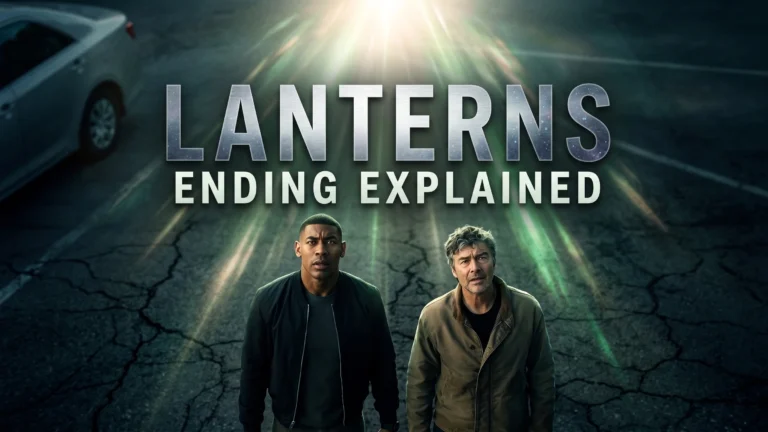
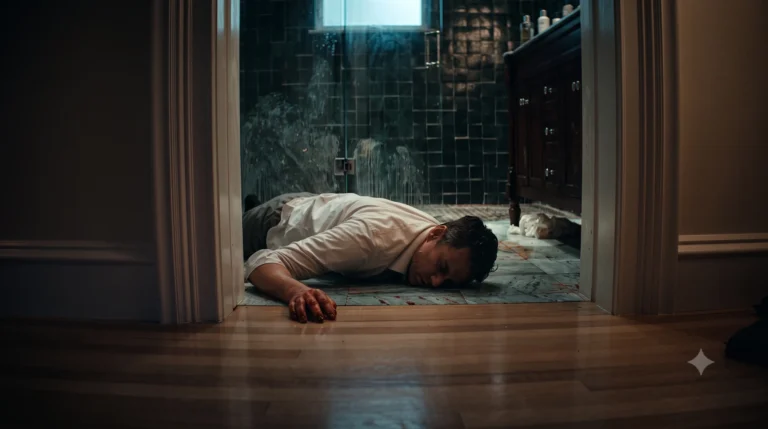
The psychological trap of modern television has found its masterpiece. The fourth season of FROM represents a structural and thematic maturation; the narrative pace deliberately decelerates, swapping visceral jump scares for an insidious, slow-burning psychological trauma.
The season is defined by the infiltration of a shapeshifting entity known as the Man in Yellow. This ancient force enters the town disguised as Sophia (Julia Doyle), presenting herself as a vulnerable, sheltered pastor’s daughter. The plot is immediately catalyzed by a devastating loss: the brutal murder of Jim Matthews by the Man in Yellow. This death, witnessed by his daughter Julie through a temporal displacement ability known as “storywalking,” shatters the Matthews family.
Tabitha, having navigated her way back from the outside world alongside Henry Kavanaugh (Victor’s long-lost father), is forced into a reluctant leadership role. Her grief is compounded by the horrifying revelation that she and Jade are the literal reincarnations of Miranda and Christopher—two historical figures who previously attempted, and catastrophically failed, to save the town’s children centuries prior.
Simultaneously, the season tracks the horrific aftermath of Fatima’s pregnancy. Instead of bearing a human child, she gives birth to a reborn version of “Smiley,” the monster Boyd thought he had destroyed. Fatima’s subsequent physical deterioration introduces the “Golem” mythology to the series, blurring the absolute lines between human survivor and supernatural predator.
Critically, Season 4 operates as a masterclass in tension-building. The narrative shifts its focus from the physical monsters in the dark to the terrifying fragility of human faith, sanity, and interpersonal trust. It intricately threads multiple complex subplots—Jade’s hallucinatory investigations, Julie’s dangerous timeline manipulations, and Boyd’s rapid cognitive decline—toward a convergence point that demands a heavy, tragic sacrifice.
Streaming Platforms, Episode Index, and Release Chronology
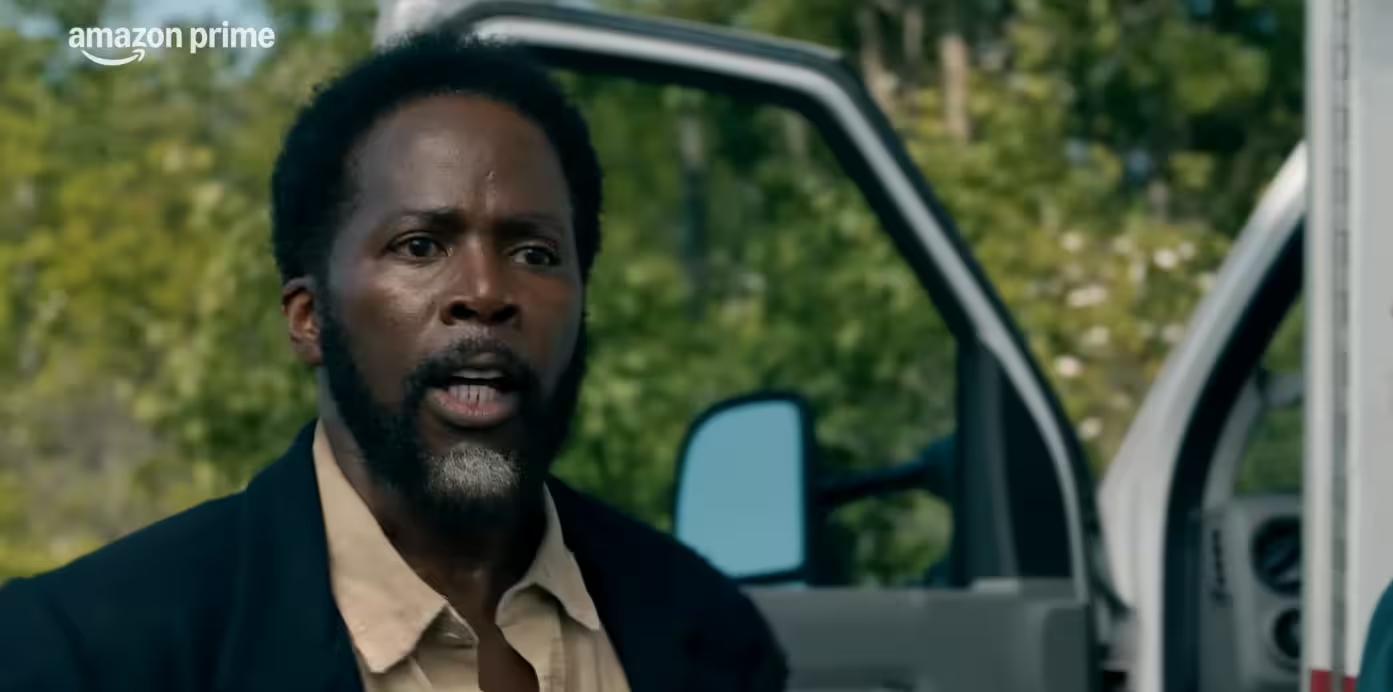
The fourth season of FROM is exclusively distributed via MGM+ (accessible through standalone subscriptions and Prime Video channels). The season consists of ten episodes, maintaining a weekly Sunday broadcast schedule.
| Episode Number | Episode Title | Release Date | Broadcast Network |
| Season 4, Episode 1 | “The Arrival” | April 19, 2026 | MGM+ |
| Season 4, Episode 2 | “Fray” | April 26, 2026 | MGM+ |
| Season 4, Episode 3 | “Merrily We Go” | May 3, 2026 | MGM+ |
| Season 4, Episode 4 | “Of Myths and Monsters” | May 10, 2026 | MGM+ |
| Season 4, Episode 5 | “What a Long Strange Trip It’s Been” | May 17, 2026 | MGM+ |
| Season 4, Episode 6 | “The Heart Is a Lonely Hunter” | May 31, 2026 | MGM+ |
| Season 4, Episode 7 | “Best Laid Plans” | June 7, 2026 | MGM+ |
| Season 4, Episode 8 | “Heavy Is the Head” | June 14, 2026 | MGM+ |
| Season 4, Episode 9 | “The Calm Before” | June 21, 2026 | MGM+ |
| Season 4, Episode 10 | “If a Tree Falls in the Forest” | June 28, 2026 | MGM+ |
It is important to note that the broadcast schedule included a programmed one-week hiatus between Episodes 5 and 6, accommodating the Memorial Day holiday weekend in the United States. This scheduling decision caused significant uproar among the global fanbase, who felt the disruption stifled the narrative momentum built during the season’s first half.
Exhaustive Analytical Breakdown: Episodes 1-4
To approach the narrative with the academic and cinematic rigor expected by fans of the series, a granular, scene-by-scene deconstruction is mandatory. The architecture of Season 4 relies heavily on subtle visual cues, esoteric historical parallels, and deep psychological manipulation.
Episode 1: “The Arrival”
The season commences by subverting the audience’s understanding of temporal linearity. A future iteration of Julie Matthews utilizes the “storywalking” mechanic to project herself backward in time to witness the brutal murder of her father, Jim, at the hands of the Man in Yellow. The entity explicitly asks Julie “when did you come from” rather than “where,” establishing his omniscient awareness of the time loop. Julie’s inability to physically intervene confirms the deterministic nature of this dimension; the past is written in stone.
Simultaneously, Sophia and an unnamed pastor arrive via a car crash—a meticulously orchestrated event by the entity to integrate his new disguise into the community. In the subterranean tunnels, Boyd and Kenny make a horrifying discovery: Fatima’s childbirth resurrected the Smiley creature. This plunges Boyd into profound nihilism, preparing for a mass suicide should the situation become entirely hopeless. Furthermore, newcomer police officer Dani Acosta struggles with the town’s moral decay, witnessing Elgen’s brutal torture at the hands of Sarah. As Acosta washes the blood from her uniform, the diner’s supernatural jukebox taunts her by playing “Send in the Clowns,” signaling the entity’s amusement.
Episode 2: “Fray”
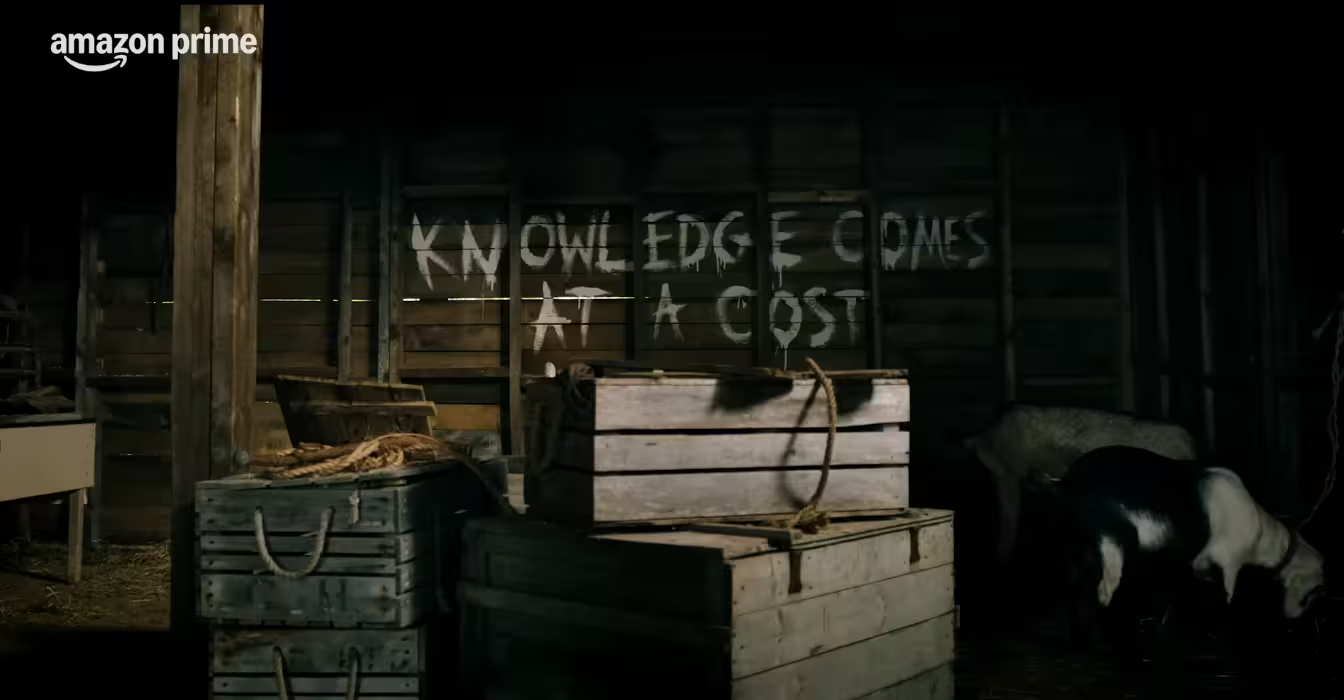
The psychological warfare escalates when Jim’s mutilated body is discovered strung up inside the barn. The Man in Yellow deliberately stages the corpse for Julie and Ethan to find, calculating the exact emotional trauma required to feed the town’s parasitic atmosphere. Above the body, a chilling message is inscribed: “Knowledge comes at a cost,” a direct warning against Jade and Tabitha’s investigative efforts.
This episode formally confirms that Sophia is the Man in Yellow. She awakens the pastor from his coma through physical touch, only for him to perish once his narrative purpose—establishing her innocent alibi—is fulfilled. Meanwhile, Acosta commandeers the ambulance in a desperate escape attempt, forcing Kenny to violently halt her with spike strips. Inside the Matthews home, violent supernatural phenomena manifest—cabinets slamming and books hurling—suggesting the town itself is reacting aggressively to the shifting timeline.
Episode 3: “Merrily We Go”
Episode 3 delves deeply into the esoteric mythological artifacts that govern the town. In a macabre sequence, Sophia physically extracts one of the deceased pastor’s teeth. This links back to previous physical anomalies, such as Fatima losing her teeth, indicating that physical tokens hold dark ritualistic power for the entity.
Jade, desperate to unlock memories of his historical predecessor “Christopher,” consumes hallucinogenic mushrooms in the forest. Concurrently, Julie successfully initiates a controlled storywalk to the Season 2 RV siege, proving the temporal mechanic is viable but highly volatile. The episode concludes with a profound psychological strike: Ethan hears his deceased father’s voice transmitting through the radio, instructing him to find the “Lake of Tears.” This is either a cruel manipulation by the Man in Yellow to lure the boy into a watery grave, or a genuine supernatural intervention.
Episode 4: “Of Myths and Monsters”
The investigation yields undeniable evidence when Victor uncovers the Man in Yellow’s buried suit hidden near the forest ruins, confirming the entity’s capacity for shapeshifting. Sophia maneuvers herself into becoming roommates with Sarah. Utilizing a terrifying “whisper ritual,” Sophia violently invades Sarah’s telepathic mind. To prove her absolute power, Sophia intentionally throws herself into the empty motel pool, shattering her own arm, thereby trapping Sarah in an inescapable psychological hostage situation.
Julie attempts to alter the past by leaving a physical folded paper “bookmark” during a storywalk to the era of the town massacre. The bookmark fails to alter her present reality, reinforcing the immutable nature of the timeline. Concurrently, Fatima begins constructing a massive mud Golem at the settlement, utilizing her terrifying new psychic tether to the resurrected Smiley creature to manifest a protector against the encroaching darkness.
Exhaustive Analytical Breakdown: Episodes 5-9
As the season progresses toward its climax, the boundary between physical reality and supernatural illusion completely disintegrates.
Episode 5: “What a Long Strange Trip It’s Been”
A significant geographical expansion occurs when Roger, Tabitha, and Donna discover a mysterious, thick rope submerged in “Nightmare Lake.” Hoisting it reveals terrifying, giant scarecrow dolls covered in seaweed. These entities do not adhere to standard monster rules; they are impervious to the protective stone talismans and operate freely during the daytime, but can be repelled by specific wooden totems.
Driven by desperation, Jade’s hallucinogenic mushroom trip triggers a severe, visually arresting psychic journey. Layered with esoteric symbolism—swarms of spiders, celestial markers indicating the safe word “Capricorn,” and a spectral encounter with his historical predecessor offering blood from a human skull—the hallucination strips away the town’s physical illusion. It reveals a massive, ancient underground sacrificial chamber located directly beneath Colony House, filled with the skeletal remains of the original seven sacrificed children (the Ankoui kids). Jade awakens with the absolute conviction that physically retrieving these bones is the key to breaking the cycle.
Episode 6: “The Heart Is a Lonely Hunter”
The fallout from the scarecrow attacks is severe. Donna suffers a massive myocardial infarction, induced by either extreme physiological stress or direct supernatural interference. Boyd utilizes a mysterious defibrillator manufactured by a company named “Maboose.” This connects thematically to the fictional cinema character Dr. Mabuse—a criminal mastermind known for disguises and body transference—directly mirroring the abilities of the Man in Yellow. Boyd resuscitates Donna against all odds, demonstrating that residents possess the agency to manifest life in direct opposition to the town’s parasitic nature.
Jade successfully convinces Boyd of his hallucinatory findings. Taking a heavy sledgehammer to the basement wall of Colony House, Boyd breaks through the masonry to reveal a physical doorway leading down into the ancient tunnel system, objectively validating Jade’s psychic journey.
Episode 7: “Best Laid Plans”
The community fundamentally fractures during a pivotal town hall meeting. Boyd discloses the reincarnation theory, revealing Tabitha and Jade hold the psychic imprints of Miranda and Christopher. Henry Kavanaugh vehemently rejects this, unwilling to accept that Tabitha carries the soul of his dead wife, while Sophia silently observes this division with calculated glee.
Boyd attempts an offensive action to trap a nocturnal monster using the settlement totems. However, Sophia telepathically alerts the creatures, resulting in a tactical blockade that traps Kenny. In absolute desperation, Fatima utilizes her psychic connection to Smiley via her mud Golem, forcing the monster to revert to its human guise long enough for Kenny to escape. The episode concludes in utter chaos as Sophia uses a fertilized chicken egg in a blood-magic ritual to resurrect the deceased resident Roger.
Episode 8: “Heavy Is the Head”
Roger’s reanimated, unstoppable corpse massacres several background residents before Elgin destroys it by driving a totem through its chest. The town’s collective morale is obliterated. Sophia escalates her manipulation of Henry, secretly spiking his alcohol with droplets of her own blood. This induces a hyper-realistic hallucination where Henry believes he is in a hospital coma in the real world, and a “doctor” instructs him that he must murder his “anchor” (Victor) to wake up permanently.
In the physical world, Tabitha encounters the Man in Yellow in his true form. Rather than executing her, he reveals a devastating truth: her survival is integral to his grand design. Her relentless hope and elaborate schemes generate the specific frequency of disappointment that the town feeds upon. Following this, Jade deduces that the magical bottle tree grows directly above the bone chamber, formulating a highly lethal tactical extraction plan.
Episode 9: “The Calm Before”
Operating as the penultimate pressure cooker, Episode 9 sets the pieces for a catastrophic finale. Sophia informs Clara that the impending tunnel heist will fail unless specifically Jade and Tabitha execute it, as they represent the embodiment of the original parents.
The daring plan initiates. Boyd’s surface team attempts to uproot the teleporting bottle tree, while Jade and Tabitha breach the dark tunnels. Inside Colony House, Sophia deliberately sabotages the rope ladder necessary for their extraction. Simultaneously, Fatima’s physiological state collapses completely; her heart rate plummets to 19 beats per minute, and necrotic spider veins consume her torso. Her Golem metamorphosis is complete. The episode cuts to black as the monstrous horde converges on Jade and Tabitha’s isolated position in the dark.
Episode 10:
I’ve got to be real with you all, this is going to be a tough conversation. I genuinely thought we were heading into one of the most explosive season finales in television history, but… well, honestly, it felt like they hit the brakes right before the finish line because they just got the green light for Season 5. Let’s just rip the band-aid off and talk about Season 4, Episode 10 of From.
Right out of the gate, we are back at the cavern. Jade and Tabitha are hurriedly packing up the bones of the Ankouey kids, while the monsters are literally standing right outside behind a tarp. It is insanely tense. The cowboy monster even taunts Tabitha, saying, “You really shouldn’t be doing that”. Above ground, Boyd is pacing around the bottle tree, waiting for the signal to pull it up. And then, Jade drops an absolute bombshell.
He lied.
He looks Tabitha dead in the eyes and admits that the bones won’t protect the chamber once the tree is pulled. There is zero protection. Why would he lie? Because he knew Boyd would have shut the whole mission down if he knew the actual risks. I actually love this for Jade’s character arc. He is making the ultimate sacrifice play, offering to stay behind and slow the monsters down so Tabitha can escape with the bones. It is a massive leap from the arrogant, egotistical jerk we met back in Season 1. He even hits her with this deeply emotional line: “Spent all those lifetimes with anyone. I’m glad it was you”. It totally pays off the reincarnation reveal from episode 5.
So, Boyd gives the signal, the truck yanks the bottle tree out by its roots, and all hell breaks loose. The second the tree is out, the monsters rush in, but here is the twist—sunlight pours into the cavern, and the monsters violently back away. It doesn’t burn them to ash like Twilight vampires, but they absolutely hate it. It proves they are restricted by the sun just like they are by the talismans. Tabitha tries to climb the rope ladder to escape, but thanks to Sophia’s sabotage from the previous episode, the rope completely gives out. She falls back down.
And then, the town reacts. The sky instantly flips from day to pitch-black night. Just like that. It’s like a cosmic switch was flipped because the balance of the town was destroyed. With the sun gone, the monsters are free to attack Jade and Tabitha. But before they can rip them apart, a massive earthquake violently shakes the entire town, causing rocks to collapse in the cavern. It traps Jade and Tabitha, but it also blocks the monsters from getting to them. It almost feels like the town itself—or whatever conscious entity controls it—is protecting them, or at least giving them preferential treatment.
While this underground chaos is happening, the crew above ground scrambles to the vehicles. And this brings me to Patty. Two-Faced Patty.
I cannot stand her. I mean it. She is having a full-blown panic attack, completely frozen in fear while monsters are rapidly closing in. Boyd literally has to drag her into the van. And what does she do once she’s safely inside? She steals Boyd’s gun and tries to unalive herself, blindly blowing out the freaking window in the process! She is a massive liability. If I were Boyd, I would have thrown her right out of the moving van. You don’t grab a loaded gun in the middle of a monster chase just because you’re scared. Acosta was 100% right when she looked at Boyd and told him he better shut Patty the hell up.
Let’s talk about the absolute bloodbath at the clinic. RIP to Marielle.
I was completely crushed by this scene. The earthquake violently knocks the protective talisman off the wall, and Smiley just casually strolls right through the doors. Marielle actually tries to fight him off with a tiny knife… actually, no, we all knew that little knife wasn’t going to do a single damn thing, but she still went out like a G trying to defend Fatima. Smiley just ruthlessly slashes her midsection wide open with his claws. When Kristi eventually finds her, Marielle uses her final breath to ask for one last kiss goodbye before dying right there in her arms. It was completely gut-wrenching. Chloe’s acting as Kristi, just breaking down and sobbing loud enough for everyone outside to hear, was phenomenal. You could physically feel her soul shattering.
But the real shocker here? Fatima.
When Smiley attacks, Fatima lets out a scream that sounds exactly like a monster’s shriek. And it works. Smiley stops dead in his tracks, morphs back into his human form, says “Interesting,” and just walks away. He completely ignores Ellis and Kristi coming from the opposite direction and just leaves. It is confirmed: Fatima has turned into a monster. The man in yellow’s blood magic from that spiked drink finally completed its dark work. Later in the episode, when Boyd and Ellis miraculously find Jade and Tabitha trapped in the collapsed tunnels, the monsters corner them. Fatima looks at her husband and says, “Remember who I was,” before fully transforming into a terrifying monster to hold off the horde and buy them time to escape.
It is intensely tragic. She used to be the brightest light of hope in this dark town, and now she is one of them. But here is my wild theory: I don’t think she is just a regular monster. I think Fatima is their new leader, because she literally commanded Smiley to leave and he actually obeyed.
And then there is Henry. Man, Henry is absolute trash.
I cannot defend this guy at all. Under the influence of Sophia’s blood-spiked hallucinations, Henry becomes completely obsessed with the idea that he is in a dream and needs to kill his “anchor” to wake up. And who is the anchor? His own grieving son, Victor. Henry finds a tin can of bullets in Victor’s room, and instead of questioning his own insanity, he treats it as a divine sign because of his severe confirmation bias. He takes a gun, tracks Victor down to the sheriff’s station, and points it directly at him. Victor is literally begging for his life, crying that Henry promised to protect him. Henry is a split second away from pulling the trigger when little Ethan accidentally walks into the room.
My heart completely stopped. I swore Ethan was going to catch a stray bullet right there. Thankfully, the distraction gives Victor the split second he needs to tackle his dad and knock the gun away. How is Victor ever going to trust anyone again after his own father tried to put a bullet in his head?
Back at the diner, Sophia offers Elgin a bargain to supposedly go home. He refuses, closes his remaining eye, and just starts praying to Jesus. Sophia gets annoyed, aggressively grabs his hands, and violently crushes him until blood pours out of his eyes and mouth. He is dead. Honestly, this death did absolutely nothing for me. It felt completely anticlimactic, though I have to put some respect on Elgin’s faith for going out praying instead of making a deal with a literal demon. As soon as the sun comes back up, Sophia looks at Clara and coldly orders her to get rid of the body.
Then, Sophia and Clara go on an absolute stealing spree. They litterally walk around town—because apparently no one bothers to lock their doors in a town filled with flesh-eating monsters—and steal every single protective talisman. Sophia is officially the ultimate agent of chaos, acting as the major roadblock to any progress the town tries to make.
Meanwhile, terrifying red lightning bolts shoot up into the sky exactly where the bottle tree used to be. When the vans return to Colony House without Jade and Tabitha, Ethan completely breaks down. He is terrified that everyone is going to die and he is going to end up entirely alone, just like Victor. Julie promises him they will figure it out together, but right on cue, the kitchen cabinets start violently opening and slamming shut on their own. Full paranormal activity. Is it Ghost Jim? Is it Julie’s storywalking powers bleeding over? The show completely ignores it and moves on.
At least Boyd finally swallows his massive pride. After watching the sky flip and earthquakes rip the town apart, Boyd admits out loud: “Victor was right. We never should have pulled that tree.” Yeah, no kidding, Boyd. Victor was literally screaming from his jail cell that this exact disaster was going to happen. You should probably start putting the guy who has survived this place for 40 years at the front of your task force.
But here is the scene that is really leaving a bad taste in my mouth. The final moments of the entire season.
Sophia walks into the woods carrying a bag full of the stolen talismans, and the Boy in White just casually appears next to her. She notes that he is “all grown up” now. He warns her that because Tabitha and Jade secured the bones, she is going to lose this time. Sophia just smirks, says she admires his optimism, and mercilessly dumps every single talisman down a faraway tree. The Boy in White looks genuinely terrified and walks away as the screen cuts to black.
I am sorry, but From is officially not beating the Lost allegations. This entire setup just confirmed… actually, wait, it didn’t just confirm it, it practically screamed in our faces that the town is nothing but a cosmic chessboard for a game between Good (Boy in White) and Evil (Sophia/Man in Yellow). It is a direct copy of Jacob and the Man in Black. If Season 5 doesn’t create some massive separation from the Lost formula, how are they ever going to prove they didn’t just cheat off someone else’s test?
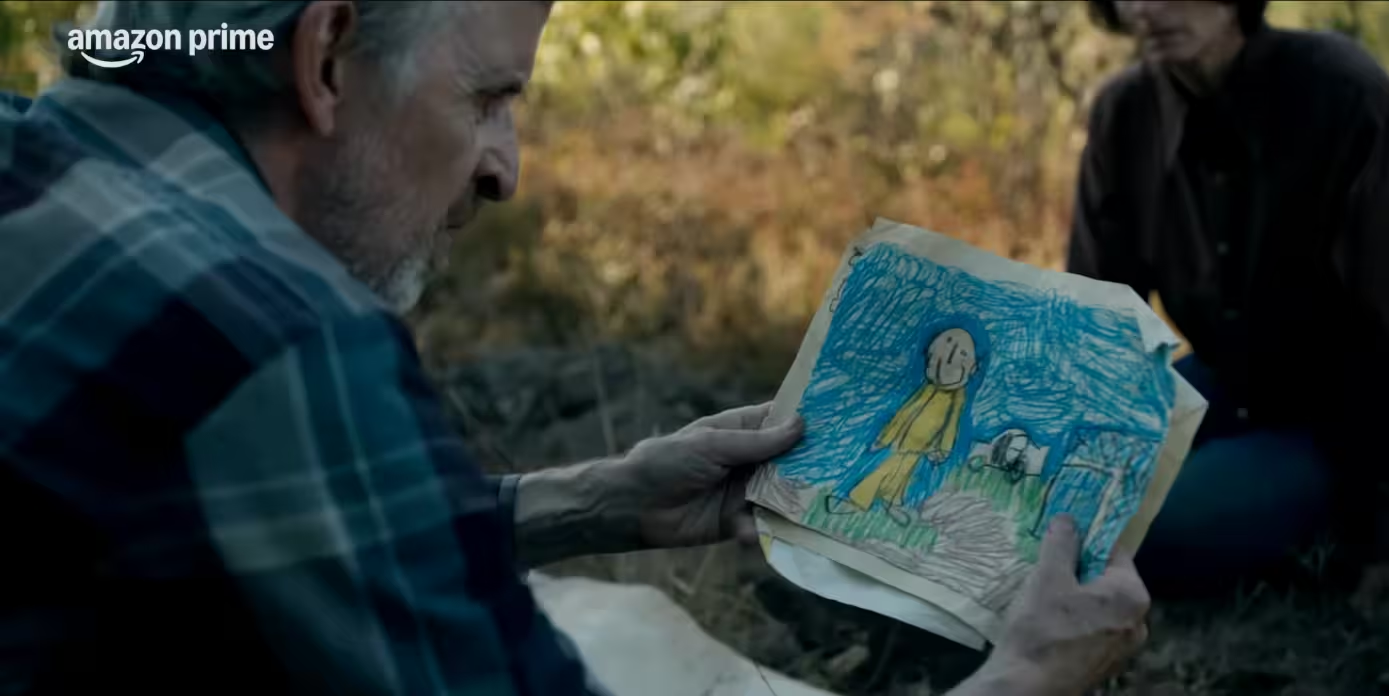
Comprehensive Audience Q&A: Unlocking the Mechanics of Season 4
To fully execute a definitive FROM Season 4 ending explained analysis, it is necessary to synthesize and answer the most complex, burning inquiries regarding the season’s mythological mechanics, categorized chronologically.
Inquiries for Episodes 1–3: The Rules of Reality
Q: Is Jim Matthews definitively dead, or is this another trick by the town?
A: Yes, the physical death of Jim Matthews is confirmed. From a narrative architecture standpoint, Jim functioned as the primary skeptic and the anchor of logic. Removing him destabilizes the Matthews family, forces Tabitha to embrace the supernatural reality of her reincarnation, and acts as the inciting trauma for Julie to master the storywalking mechanic.
Q: How exactly does “Storywalking” function, and can characters alter the past?
A: Storywalking is depicted as a form of temporal astral projection. However, the cosmological rules of the series strictly adhere to a closed-loop, deterministic timeline. As explicitly stated by the characters, “once a story has been written, it cannot be changed.” Julie cannot physically prevent her father’s death; she can only witness the event as it unfolded.
Q: What is the significance of the “Lake of Tears” mentioned by Jim’s voice on the radio?
A: The Lake of Tears originates from Ethan’s children’s book, The Cromenocle. Thematic evidence strongly suggests the book is actually a prophetic survival guide. The Lake is believed to possess restorative magical properties and is theorized to be the final destination where the Ankoui children’s bones must be taken to break the curse.
Inquiries for Episodes 4–6: Myths and Machinations
Q: Why did the protective wooden totems work against the Scarecrows but completely fail against the town monsters?
A: The FROM universe operates on highly specific mythological rules where every nightmare manifestation has a unique weakness. The wooden totems are the specific countermeasure to the daytime Scarecrow entities. The nocturnal town monsters operate on a different mythological frequency and are immune to these totems; their only known weakness remains the necrotic blood transferred from the chained man, Martin.
Q: How does Sophia’s telepathy with Sarah operate, and why target her?
A: Sarah possesses a unique neurological sensitivity to the frequencies of the town’s entities. Sophia exploits this by conducting a dark “whisper ritual.” By forcing compliance through horrific physical self-mutilation (shattering her own arm in the pool), the entity establishes a dominance hierarchy, utilizing Sarah as an unwilling pawn.
Q: What is the significance of the “Maboose” defibrillator?
A: The defibrillator used to save Donna is a profound cinematic Easter egg pointing to the fictional German cinema character Dr. Mabuse. Mabuse was a criminal mastermind known for his mastery of disguise, telepathic hypnosis, and body transference—traits that flawlessly mirror the exact abilities of the Man in Yellow.
Inquiries for Episodes 7–9: The Final Descent
Q: What exactly is happening to Fatima’s biology, and what is the Golem?
A: Fatima’s monstrous pregnancy resulted in a permanent physiological tether to the town’s dark forces. By Episode 9, her resting heart rate drops to an impossible 19 beats per minute. The mythological motifs point heavily toward the folklore of the Golem of Prague. She is literally turning into a creature of stone or earth—a protector entity whose immense power threatens to become uncontrollable.
Q: Why did the Man in Yellow deliberately spare Tabitha at the RV?
A: The entity feeds on the specific emotional resonance of dashed hope. By keeping Tabitha alive, the entity ensures she will continue to construct elaborate, desperate plans to save the children. The inevitable, crushing failure of these plans generates the exact frequency of suffering required to sustain the dimension.
Q: Will Henry Kavanaugh actually murder his son, Victor?
A: Henry has been subjected to severe psychological poisoning via the ingestion of Sophia’s blood. The entity has convinced him that his current reality is a coma-induced hallucination, and Victor is the subconscious “anchor” keeping him trapped. This tragic delusion sets up a heartbreaking climax for the finale where a father attempts to kill his son to “wake up.”
Inquiries for Episode 10:
Q: Why did Jade deliberately lie to Tabitha about the bones protecting the cavern?
A: He lied because he knew Boyd would completely cancel the mission if he found out the truth. Jade fully realized that pulling the tree would leave them completely defenseless. He made a noble sacrifice play… actually, it was a straight-up suicide mission. He planned to stay behind and physically hold off the monsters so Tabitha could escape with the bones, proving he is the only character actively pushing the story forward.
Q: What exactly happens the second the bottle tree is uprooted?
A: Absolute cosmic retaliation. First, sunlight pours into the cave, proving the monsters are physically repelled by daylight just like they are by the talismans. Then, the town strikes back. Day instantly flips to pitch-black night, a massive earthquake violently shakes the ground, and red lightning shoots into the sky. The delicate balance of the entire town is completely destroyed.
Q: How do Jade and Tabitha survive the cavern after the sun disappears?
A: Pure, unbelievable luck. As the monsters corner them in a dead-end crevice, a perfectly timed earthquake causes a massive cave-in. The falling rocks completely block the monsters’ path, trapping our heroes but saving their lives. It feels like the town itself is actively showing them preferential treatment.
Q: What exactly went down during the absolute bloodbath at the clinic?
A: The earthquake violently knocks the protective talisman off the wall, and Smiley casually breaks the door open. Marielle idiotically tries to fight him off with a tiny drawer knife, and Smiley just ruthlessly slashes her stomach wide open. It is absolutely gut-wrenching, especially when she bleeds out in Kristi’s arms after asking for one last kiss goodbye. But here is the crazy part: Fatima lets out a terrifying shriek that sounds exactly like a monster. Smiley stops dead in his tracks, morphs back to his human face, says “Interesting,” and just casually walks away, completely ignoring Kristi and Ellis on his way out.
Q: Wait, so Fatima is officially a full-blown monster now?
A: Oh, 100%. The dark magic from her spiked drink worked. Later in the collapsed tunnels, when the creepy horde corners Boyd, Ellis, Jade, and Tabitha, Fatima decides to stay behind. She literally looks at Ellis and says, “Remember who I was,” before fully transforming into a monster right in front of them. She saved them… actually, wait, I don’t even know if she physically fought the horde or just telepathically commanded them to stop, but she bought the group enough time to escape. I genuinely believe she isn’t just a basic foot soldier; she might be their new leader since Smiley directly obeyed her earlier.
Q: How could Henry actually try to murder his own son, Victor?
A: Because the man is absolute trash! Under the influence of the man in yellow’s blood magic, Henry suffers from sick hallucinations convincing him he’s trapped in a dream and needs to eliminate his “anchor” to wake up. When he finds a tin can of bullets in Victor’s room, his confirmation bias kicks into overdrive, and he treats it as a divine sign to kill his boy. He tracks Victor down, points a stolen revolver right at his face, and completely ignores Victor crying and begging for his life. If little Ethan hadn’t randomly walked into the room and distracted him, Henry would have pulled the trigger. Victor had to physically tackle his own dad to survive.
Q: What happened between Elgin and Sophia at the diner?
A: Elgin was incredibly naive, but he went out like a boss. Sophia offered him a demonic bargain: help her with her sick game, and she would supposedly let him go home. Elgin completely rejected the deal, closed his remaining eye, and just started praying. Sophia got visibly annoyed, aggressively grabbed his hands, and violently crushed him until blood rushed out of his eyes and mouth. He died instantly. Honestly, his death felt wildly anticlimactic for someone who knew so much about the town’s mysteries, but as soon as he dropped dead, Sophia coldly ordered Clara to dispose of his body.
Q: What was Sophia’s master plan after killing Elgin?
A: Absolute, unadulterated chaos. She and Clara went on a massive stealing spree. Because no one in this terrifying town apparently bothers to lock their doors, the two of them easily walked into the diner, the sheriff’s station, and random houses, stealing every single protective talisman. Sophia is the ultimate roadblock to the town’s survival. By removing all the talismans exactly when the day-night cycle is broken, she has practically guaranteed an all-out massacre for Season 5.
Q: What is the significance of the final scene between Sophia and the Boy in White?
A: It confirmed everyone’s absolute worst fear: From is officially not beating the Lost allegations. In the final moments, the Boy in White appears next to Sophia in the woods. She notes that he is “all grown up” now. He warns her that because the humans secured the bones, she is going to lose this time. Sophia just smirks, says she admires his optimism, and mercilessly dumps every single stolen talisman down a faraway tree, leaving the town completely defenseless.
Q: Does this scene prove the town is just a game?
A: Yes, it strongly implies that the entire town is just a cosmic chessboard. Sophia (the Man in Yellow) represents Evil, and the Boy in White represents Good, exactly like the Man in Black and Jacob from Lost. They aren’t trying to physically kill each other; they are just manipulating the human “chess pieces” in an endless, cyclical game.
Ensemble Cast and Character Architecture
The intricate narrative of Season 4 is anchored by a vast ensemble cast, incorporating veteran characters and disruptive newcomers whose actions drive the plot toward the inevitable climax.
| Actor Name | Character Name | Narrative Function in Season 4 |
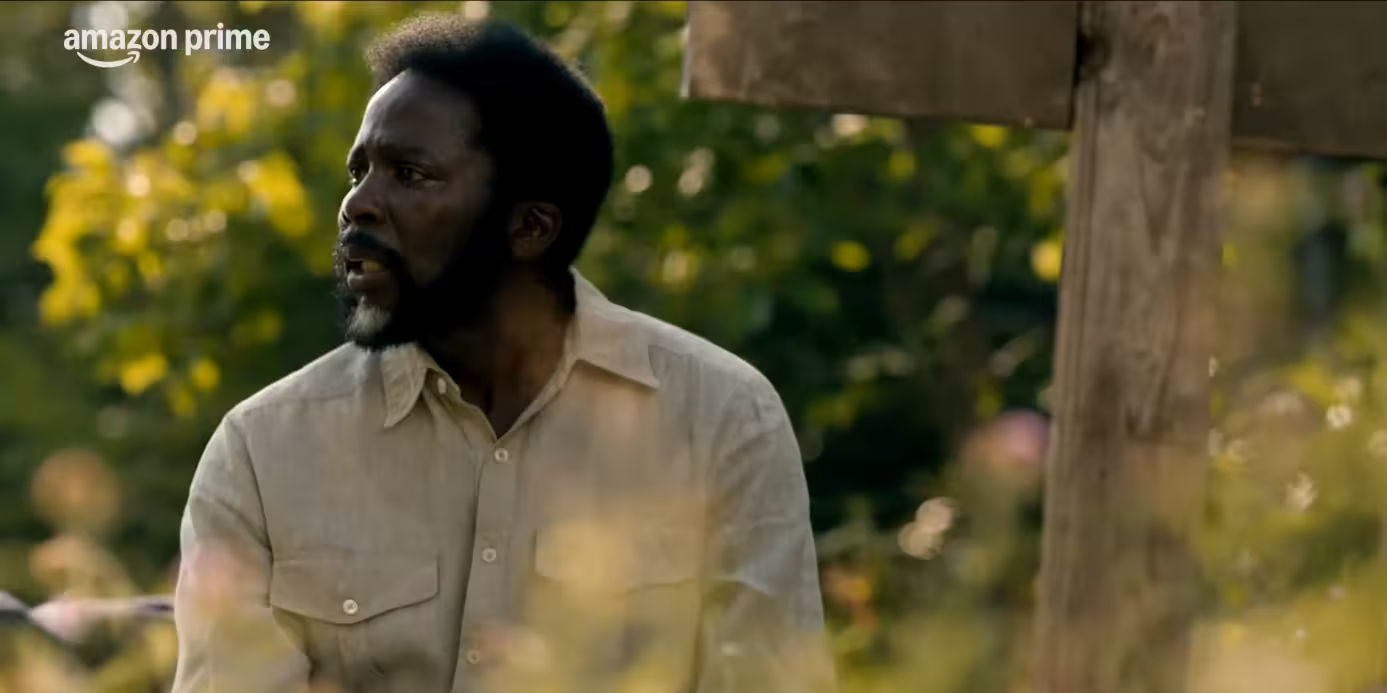
| Harold Perrineau | Boyd Stevens | The Sheriff. Battles severe cognitive decline, nihilism, and the immense responsibility of leading the final, suicidal assault into the tunnels. |
| Catalina Sandino Moreno | Tabitha Matthews | The Reincarnation of Miranda. A reluctant leader forced to descend into the sacrificial pit following the brutal murder of her husband. |
| David Alpay | Jade Herrera | The Reincarnation of Christopher. The intellectual engine of the town, utilizing hallucinogens to map the subterranean architecture of the enemy. |
| Julia Doyle | Sophia / Man in Yellow | The primary antagonist. A shapeshifting, ancient entity operating under the guise of a vulnerable pastor’s daughter to destroy the town from within. |
| Robert Joy | Henry Kavanaugh | Victor’s father. Manipulated by Sophia into a severe psychotic break, believing the town is a hallucination and his son is the anchor. |
| Samantha Brown | Dani Acosta | The skeptical police officer. Acts as the moral compass and audience surrogate protesting the town’s brutal, draconian survival methods. |
| Eion Bailey | Jim Matthews | Murdered in the premiere by the Man in Yellow. His death serves as the profound catalyst for the season’s psychological unraveling. |
| Scott McCord | Victor Kavanaugh | The oldest living resident. Holds the fragmented historical knowledge of the town’s previous massacres and the entity’s past disguises. |
| Pegah Ghafoori | Fatima Hassan | Undergoes a horrifying biological metamorphosis into a Golem-like entity after giving birth to a monster. |
| Ricky He | Kenny Liu | Boyd’s loyal lieutenant. Survives a targeted assassination attempt by the monsters, saved only by Fatima’s telepathic intervention. |
| Hannah Cheramy | Julie Matthews | The “Storywalker.” Masters temporal projection to witness historical events, though she is tragically bound by the deterministic rules of time. |
| Simon Webster | Ethan Matthews | The child whose literature (The Cromenocle) seemingly provides the prophetic, hidden roadmap to the town’s ultimate escape. |
| Elizabeth Saunders | Donna Raines | The matriarch of Colony House. Survives a supernatural heart attack and commands the surface extraction operations during the finale. |
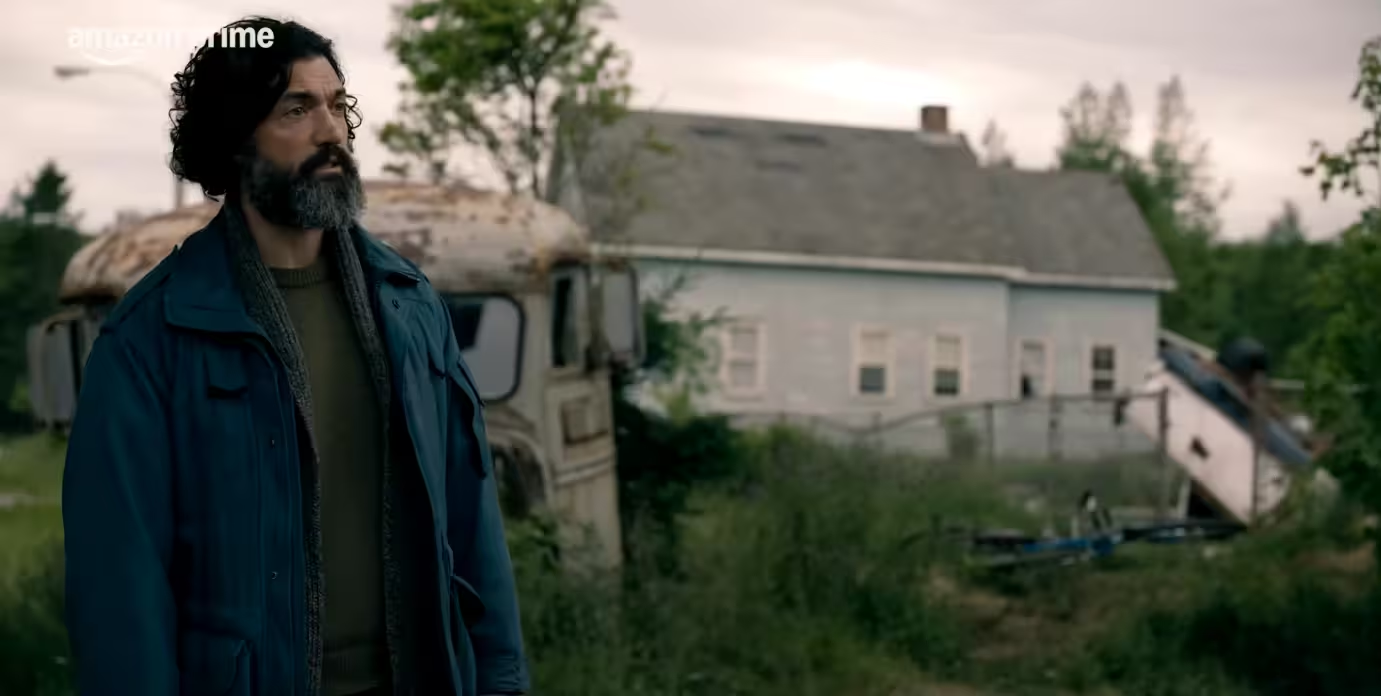
Secrets, Theories, and the Final Trajectory
To construct a definitive projection of the FROM Season 4 ending explained phenomena, the focus must turn toward the convergence of the season’s grand theories and mythological secrets.
The Giant Spider Entity and the True Architect
While the Man in Yellow (currently operating as Sophia) presents as the primary antagonist, deep mythological analysis indicates this entity is merely an avatar or a middle-management warden for a far older, cosmic horror. Season 1 laid the geographical groundwork with the spiderweb forest, and Season 4 revives these motifs during Jade’s psychic journeys. The reigning critical theory postulates that the true form of the dimension’s architect is a colossal, ancient arachnid entity that literally weaves the spatial loop. The human facades—Sophia, the colonial violinist—are merely disposable masks.
The Ritual of the Bones and the Lake of Tears
The core tactical objective of the finale relies on Jade and Tabitha extracting the skeletal remains of the original Ankoui children from the subterranean chamber. However, this is merely the first phase of an esoteric ritual. Analytical consensus indicates these remains must be transported to the “Lake of Tears.” By physically submersing the bones into the waters, the residents may sever the immortality pact made by the original parents (the nocturnal monsters), effectively dissolving the pocket dimension entirely.
The Deterministic Loop and the Bootstrap Paradox
The concept of “Storywalking” introduces a severe philosophical terror. If Julie can project her consciousness into the past but cannot physically alter the events, the town operates on a closed, inescapable timeline. A highly credible theory suggests a massive bootstrap paradox is at play: Julie, or another resident, escapes the town in the future and authors the children’s book, The Cromenocle, embedding the exact escape instructions within the text. This book is then unknowingly brought into the town by Ethan in the past, creating a continuous, unbreakable cycle. The infinity loop symbol found inside Abby’s ring serves as a terrifying confirmation of this endless cycle.
The Imminent Climax
As the finale approaches, the structural integrity of the town is failing on every conceivable front. Henry is psychologically primed to assassinate Victor. Fatima is completely lost to her stone Golem metamorphosis. Sophia has successfully sabotaged the vertical extraction point for Jade and Tabitha.
The FROM Season 4 ending explained trajectory points toward a devastating pyrrhic victory. The children’s bones may ultimately be secured, but the thematic analysis suggests that permanently breaking the cycle requires a willing, eternal sacrifice, potentially cementing Tabitha or Jade as the new eternal wardens of the realm to ensure the others can escape. The fourth season has meticulously deconstructed the residents’ hope, ensuring that whatever answers are finally found in the dark, they will be paid for entirely in blood.
read also : The Witness Ending Explained: Shocking Netflix Cast & Hidden Facts