Kraken 2026 ending explained is the exact phrase tearing through online forums, social media discussions, and deep-dive cinematic communities right now. When director Pål Øie unleashed this 100-minute Norwegian aquatic nightmare at the 36th Tromsø International Film Festival (TIFF) in January 2026, it became immediately clear that the traditional monster movie paradigm had shifted. Stepping far away from the campy, hyper-kinetic blockbuster aesthetics of Hollywood franchises, Øie engineered a harrowing, psychologically dense exploration of environmental hubris that leaves audiences entirely breathless.
Screening in the “Overdrive” program at TIFF alongside heavy-hitting titles like Blue Trail and 2000 Metres to Andriivka, this project immediately stood out as a massive genre swing for Norwegian cinema. By utilizing a relatively modest European budget of approximately €5.3 million, the production team managed to craft a visceral experience that rivals films with ten times the financial backing. The secret to its success is not just the special effects; it is the suffocating atmosphere, the grounded human drama, and a storyline that taps directly into modern anxieties regarding ecological destruction.
Here at memoria.film, the goal is always to tear down the cinematic facade and look at the gears turning beneath the narrative. This film demands that exact level of rigorous scrutiny. The beast in Øie’s film is not a malicious extraterrestrial invader or a genetically mutated science experiment gone wrong. It is an ancient resident of the Sognefjord, violently disturbed by the deafening noise of commercial expansion.
For viewers who found themselves paralyzed with anxiety as the screen faded to black—or those still reeling from the ominous post-credits revelation—this comprehensive dossier serves as the ultimate analytical resource. By dissecting the elite Norwegian cast, the underlying socio-environmental themes, the terrifying biological lore of the deep-sea parasites, the explosive final confrontation, and even the bizarre alternate narrative elements discussed in early promotional materials, this report will leave absolutely no stone unturned.
What is Kraken (2026)?
Before we dive into the terrifying depths of the ending, we need to set the stage. Kraken 2026 is the latest subaquatic nightmare crafted by Norwegian director Pål Øie. Unlike typical Hollywood monster movies, this film leans heavily into claustrophobic, psychological dread. It traps its characters—and the audience—in the freezing, unforgiving depths of the ocean, teasing the ancient, mythical threat just beyond the submarine’s lights.
The Evolution of the Subaquatic Creature Feature
To fully comprehend the massive cinematic weight of this project, one must contextualize the film within the broader historical framework of aquatic monster movies. The representation of deep-sea terror has constantly evolved to reflect the prevailing cultural anxieties of the era in which it is produced. Pål Øie and his writing team—Vilde Eide, Kjersti Helen Rasmussen, and Natasha Arthur—did not write this script in a vacuum. They built upon decades of cinematic dread, refining it into a uniquely Scandinavian warning.
The following table tracks how the genre has mutated over the past fifty years, leading directly to the 2026 premiere:
| Cinematic Era | Defining Film Example | Thematic Core & Societal Context | Evolution of the Subaquatic “Monster” |
| The 1970s | Jaws (1975) | The unpredictability of nature and the failure of local governance to protect citizens from natural threats out of economic greed. | A biological, earthly apex predator acting on pure instinct. Hidden for the majority of the runtime to build unbearable suspense. |
| The 1980s | The Abyss (1989) | Cold War paranoia, the physical limits of deep-sea exploration, and the fear of the unknown frontier. | Extraterrestrial or hyper-advanced entities existing beyond human comprehension, positioned as peaceful but stern judges of humanity. |
| The 2010s | The Meg (2018) | Pure spectacle, international commercialism, and the conquering of prehistoric threats through brute force and advanced weaponry. | An oversized, prehistoric relic functioning purely as a blockbuster obstacle rather than a nuanced thematic metaphor. |
| The 2020s | Troll (2022) | The clash between ancient folklore and modern infrastructural development in Scandinavia. | A mythological entity awakened by corporate greed and the physical desecration of nature. |
| The 2026 Era | Kraken (2026) | Severe ecological disruption, the dark side of the aquaculture industry, and the violent recalibration of ecosystems. | A 100-meter ancient organism acting as an ecological immune system, responding directly to sonic pollution and corporate arrogance. |
While earlier films focused on human survival against a mindless eating machine, this modern entry operates on a foundation of profound guilt. Guardian film critic Phil Hoad accurately noted that the film acts as a Greta Thunberg-esque eco-chastising, providing a cleansing experience regarding humanity’s tampering with nature. The Sognefjord serves as a beautiful, extended tourist promo until the very moment the consequences of human greed rise from the 1,300-meter depths. The true villains are the systemic forces of capitalism that prioritize profit margins over planetary equilibrium.
Dissecting the Cast: Psychological Profiles of the Doomed
The sheer terror of the narrative relies heavily on its understated, grounded performances. By casting actors who excel at portraying internal conflict, the film ensures that the human drama occurring above the water is just as compelling as the monster lurking beneath the waves.
Sara Khorami as Johanne
Following her acclaimed performance in Troll 2, Sara Khorami cements her status as the undisputed queen of Norwegian creature features by taking on the lead role of Johanne. Johanne is an elite marine researcher working at the Institute of Marine Research, but she is a woman heavily burdened by professional and romantic regrets. Years prior, she co-developed a revolutionary piece of technology called the “sonic groomer” alongside her former partner, Erik. The device was intended to be an environmentally friendly alternative to chemical pesticides, using high-frequency sound waves to remove parasitic sea lice from farmed salmon.
However, Johanne realized the catastrophic potential of her own creation. If the acoustic frequencies were incorrectly calibrated, the sound waves would inflict immense physiological stress on marine life and irreversibly damage the fjord’s delicate ecosystem. Upon discovering this, she abandoned the project and her relationship, leaving the coastal town with a heavy conscience. Khorami’s performance is a masterclass in quiet, simmering intensity. When the crisis unfolds, she relies less on screamed dialogue and more on micro-expressions of mounting dread. She serves as the audience’s anchor, processing the horrors with a scientific, albeit terrified, mind.
Mikkel Bratt Silset as Erik
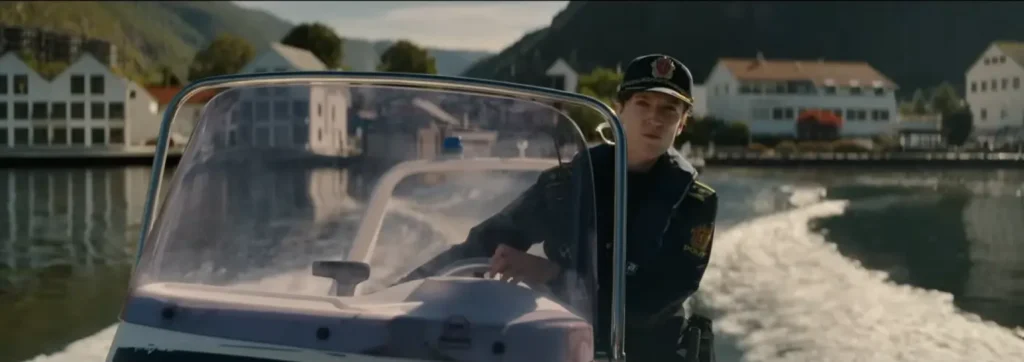
Mikkel Bratt Silset portrays Erik, the head aquatic engineer at the fish farm. Erik represents the extreme danger of moral compromise in the face of career advancement. While he is not portrayed as inherently evil, he is deeply complicit. After Johanne’s departure, Erik remained with the sonic groomer project, convincing himself that he could control the technology and mitigate its risks.
When the aquatic crisis begins, Erik is paralyzed by a mixture of denial and guilt. His emotional journey throughout the runtime is one of painful realization, as he is forced to confront the fact that his technological “solution” has become an apocalyptic trigger. His tragic arc peaks during a tense confrontation when he realizes that he was kept completely in the dark by upper management regarding the deactivation of the sonic blockers—the very safeguard he personally implemented to prevent disaster.
Øyvind Brandtzæg as Avaldsnes
The primary human antagonist is Avaldsnes, the greedy and fiercely ambitious owner of the fish farm, played with terrifying corporate callousness by Øyvind Brandtzæg. Avaldsnes is the living embodiment of modern capitalism’s massive blind spot regarding ecological boundaries. To secure a highly lucrative deal with Japanese investors and effectively triple his salmon production, Avaldsnes orders the fish farm’s sonic groomers to be pushed to their absolute maximum capacity. Worse still, to ensure the waters seem pristine for the investors, he turns off the sonic blockers.
He views the Sognefjord not as a living, breathing ecosystem, but as an endless resource meant to be exploited for personal gain. His stubborn refusal to shut down the machinery, even as human bodies begin to wash up, is a chilling indictment of corporate negligence. Yet, the screenwriters cleverly afford him a moment of surprising, redemptive humanity in the final act, subverting the one-dimensional corporate villain trope and making his ultimate fate far more impactful.
The Supporting Roster
The film rounds out its cast with stellar supporting performances from Ingvild Holthe Bygdnes, Jenny Evensen, Steinar Klouman Hallert, and Filip Bargee Ramberg. Whether playing terrified technicians trapped in the flooding facility, environmentally conscious youth trying to protest the farm, or investors realizing their money has bought them a front-row seat to a massacre, the supporting cast grounds the horror in stark realism. The sheer panic exhibited by the background characters elevates the stakes, making the remote Norwegian setting feel incredibly claustrophobic.
The Threat Below: Biological Breakdown of the Monsters
One of the most fascinating aspects of this film is that the primary antagonist is not a single entity, but a highly complex, symbiotic ecosystem. The terror is delivered on both a massive, unfathomable scale and a microscopic, intimate level.
The Leviathan of the Fjord
The Kraken itself is an awe-inspiring achievement in creature design. Described as towering over 100 meters high when fully extended, the creature is ancient, scarred, and overwhelmingly powerful. However, the film goes out of its way to establish that the creature is not inherently evil. It is not seeking out human flesh to consume; rather, it is a localized biological immune system.
The Earth, specifically the ancient fjord, is portrayed as a living entity. When the fish farm introduces foreign, destructive elements—namely, the high-frequency sonic groomers—the fjord reacts exactly the way a human body reacts to a virus. It deploys its ultimate white blood cell. The beast is driven mad by the acoustic torture piercing its deep-sea habitat, and its violent attacks on the surface infrastructure are desperate attempts to silence the source of its pain.
The Cat-Sized Parasites
What elevates the film from a standard giant monster movie into the realm of body horror is the inclusion of the parasites. Dislodged from the Kraken’s body during its violent ascent to the surface, these creatures are terrifying in their own right. Roughly the size of a large cat, these bioluminescent ticks are perfectly adapted to the high-pressure environment of the abyss.
When they are brought to the surface, they infiltrate the floating naval modules through the ventilation shafts. In a deeply unsettling sequence that heavily evokes Ridley Scott’s Alien, the survivors must navigate the dark, damp corridors of the facility while avoiding these lethal pests dropping from the ceiling. The parasites secrete a glowing, blue slime—a biological marker that becomes a death sentence for anyone who touches it. The tragedy of the parasites is that, much like the Kraken, they are entirely out of their element. Separated from their host ecosystem, they are driven into a feeding frenzy by the same sound waves that are torturing their mother host.
Act-by-Act Narrative Deconstruction
To arrive at a full understanding of the explosive ending, it is necessary to map out how the tension systematically escalates across the film’s runtime. The narrative structure is a masterclass in pacing, utilizing the Jaws philosophy of keeping the monster hidden for as long as possible to maximize psychological dread.
Act I: The Fjord’s Warning and the Sonic Trigger
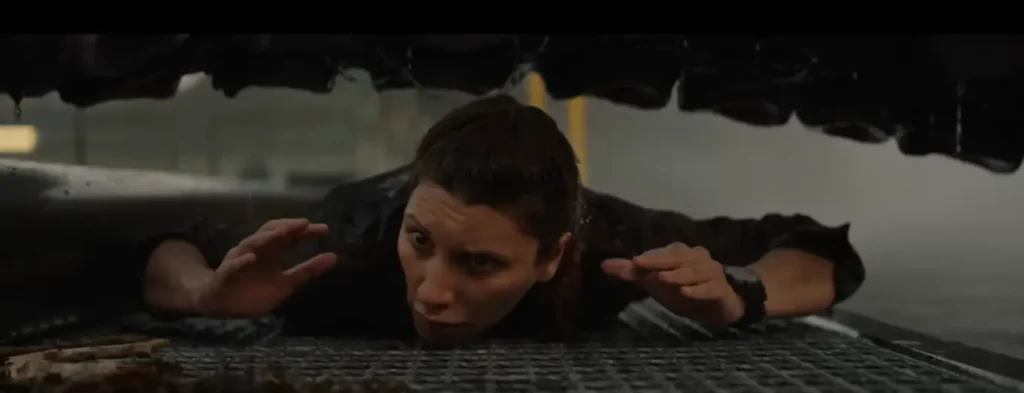
The film opens with a textbook example of sub-mechanophobia and open-water terror. Two young, carefree thrill-seekers are speeding across the pristine waters of the fjord on a jet ski. The camera utilizes terrifying underwater voyeuristic angles, tracking them from below. Suddenly, the water begins to churn. A massive, unnatural whirlpool forms, violently sucking the jet ski and its riders into the dark depths without a single tentacle breaching the surface. This prologue establishes the lethal stakes immediately.
Simultaneously, miles away, Johanne is interrupted during a rare vacation by an emergency call from her institute. Thousands of salmon are beaching themselves in mass, driven completely mad by an unseen environmental stressor. Reluctantly returning to the coastal town she abandoned years prior, she arrives exactly during Avaldsnes’s corporate celebration. The juxtaposition of the lavish, champagne-soaked investor party against the backdrop of an impending ecological disaster perfectly sets the cynical tone of the film.
Johanne confronts Erik, demanding access to the sonic groomer’s operational logs. Their tense reunion is interrupted when a deep-water transducer device malfunctions. When the technicians hoist the heavy machinery to the surface, they discover the first undeniable proof of the nightmare below. Inside the mangled metal, they find the massive, oozing carcass of an unknown parasitic organism.
Johanne’s subsequent autopsy of the creature reveals abnormal amino acid values indicative of extreme deep-sea pressure. The horrifying realization sets in: if a mere parasite can grow to the size of a cat, the host organism it fell off of must be of unfathomable proportions. The tension spikes irrevocably when the mangled remains of the missing jet skiers are found washed ashore, covered in the same bioluminescent slime and being devoured by panicked local wildlife.
Act II: The Siege of the Naval Module
The narrative shifts gears entirely in the second act, transitioning from an investigative mystery into a contained, claustrophobic survival horror. Johanne deduces that Avaldsnes has deactivated the sonic blockers to impress the investors, sending agonizing high-frequency waves straight down into the 1,300-meter depths.
Before they can manually shut the system down, the retaliation begins. However, director Pål Øie makes the brilliant choice to delay the full monster reveal. The attack is heralded by an unnatural, thick white fog rolling over the water—a visual motif pulled straight from ancient Norwegian maritime folklore.
The attack is brutally systematic. The unseen creature violently strips the massive anchor chains of the fish farm, setting the entire facility adrift into the deeper, more dangerous waters of the fjord. As the facility floats blindly in the fog, the secondary threat emerges. The giant parasites begin flooding the lower decks.
One particularly gruesome sequence features a technician attempting to hide in a walk-in freezer unit, only to realize the parasites have already nested inside. The slow, agonizing death of the technician highlights that nature is merciless on both a macro and micro scale. Meanwhile, on the upper decks, massive tentacles begin blindly smashing through the reinforced glass of the underwater restaurant, dragging screaming investors out into the freezing water.
Act III: The Flare and The Father’s Redemption
As the surviving characters are pinned down in the control room, the film delivers one of its most visually arresting sequences. A distress flare is fired into the foggy night sky by Erik. As the red light slowly descends, illuminating the mist, the true, Eldritch scale of the beast is finally revealed.
Towering over the naval module, the Kraken is a biological marvel. It wraps its massive limbs around the facility, its giant bioluminescent eyes locking onto the structure. During the ensuing chaos, Avaldsnes’s daughter, Maria, is cornered by a sweeping tentacle and nearly crushed by a collapsing steel bulkhead.
In a moment of absolute desperation and shocking paternal redemption, Avaldsnes—the greedy fish farm owner who caused the disaster—grabs a heavy fire axe. He charges the tentacle, hacking wildly at the thick, rubbery flesh. He physically shoves his daughter to safety, allowing himself to be violently pulled screaming into the abyss. It is a brutal, thematic end for the man who believed he could conquer nature for profit; he is ultimately consumed by the very environment he sought to exploit.
Realizing that the Kraken will not stop until the agonizing sound waves are silenced—and recognizing that the facility is literally minutes away from being dragged to the bottom of the fjord—Johanne formulates a desperate, suicidal gambit.
Kraken 2026 Ending Explained in Detail
The climax of the film is a masterstroke of tension, emotional sacrifice, and tragic irony. If you are searching for a definitive explanation of how the narrative resolves, this sequence holds the absolute key to the film’s underlying message.
The Sonic Bomb
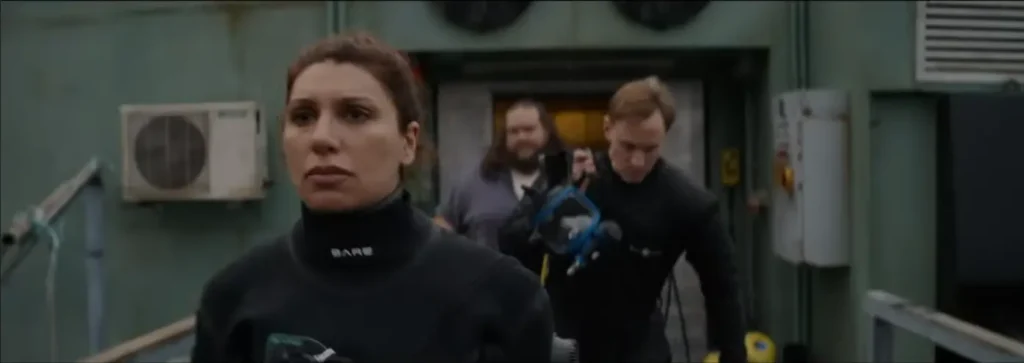
Johanne realizes that conventional weapons, like the shotguns carried by the local authorities, are completely useless against a creature of this magnitude. However, she knows the beast’s greatest weakness is the very thing that summoned it: sound. Johanne commandeers a small, rapid-response speedboat docked at the edge of the facility and loads it with the facility’s reserve sonic groomer devices.
Her plan is terrifyingly simple: she must lure the creature away from the sinking survivors by creating a louder, more concentrated sonic target. She speeds out into the open water, drawing the beast’s attention away from the naval module. The Kraken pursues her, its massive bulk churning the surface water into a localized maelstrom.
Once she is a safe distance from the survivors, Johanne sets the sonic devices on a delayed timer and cranks the acoustic frequency far beyond the established safety parameters. She effectively turns the lice-removing tool into a devastating acoustic bomb.
As the timer ticks down to its final seconds, a colossal tentacle breaches the surface, wrapping tightly around Johanne’s vessel and pulling her beneath the icy waves. For a terrifying, extended moment, the audience is placed in a first-person perspective, staring directly into the massive, ancient eye of the Kraken underwater. The film lingers on this moment; the eye does not look evil. It looks tired, defensive, and in immense pain.
Suddenly, the sonic payload detonates.
The water ripples violently as the extremely high-frequency waves propagate through the dense liquid. The acoustic pressure achieves its gruesome goal: it literally shatters the Kraken’s massive heart. The grip on the boat instantly loosens, and the colossal titan of the deep goes limp, its enormous bulk slowly sinking back into the silent abyss from which it came.
The Ironic Weaponization and Guilt
The tragic irony of the film’s conclusion cannot be overstated. The exact device built by Johanne and Erik to “cleanse” the environment and create a sustainable, profitable future is the exact tool used to murder an ancient, irreplaceable wonder of the natural world.
When Johanne weaponizes the sonic groomer, the film asks a deeply uncomfortable question of the audience: did humanity actually win? By killing the Kraken, they essentially destroyed a prehistoric marvel simply to save an artificial, commercial fish farm that shouldn’t have been polluting the waters in the first place. The ending is drenched in melancholic guilt, reflecting the real-world reality that human “solutions” to ecological problems often result in the permanent destruction of biodiversity.
The “One Year Later” Epilogue
In the immediate aftermath of the underwater detonation, the intense shockwave renders Johanne completely unconscious. The water around her goes dead still as the thick fog finally begins to lift. The surviving crew members from the facility navigate through the debris field and pull Johanne’s lifeless body from the water. The initial editing of the sequence heavily implies that she has died, sacrificing herself to correct the catastrophic mistake she inadvertently helped create years prior.
However, the film transitions to a hard cut: “One Year Later.”
The scene reveals a pristine, sunlit view of the Sognefjord. Johanne is alive. She is standing on the shore, gazing out at the calm water. Her survival is a crucial thematic choice by the director. Rather than dying a martyr and escaping the consequences of her actions, she is forced to live with the heavy psychological burden of what transpired. The dialogue and visual cues imply that the entire aquaculture operation has been permanently dismantled and outlawed in the region. Nature has reclaimed the fjord. Johanne has dedicated her life to ensuring that the waters remain untouched, serving as a vigilant environmental steward who truly learned the hard lesson.
The Post-Credits Scene: The Wriggling Egg
Just as the audience begins to process the bittersweet, melancholic victory of the ending, Øie delivers a final, chilling blow. After the main credits roll, the camera plunges back into the water. It dives down past the photic zone, past the twilight zone, and deep into the pitch-black abyss at 1,300 meters deep.
There, resting securely in a cavernous underwater trench, is an enormous, translucent egg. Inside the glowing membrane, a massive shadow slowly wriggles.
The implication is terrifyingly clear. The Kraken was not just defending its territory; it was a mother aggressively protecting its nesting ground from the agonizing sonic vibrations of the fish farm above. The majestic creature they killed was merely the guardian of the next generation. The ecological balance has not been fully restored, and the consequences of humanity’s violent intrusion will inevitably hatch.
Alternate Lore: The Havvic Village Narrative
A truly fascinating aspect of analyzing this film is uncovering the discrepancies in early promotional materials, leaked script drafts, and alternative narrative summaries circulating online. While the final theatrical cut focuses almost entirely on the isolated naval fish farm, early lore documents and some conflicting online recaps feature a significantly different storyline.
In these alternate breakdowns, the story centers around a quiet Norwegian village named Havvic. Johanne arrives not at a fish farm, but at the village docks, where she teams up with a young local named Lars. In this version, the Kraken is awakened not by a sonic groomer, but by deep underwater mining and drilling.
The climax of this alternate script features Johanne and Lars setting up massive radio equipment and speakers along the shoreline to broadcast controlled low-frequency patterns to drive the beast away. The equipment overloads, the frequencies destabilize, and the Kraken surges upward, causing a towering wave that crashes into the village of Havvic. Johanne must frantically recalibrate the machine on the docks while dodging falling debris, eventually sending a deep pulse that forces the creature to retreat back into the trench without killing it.
While this “Havvic” narrative was either an early draft, a deleted subplot, or a completely fabricated synopsis generated by confused online algorithms, it remains a fascinating piece of the film’s broader mythological footprint. The final theatrical version’s focus on the claustrophobic fish farm and the explosive heart-shattering conclusion is universally considered the canon ending , but the existence of the Havvic lore proves just how much creative iteration went into finding the perfect ecological metaphor.
The Cinematic Craft: Tension, Sound, and Scale
The sheer impact of the film is amplified by its extraordinary technical execution. Operating on a European budget, the production team utilized highly strategic filmmaking techniques to rival Hollywood blockbusters.
The Jaws Philosophy of Concealment
Director Pål Øie understood perfectly that rendering a fully CGI, 100-meter octopus in broad daylight on a limited budget would immediately break the audience’s immersion. Therefore, the film strictly adheres to the legendary Jaws philosophy: the unseen is always far more terrifying than the seen.
For the entire first two acts, the beast is depicted entirely through environmental interaction. The audience sees massive anchor chains snapping taut, structural bulkheads buckling inward, and the chaotic displacement of water. By utilizing the thick, natural fog of the Norwegian coastline and the pitch-black depths of the fjord, the visual effects team was able to hide the creature. This forced the viewer’s imagination to construct a monster far more terrifying than any computer-generated model could achieve early in the runtime. When the creature is finally revealed under the crimson glow of the emergency flare, the visual payoff is immense because the VFX budget was saved specifically for that crucial, high-impact shot.
The Auditory Landscape: A Symphony of Dread
In a film where sound is the primary catalyst for the disaster, the audio mixing is arguably the most vital component of the cinematic experience. The sound designers created a truly oppressive auditory landscape.
The ambient noise is dominated by the slow, rhythmic creaking of the metal naval modules under immense water pressure, creating a constant sense of sub-mechanophobia. Furthermore, the film utilizes a droning, low-frequency hum to represent the activation of the sonic groomer. This sound physically vibrates through the theater seats, ensuring that the audience feels the exact acoustic stress being inflicted upon the marine environment. The juxtaposition of the dead silence of the misty fjord against the deafening roar of the Kraken creates a dynamic auditory whiplash that keeps the viewer perpetually on edge.
FAQ: Answering the Web’s Biggest Questions
To ensure this definitive breakdown is as exhaustive as possible, here are the direct, highly researched answers to the internet’s most pressing questions regarding the 2026 Norwegian hit.
Is Kraken (2026) based on a true story or real folklore? While the specific events of the film are entirely fictional, the concept of the beast is deeply rooted in ancient Norse sagas and Scandinavian folklore. Historically, terrified sailors described massive, tentacled beasts capable of dragging ships into the abyss. In a modern context, the film grounds this myth by connecting it to the very real ecological issues surrounding Norway’s massive salmon farming industry, blending ancient myth with highly contemporary environmental anxieties.
What exactly is the “Sonic Groomer” and is it a real device? In the film, the sonic groomer is an experimental device designed by Johanne and Erik to emit specific acoustic frequencies that target and kill sea lice on salmon without using harmful chemicals. In the real world, the aquaculture industry is constantly battling sea lice infestations. While acoustic, laser-based, and thermal delousing technologies are actively being researched and deployed in modern commercial fish farms, the catastrophic, monster-waking frequencies depicted in the film are pure science fiction utilized for narrative horror.
Did Johanne survive the explosion at the end? Yes. Despite the initial ambiguity of the scene where she is pulled unconscious from the water, the film cuts to a “One Year Later” epilogue showing Johanne alive, standing safely on the shores of the Sognefjord. She has survived the physical ordeal but is left to grapple with the immense ecological trauma of having to destroy the majestic creature.
What was the budget for the film? The film was produced on a budget of approximately €5.3 million. Despite this relatively modest figure compared to major American studio releases, the filmmakers achieved spectacular visual fidelity through clever visual concealment, extensive practical effects, and utilizing the naturally stunning and eerie locations of the Norwegian fjords.
Will there be a sequel to the film? The post-credits scene—featuring a massive, glowing egg wriggling in the deep trench of the fjord—heavily implies that the story is far from over. While no official sequel has been greenlit by Nordisk Film as of the summer of 2026, the critical success of the film at TIFF and its strong performance on the international market make a continuation highly likely. A sequel would presumably deal with the hatching of the offspring and humanity’s terrifying attempt to coexist with a new generation of apex predators.
Why is Google showing me hockey scores when I search for the film? An interesting SEO quirk surrounding the film’s release is its shared name with the Seattle Kraken, a professional ice hockey team in the National Hockey League (NHL). During the film’s peak promotional window in early 2026, the Seattle Kraken were simultaneously wrapping up their 2025–2026 NHL regular season, playing high-profile games against teams like the Nashville Predators, Colorado Avalanche, and Vegas Golden Knights. This created massive search intent overlap. If you are looking for hockey stats, you need the NHL; if you are looking for shattered hearts and deep-sea terror, you need Pål Øie’s masterpiece.
How did the critics react to the film? Critical reception was generally highly positive, particularly regarding the film’s atmosphere and thematic depth. The Guardian praised its “eco-chastising” message and the suspenseful direction. Reviewers from Rue Morgue noted that while some character arcs felt slightly predictable, the 15-minute climax provided thrilling, well-realized action. Roger Ebert’s site gave it a solid review, acknowledging its Jaws-like formula but praising the visually dynamic monster attacks.
The Final Verdict on the Deep-Sea Nightmare
The sheer brilliance of this cinematic achievement lies in its unyielding commitment to exploring the devastating consequences of environmental arrogance. By substituting the mindless, CGI-heavy destruction of typical monster movies with the slow, agonizing erosion of ecological balance, the narrative creates a masterclass in ambient dread.
The human characters do not conquer nature with triumph and heroism; they merely survive the agonizing burden of their own mistakes. The death of the Kraken is not framed as a victory, but as a tragic necessity born of capitalist greed. As the screen fades to black on Johanne standing by the reclaimed waters of the Sognefjord, the audience is left to grapple with a terrifying, beautiful reality. The true monster outside the door is merely human hubris, and the dark waters of the abyss are always watching, waiting for humanity to finally pay attention.
read also : Disclosure Day Ending Explained: The Definitive Breakdown of Spielberg’s 2026 Sci-Fi Masterpiece