Leviticus ending explained begins with a profound understanding of the deep-seated psychological trauma that serves as the foundation for Adrian Chiarella’s monumental 2026 feature film debut. Released theatrically today, June 19, 2026, by NEON, Leviticus has instantly established itself as a seminal work in the queer horror subgenre. It completely transcends the traditional boundaries of supernatural cinema to deliver a searing, unforgiving critique of religious hypocrisy, forced conversion therapy, and the brutal weaponization of natural human desire. Through a narrative that is equally heartbreaking and terrifying, the film forces audiences to confront the absolute devastation inflicted upon marginalized youth by the very institutions meant to nurture and protect them.
Set against the desolate, industrial backdrop of regional Victoria in Australia, the film meticulously follows two teenage boys whose burgeoning, secretive romance becomes the tragic catalyst for a horrific supernatural curse. By intricately intertwining the visceral, heart-pounding thrills of the horror genre with the tender, often intensely painful realities of a coming-of-age romance, Leviticus achieves a rare, earth-shattering emotional resonance. This exhaustive, definitive report will dissect every conceivable facet of the film, from its meticulously crafted plot and underlying thematic architecture to its devastating conclusion, providing the ultimate exploration of its cinematic, psychological, and cultural significance.
1. Introduction to the Film and the Queer Horror Renaissance
The horror genre has always functioned as a societal mirror, reflecting our deepest collective anxieties and repressed fears. However, in recent years, the genre has undergone a profound renaissance, particularly in its embrace of queer narratives. Leviticus stands at the absolute vanguard of this movement. Written and directed by Adrian Chiarella in his feature debut, the film was developed through VicScreen’s Originate initiative and produced by the powerhouse team at Causeway Films—the prestigious production company responsible for global horror phenomenons like The Babadook and Talk to Me.
Premiering to rapturous applause and terrified shrieks in the Midnight section of the 2026 Sundance Film Festival, the project immediately sparked a fierce bidding war. It ultimately culminated in a massive seven-figure acquisition by NEON, securing worldwide distribution rights and cementing the film’s status as the most anticipated horror release of the summer.
The narrative centers on Naim (Joe Bird) and Ryan (Stacy Clausen), two teenagers who find themselves violently tormented by a malevolent, shape-shifting entity. This demon is not summoned from the depths of hell via an ancient grimoire; rather, it is deliberately invoked by their conservative religious community through a twisted “deliverance” ritual. Executive produced by Mia Wasikowska, who also delivers a chilling, career-defining performance as Naim’s mother, Leviticus utilizes the framework of a monster movie to explore the very real, waking nightmare of Sexual Orientation Change Efforts (SOCE), commonly known as conversion therapy. With a tight, relentless runtime of 88 minutes, the film is a masterclass in atmospheric dread, utilizing the claustrophobic confines of a deeply prejudiced society to amplify its supernatural terror.
2. Summary, Plot Breakdown, and Comprehensive Review
To fully grasp the “Leviticus ending explained” phenomenon, one must first dissect the film’s narrative architecture. The plot is a meticulously paced descent into paranoia, combining the slow-burn dread of a psychological thriller with the devastating emotional stakes of a tragic romance.
Act I: The Awakening in an Industrial Wasteland
The narrative commences with a cold, shocking prologue that immediately establishes the severe supernatural stakes. In the cavernous, echoing shower area of a public indoor swimming pool, a young woman is violently attacked and slaughtered by an unseen, invisible force. This sequence, evoking the claustrophobic, inescapable dread of Alfred Hitchcock’s Psycho, operates entirely without exposition. It plunges the audience into a hostile world where fatal danger lurks in moments of isolation and vulnerability, setting a tone of pervasive anxiety.
The story then sharply transitions to Naim (Joe Bird), a quiet, deeply anxious teenager who has recently relocated from the bustling city to a decaying, industrial town in Victoria, Australia, alongside his mother, Arlene (Mia Wasikowska). Arlene, seeking desperate solace and structure after the traumatic loss of her husband, immerses herself entirely in a rigid, cult-like local church, dragging a reluctant Naim into an environment steeped in conservative, uncompromising dogma.
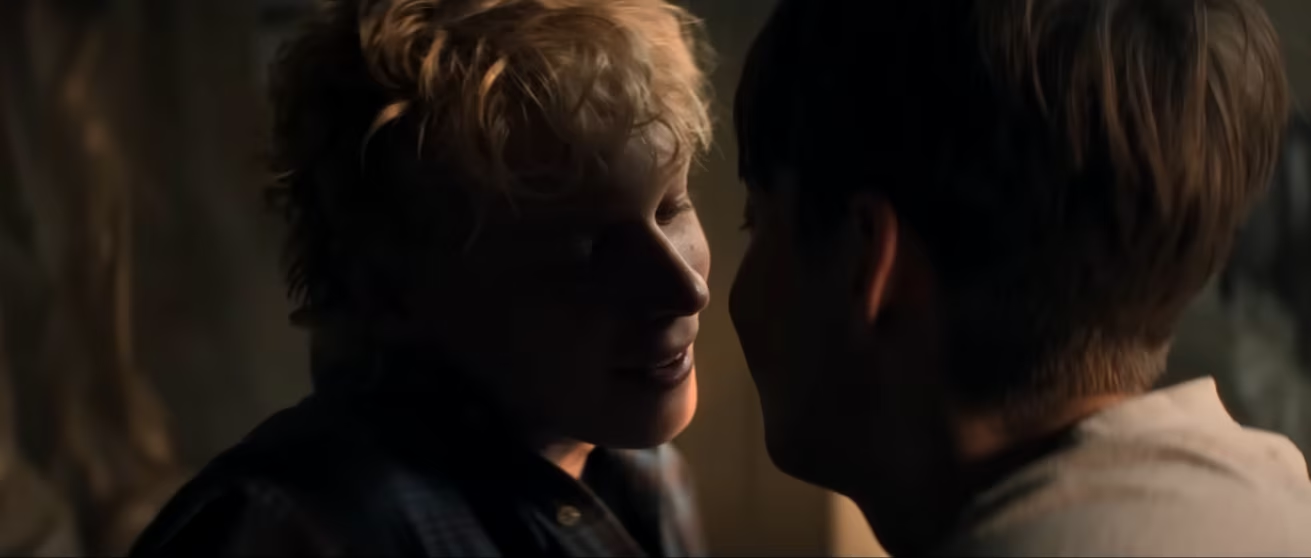
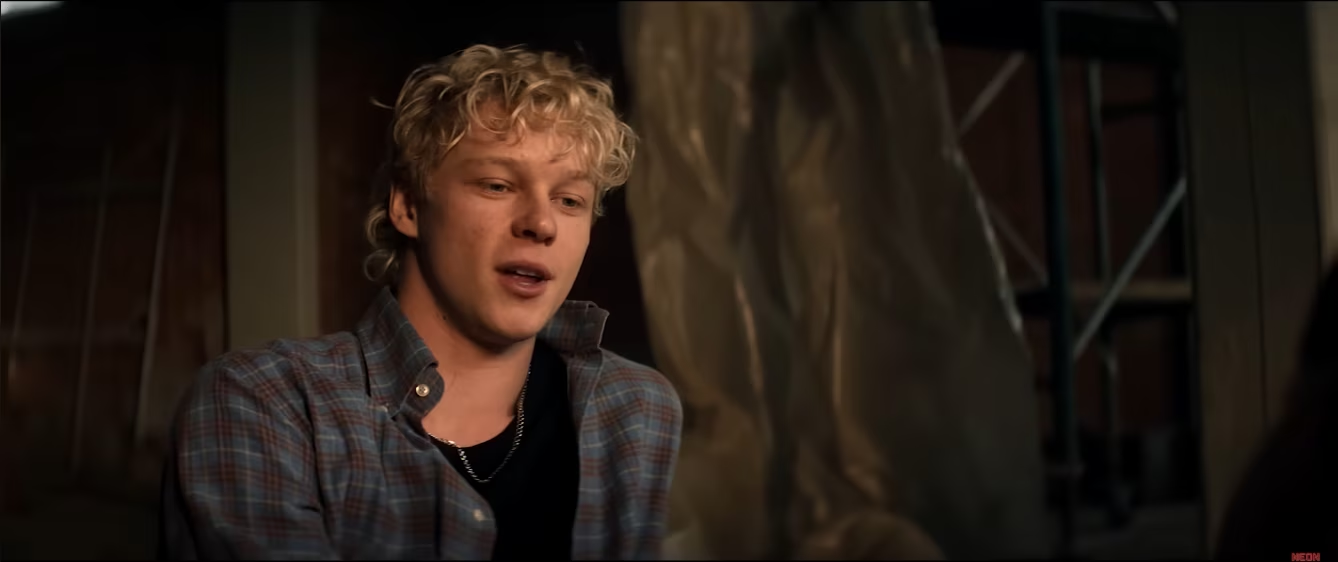
Naim, struggling to navigate his new reality, soon crosses paths with Ryan (Stacy Clausen), a bleached-blonde, rough-around-the-edges classmate who happens to be the son of a prominent, highly respected church family. Their relationship begins with aggressive physical roughhousing—shoving, wrestling, and throwing rocks in an abandoned, decaying mill—which slowly, inevitably gives way to genuine tenderness.
These stolen moments of hidden kisses and lingering touches are beautifully illuminated by late-afternoon sunbeams piercing through the dilapidated roof of the mill. The brilliant cinematography by Tyson Perkins perfectly captures this overarching duality, framing the boys against harsh, landscape-scarring machinery, towering power lines, and blazing oil refineries. The visual language communicates that their environment is inherently hostile to their natural affection. The boys are exceedingly careful to keep their romance a heavily guarded secret, acutely aware of the town’s regressive, dangerous attitudes toward homosexuality.
A pivotal early scene sees the boys observing a large snake swallowing a poisonous frog. This moment serves as a heavy-handed yet effective metaphor for the harsh Australian outback and the toxic environment they inhabit—a world where survival dictates that one must consume or be consumed, and where two toxic forces (the snake and the poisonous frog) are locked in a deadly, paralyzing embrace.
Act II: The Betrayal, The Ritual, and The Curse
The fragile, beautiful sanctuary Naim and Ryan have built shatters entirely when Naim unexpectedly visits Ryan’s home. There, he catches Ryan being intimately involved with Hunter (Jeremy Blewitt), the son of the church’s powerful pastor. Consumed by a potent, blinding mixture of heartbreak, severe jealousy, and the impulsive emotional volatility typical of teenagers, Naim commits a devastating act of betrayal. He approaches the pastor and reports Ryan and Hunter’s relationship, effectively outing them to the highly religious, unforgiving community.
The community’s response is swift, unified, and utterly draconian. Rather than offering psychological guidance or familial support, the parents enlist a “Deliverance Healer” (Nicholas Hope), an intimidating, heavily tattooed figure who performs a grotesque, terrifying inversion of a traditional exorcism. In a ritual explicitly designed to “cleanse” the boys of their impure desires, the healer brings the boys before the congregation. He uses a simple lighter, striking the flint and chanting the chilling incantation, “Two flames: one to defile, one to reform,” before violently blowing his hot breath directly into the faces of Ryan and Hunter.
This ritual, representing the absolute horrors of conversion therapy, does not magically remove their desires. Instead, it weaponizes them. It violently binds a demonic entity to the boys—a relentless spirit that is completely invisible to outsiders but appears to the victims in the exact physical form of the person they desire most.
Hunter, who expresses his desires heavily through physical aggression and violence, is swiftly overwhelmed. With his defenses completely lowered by the appearance of his desire, he is brutally attacked and killed by the entity. Following the horrifying discovery of Hunter’s death, an increasingly terrified and guilt-ridden Naim confesses his own sexuality to the local authorities, hoping to explain the supernatural threat. This confession inevitably reaches his mother, Arlene.
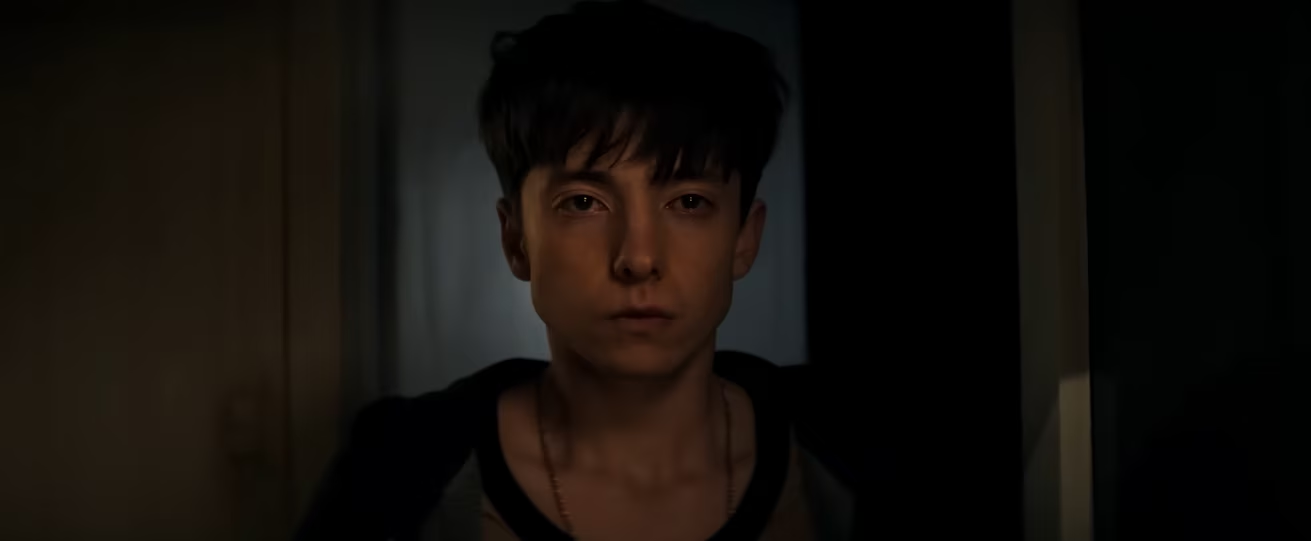
Believing she is protecting her son from suffering the same fatal destiny as Hunter, Arlene forcibly subjects Naim to the exact same deliverance ritual. Now, the curse is fully realized. Naim and Ryan are both hunted. For Naim, the murderous entity appears as a dead-eyed, terrifying version of Ryan; for Ryan, it appears as Naim.
Act III: The Hunt, The Hospital, and The Escape
The final act of Leviticus transforms into a harrowing, pulse-pounding cat-and-mouse thriller, highly reminiscent of the paranoia found in It Follows, but layered with profound, debilitating queer trauma. The boys quickly discover a terrifying rule: the entity only initiates its attacks when they are entirely alone. This forces them into a state of constant, exhausting vigilance, constantly seeking crowded spaces or frantically verifying reality with bystanders who cannot see the monster.
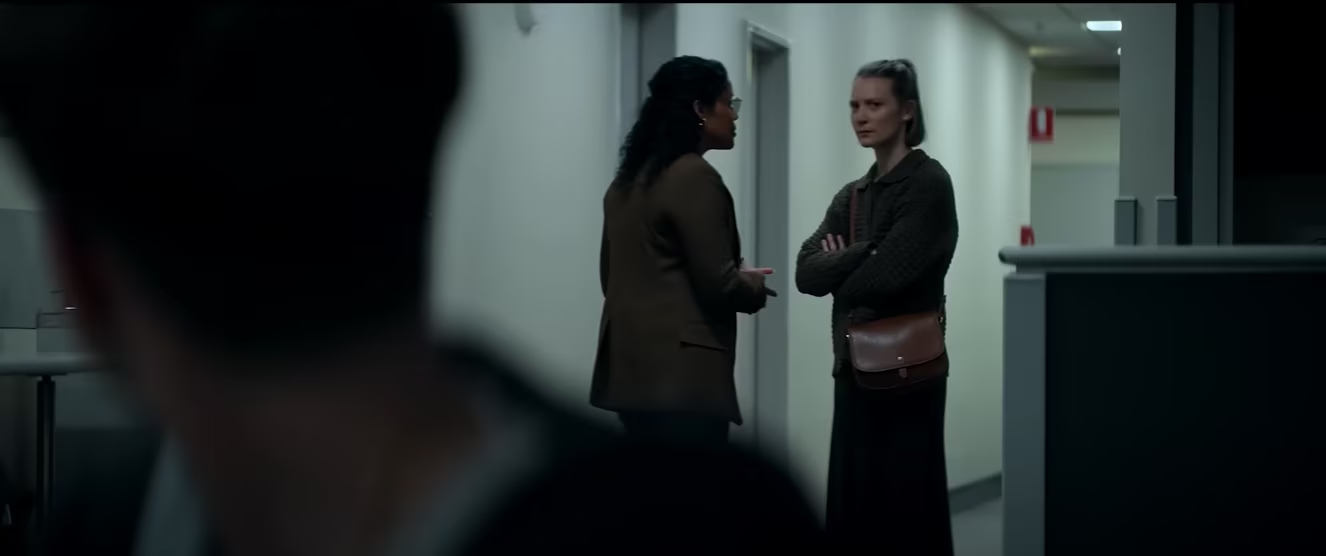
Desperate for a solution or a counter-curse, the boys connect with Hunter’s grieving sister, Izzie (Davida McKenzie). Izzie reveals that a survivor named Jessica (Shannon Berry) exists in a neighboring town. Naim and Ryan track Jessica down to the sterile, depressing corridors of Murrayville Hospital. Jessica, the girlfriend of the woman murdered in the opening pool scene, delivers devastating news. She explains the absolute, unbreakable rules of the curse: the entity mimics desire flawlessly, it exclusively attacks the isolated, it grows significantly stronger and more aggressive over time, and worst of all, it cannot be stopped, killed, or reversed.
The entity continuously exploits their deepest emotional vulnerabilities. In one of the film’s most harrowing, unforgettable sequences, Ryan attempts to seek a moment of solace inside an old, abandoned photo booth. He is suddenly attacked by the entity mimicking Naim. The audience watches Ryan seemingly fighting the air, gasping and choking. However, when the automated photos print, they show Ryan sitting entirely alone, his neck being brutally compressed by invisible hands.
In a desperate bid for survival, Naim attempts to fight back using the element that created the curse: fire. He tracks the entity to an abandoned warehouse and burns the entire structure to the ground. For a brief moment, touching the entity’s cheek seems to recoil it, but the victory is hollow; the entity simply reappears in subsequent scenes, completely unharmed.
The climax forces the boys to navigate a terrifying reality where they can no longer trust their own eyes or their own hearts. Following a brutal setup by Izzie, who attempts to have the boys gay-bashed as revenge for Hunter’s death, Ryan intervenes and saves Naim from the violent mob. Despite this act of profound love, the trauma is too immense. The film concludes not with a triumphant, bloody victory over the monster, but with a melancholic, desperate acceptance. Naim and Ryan decide to flee the toxic town together, walking down a desolate highway and boarding a bus to an unknown destination. As the bus rolls down the road, Naim looks out the window and spots the entity standing completely still by the side of the road, a chilling, permanent reminder that their trauma will forever follow them.
Comprehensive Review: A Triumph of Atmospheric Terror
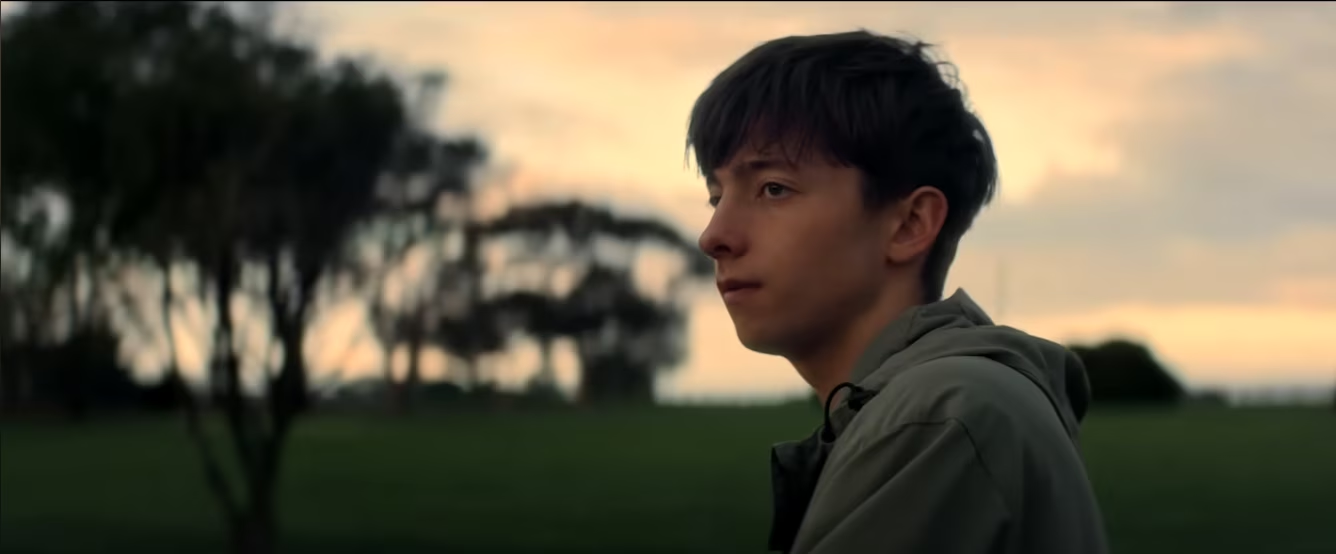
As a cinematic achievement, Leviticus is a towering triumph of atmospheric storytelling and thematic depth. Adrian Chiarella’s direction is phenomenally assured for a feature debut, demonstrating a restraint and maturity rarely seen in the genre. He prioritizes creeping, existential dread and psychological horror over cheap, predictable jump scares. The film’s structural pacing is deliberate, allowing the central romance to genuinely breathe and develop. This crucial decision makes the subsequent supernatural punishment feel deeply, authentically tragic rather than purely exploitative.
Joe Bird and Stacy Clausen deliver absolute star-making performances. They expertly balance the tender, awkward vulnerability of first love with sheer, unadulterated, wide-eyed terror. Clausen, in particular, masters a chilling, incredibly difficult duality. He must seamlessly shift between the deeply vulnerable, heartbroken Ryan and the cold, predatory, sociopathic mimicry of the entity.
Mia Wasikowska’s portrayal of Arlene is a masterclass in quiet, suffocating fanaticism. She plays a mother whose love is strictly conditional, hiding unimaginable malice behind a mask of soft-spoken, maternal righteousness. Her performance is terrifying precisely because it is so grounded and recognizable.
From a technical standpoint, the film is flawless. Jed Kurzel’s original score is a vital, pulsating component of the film’s success, blending eerie, atonal dissonance with sweeping melancholy to perfectly match the emotional stakes. Cinematographer Tyson Perkins constructs a muted, oppressive visual palette, utilizing anamorphic lenses to make the boys appear small and swallowed up by their harsh surroundings.
While some critics noted that the third act momentarily flirts with repetitive horror tropes—the familiar “Is it really you?” dynamic—the film’s emotionally devastating, highly symbolic conclusion elevates it far beyond its genre constraints. Leviticus is a profoundly affecting, deeply upsetting experience that exposes the real horrors hiding in plain sight within intolerant communities.
3. Streaming Platforms and Global Release Strategy
For audiences eagerly searching for where to watch Leviticus, the film’s distribution strategy reflects its prestige status as an elevated horror event. As of its global launch today, June 19, 2026, Leviticus is primarily available through a highly publicized, exclusive theatrical release window.
Following its massively successful festival run—which included the Sundance Film Festival in January, SXSW in March, and the Sydney Film Festival in early June—the film debuted in Australian cinemas yesterday, June 18, 2026, distributed locally by Maslow Entertainment. Today, NEON has released the film widely in theaters across the United States, capitalizing on the momentum of Pride Month.
Currently, Leviticus is not available for standard subscription streaming on platforms such as Hulu, Netflix, Max, or Amazon Prime Video. However, as per the standard industry distribution models heavily utilized by NEON for their mid-budget horror titles, it has been made simultaneously available for Premium Video on Demand (PVOD) for audiences who prefer home viewing. Viewers can rent or purchase the film digitally in high definition through platforms like Apple TV, Fandango at Home (formerly Vudu), and Amazon Prime Video’s rental service.
A physical media release (comprising 4K UHD, Blu-ray, and DVD formats) is highly anticipated to follow in late August or September 2026. Furthermore, a dedicated streaming drop on platforms affiliated with NEON’s long-term output deals—historically, Hulu has been the primary destination for NEON’s independent and horror titles—is expected to occur in the fourth quarter of the year, though no official streaming date for Hulu has been confirmed by the studio at this time.
4. Leviticus Ending Explained: Deep Thematic Analysis and Hidden Secrets
The absolute core of this report is dedicated to a meticulous, uncompromising dissection of the film’s narrative mechanics, its profound thematic resonance, and the chilling intricacies of its conclusion. Leviticus operates heavily on metaphor, transforming sociological oppression and religious bigotry into literal, physical monsters. This section focuses heavily on the “Leviticus ending explained” keyword to provide readers with the ultimate breakdown of the film’s subtext.
The Significance of the Title
To truly comprehend the film’s immense depth, one must first examine its provocative title. The Book of Leviticus is the third book of the Torah and the Old Testament, largely concerned with stringent laws regarding ritual purification, blood sacrifice, and the appeasement of a demanding God. Most pertinently to the film’s narrative, Leviticus 18:22 and 20:13 contain the specific passages historically weaponized by conservative religious groups to condemn homosexuality as a grave “abomination”.
By adopting this specific title, writer-director Adrian Chiarella explicitly signals to the audience that the true horror of the film is not born from hell or the supernatural realm, but from the cruel, unforgiving human interpretation of scripture. The film meticulously illustrates how religious dogma, when applied without a shred of empathy or humanity, becomes a devastating mechanism for psychological and physical destruction. The monster is not a demon; the monster is the ideology of the Book of Leviticus made flesh.
The Deliverance Ritual: Weaponized Trauma and SOCE
The irrevocable turning point of the film is the “deliverance healing” ceremony. Unlike traditional cinematic exorcisms meant to expel a foreign, invasive demonic entity (such as the archetype established in The Exorcist), this specific ritual is a form of spiritual conversion therapy. It is designed to forcibly eradicate an intrinsic, natural part of the boys’ identities. The Deliverance Preacher (Nicholas Hope) does not cure them of a disease; he actively curses them with a lifelong affliction.
This supernatural entity operates as a terrifying, literal manifestation of internalized homophobia. By taking the exact physical form of the person the victim desires most, the curse actively and sadistically trains the boys to fear their own sexual and romantic attractions. It operates on a principle of Pavlovian psychological torture: it forces them to inextricably associate the object of their deepest affection with imminent, violent, bloody death.
As the film notes textually, the ultimate, sinister goal of this oppressive community is realized: “This is what they wanted… us to be scared of each other”. The ritual serves as a brilliant, horrifying metaphor for how real-world Sexual Orientation Change Efforts (SOCE) inflict lasting, irreversible psychological damage, teaching queer youth that their innate capacity for love is inherently monstrous, unnatural, and self-destructive.
The Photo Booth Scene: Safe Spaces Violated and Queer History
One of the film’s most striking, terrifying, and historically loaded sequences occurs when Ryan seeks a moment of refuge inside an old, abandoned photo booth. He is suddenly and brutally attacked by the entity mimicking Naim. Audiences watch in horror as Ryan seemingly fights the empty air, gasping, choking, and fighting for his life. However, when the automated flash goes off and the photos print, they show the terrifying reality: Ryan sitting entirely alone, his neck being brutally compressed by invisible, phantom hands.
Director Adrian Chiarella has explicitly stated in interviews that this scene carries deep, intentional historical significance. In the mid-20th century, long before the advent of widespread gay rights or accepted public affection, enclosed photo booths were among the very few public spaces where queer men could steal a brief, unobserved moment of physical intimacy away from the highly judgmental, dangerous eyes of society.
By deliberately staging a brutal, suffocating attack within this specific, historically significant setting, the film metaphorically violates a vital historical queer sanctuary. It powerfully underscores the pervasive, inescapable nature of the curse: there is nowhere left to hide from the community’s instilled hatred. The sanctuary has been breached. Furthermore, Chiarella embeds other historical homages, such as a scene where Naim and Ryan communicate their yearning through a separating screen door—a direct, intentional nod to Jean Genet’s 1950 erotic masterpiece Un Chant d’Amour, which depicted imprisoned men expressing intimacy through a shared prison wall.
Arlene’s Betrayal: The Monster in the Mother
While the shape-shifting demon provides the visceral, bloody scares, the most insidious, deeply unsettling villain of Leviticus is Arlene, Naim’s mother. Portrayed with terrifying, cold emotional detachment by Mia Wasikowska, Arlene represents the profound horrors of conditional parental love.
Upon discovering her son’s sexuality from the local police, she does not seek to understand him, comfort him, or protect him from the town’s bigotry. Instead, she willingly and aggressively subjects him to the dangerous, traumatizing deliverance ritual to “fix” him. The morning after Naim barely survives a brutal encounter with the entity, he seeks comfort from his mother, sleeping on the floor of her bedroom. Her response the next morning is chillingly pragmatic and devoid of warmth: “We need fear. It’s how we survive”.
Arlene’s terrifying monologue reveals the twisted, impenetrable logic of the religious fanatic. She genuinely believes that living in a state of perpetual terror of a violent demon is vastly preferable to living as an openly gay man in a hostile, unforgiving world. She views the supernatural curse not as a horrific punishment, but as a highly necessary, effective behavioral deterrent. This profound, unforgivable betrayal by a primary caregiver cements the film’s core message: the most devastating, lasting wounds are often inflicted by those loudly claiming to protect us.
Leviticus Ending Explained: The Bus, The Highway, and Frank Ocean
The climax and resolution of Leviticus purposefully and brilliantly subvert standard horror genre expectations. There is no triumphant final battle where the monster is vanquished by a “final boy.” There is no magical counter-spell discovered in an ancient book to break the deliverance curse. Instead, the film presents a somber, deeply realistic truth: profound trauma cannot simply be magically erased.
After realizing they can neither cure the curse nor safely exist in their hometown, Naim and Ryan make the harrowing, life-altering decision to leave. In the film’s final moments, they walk down the desolate, sun-baked highway and board a bus heading out of the industrial town, into the vast unknown. They have no money, no support system, and no concrete plan, but they have actively chosen each other over the suffocating safety of repression.
As they sit together in the back of the bus, finding a fleeting, beautiful moment of solace, physical connection, and shared survival, Naim looks out the dusty window. Standing completely motionless by the side of the road, watching the bus depart, is the entity. The curse has not been broken; the entity will follow them wherever they go.
This ending is profoundly, agonizingly bittersweet. On a literal narrative level, it dictates that the boys will spend the rest of their lives looking over their shoulders, never entirely sure if the person approaching them in the dark is their lover or their demonic executioner. However, on a metaphorical, psychological level, it is a massive triumph of the resilient human spirit.
By choosing to stay together despite the looming presence of the entity, Naim and Ryan are actively refusing the ultimate goal of the conversion therapy. They are accepting that their religious trauma (represented by the entity) is a permanent fixture in their lives, but they are absolutely refusing to let it dictate their capacity to love. They will carry their scars, but they will carry them together.
This poignant, breath-stealing closure is elevated to the realm of cinematic perfection by the unexpected, highly emotional needle drop of Frank Ocean’s acclaimed song “Self Control” during the final moments and bleeding into the end credits. The song, which deals heavily with themes of unrequited love, impossible timing, and agonizing, desperate yearning—featuring the incredibly resonant lyric, “I’d do anything for you in the dark”—perfectly encapsulates the boys’ tragic, dangerous romance. The melancholic yet deeply comforting tones of Ocean’s track wash over the audience, reinforcing the thematic idea that while their future is highly uncertain and fraught with perpetual danger, their love is real, valid, and unconditionally worth fighting for.
5. Audience Questions and Answers (Comprehensive FAQ)
To provide the most exhaustive, unparalleled coverage of Leviticus, this section addresses the most pressing, highly debated questions from audiences regarding the intricate plot, thematic metaphors, character motivations, and deep lore of the film.
Q1: Why is the movie called Leviticus? A: The title directly references the Book of Leviticus in the Old Testament, specifically verses 18:22 and 20:13. These specific passages have been historically interpreted and violently weaponized by religious fundamentalists to condemn same-sex relationships as sinful abominations punishable by death. The title indicates that the true horror of the film stems from human bigotry justified by ancient religious texts, rather than standard cinematic monsters.
Q2: Who is Jessica, and what is her specific role in the film? A: Jessica (played by Shannon Berry) is a deeply traumatized survivor introduced in the third act. She is the grieving girlfriend of the young woman who was violently murdered by the entity in the public pool during the film’s shocking opening scene. Naim and Ryan track her down to Murrayville Hospital. Jessica serves as the harbinger of absolute despair, confirming to the boys the terrifying, unbreakable rules of the curse: the entity mimics desire, it exclusively attacks when the victim is alone, it grows significantly stronger over time, and it absolutely cannot be stopped or reversed.
Q3: Can the entity be killed by fire? A: No. While there is a tense moment in the film where Naim attempts to use fire against the entity—seemingly scaring it because the original curse was cast using the flame of a lighter—fire does not destroy it. Naim goes as far as burning down an entire abandoned warehouse hoping to incinerate the spirit, only for it to seamlessly reappear in the subsequent scenes, completely unfazed. The entity is immortal and irrevocably bound to the victims’ souls.
Q4: Why did Naim report Ryan and Hunter to the pastor? A: Naim’s devastating actions were driven by a highly complex, volatile mix of heartbreak, severe jealousy, and the impulsive emotional immaturity typical of isolated teenagers. Having shared highly intimate, secretive moments with Ryan, discovering him kissing Hunter felt like a profound, unforgivable betrayal. In a moment of spiteful, blind retaliation, Naim outs them. He drastically underestimates the violent, supernatural lengths the church would go to in order to “cure” them, a decision he regrets for the remainder of the film.
Q5: What is the significance of the snake eating the poisonous frog in the beginning? A: Early in the film, Naim and Ryan observe a large snake swallowing a poisonous frog. This functions as heavy, deliberate foreshadowing and potent visual symbolism. It represents the inherent hostility of the Australian landscape, perfectly mirroring the toxic, dangerous environment of the town. Furthermore, it symbolizes two highly destructive forces colliding—the deadly venom of the frog (representing the town’s deeply ingrained bigotry) being consumed by the predatory snake (representing the demonic, relentless entity), with the innocent boys caught helplessly in the middle.
Q6: Does the entity just want to kill them, or cure them? A: The entity’s ultimate, programmed goal, set by the Deliverance Healer, is to eradicate homosexual desire. However, because human desire is innate and cannot simply be turned off, the entity attempts to achieve this goal through extreme psychological terror and physical violence. It weaponizes lust, attempting to traumatize the boys so severely that they suppress their true selves. If they absolutely refuse to suppress their identities, the entity defaults to lethal force to eradicate the “sin,” as seen with the brutal death of Hunter.
Q7: Why does Arlene, Naim’s mother, betray him so callously? A: Arlene is entirely blinded by grief over her late husband, heavy religious indoctrination, and a highly twisted, pragmatic sense of maternal duty. She genuinely, deeply believes that being a gay man in their society is a fate significantly worse than being stalked by a bloodthirsty demon. When she states, “We need fear. It’s how we survive,” she is articulating her core belief that the supernatural terror will force Naim to live a “normal,” safe, heterosexual life, thereby protecting him from societal persecution and damnation. Her love is highly conditional and ultimately destructive.
Q8: What does the ending mean when they are on the bus? A: The “Leviticus ending explained” discourse centers heavily on this scene. It signifies that Naim and Ryan have actively chosen to face the horror together rather than live apart in miserable, repressed safety. By leaving town, they escape the immediate physical threat of their homophobic community. However, seeing the entity by the side of the road confirms they can never escape their trauma. It is a profound metaphor for queer individuals carrying the heavy scars of their past into the future, bravely choosing love despite the lingering, ever-present shadows of societal hatred.
Q9: Why does the entity only attack when they are alone? A: The entity requires total isolation because it operates as a direct metaphor for shame and internalized homophobia, emotional states which thrive exponentially in secrecy, silence, and loneliness. From a practical narrative horror standpoint, attacking only when the victim is entirely alone prevents witnesses from verifying the supernatural threat. This makes the victims feel completely insane, invalidates their experiences, and further isolates them from potential allies or help.
Q10: Why did the filmmakers choose Frank Ocean’s “Self Control” for the ending? A: Director Adrian Chiarella wrote a deeply personal, heartfelt letter directly to Frank Ocean to secure the rights to the highly acclaimed song. The poignant lyrics of “Self Control” perfectly echo the narrative’s central themes of intense yearning, impossible timing, and the tragic beauty of a love that must endure immense darkness (specifically the lyric, “I’d do anything for you in the dark”). The song creates a powerful, devastating emotional juxtaposition against the bleak, terrifying reality of the boys’ situation, leaving audiences in stunned, tearful silence.
Q11: Was there a real Deliverance Healer? A: While the shape-shifting entity in the film is fictional, the practice of “deliverance healing” is a very real-world concept. It is utilized by some extremist religious sects as a form of spiritual conversion therapy, essentially treating homosexuality as a demonic possession. The film brilliantly uses the horror genre to literalize the intense psychological violence and trauma inflicted by these real-world practices.
Q12: Why are the visuals so bleak, muted, and brown? A: Cinematographer Tyson Perkins deliberately utilized anamorphic lenses and a desaturated, harsh amber/brown color palette to create an overwhelming sense of claustrophobia, decay, and stagnation. The visual style represents a town “trapped in amber”—stagnant, entirely lifeless, and completely devoid of the vibrant, colorful passion that Naim and Ryan possess. It visually suppresses the characters in the same way the town suppresses their identities.
Q13: Why is the Deliverance Preacher heavily tattooed? A: This is a brilliant, subtle piece of visual storytelling by Chiarella to highlight religious hypocrisy. The Book of Leviticus (specifically 19:28) strictly forbids the marking of the skin with tattoos. The preacher enforcing the rules of Leviticus 18:22 (against homosexuality) while blatantly ignoring the rules of 19:28 exposes how religious fundamentalists cherry-pick scriptures to justify their own prejudices while ignoring rules that apply to themselves.
Q14: How did the actors build such convincing chemistry? A: To build the authentic, tender chemistry required for the film, director Adrian Chiarella had Joe Bird and Stacy Clausen engage in unconventional bonding exercises before shooting. He placed them in high-stress, fear-inducing scenarios, such as completing complex escape rooms together and interacting with live snakes. Chiarella knew that sharing genuine vulnerability and fear off-screen would translate into a deep, believable connection on-screen, a tactic that paid off immensely.
Q15: What is the significance of the “death of the self” theme mentioned by the cast? A: In interviews, the cast, particularly Stacy Clausen, discussed how the film doesn’t rely solely on literal, physical death to generate stakes. Instead, it focuses heavily on the “death of the self”. The true horror is the community’s attempt to murder the boys’ authentic identities. Surviving the film is not just about avoiding the monster’s physical attacks; it is about refusing to let the community kill who they truly are inside.
6. Comprehensive Cast and Crew Breakdown
The profound emotional weight and sheer terror of Leviticus is carried by a meticulously selected cast, flawlessly blending rising, immensely talented stars with established, highly respected industry veterans. The crew behind the camera is equally formidable, representing the absolute best of the Australian film industry. Below is a comprehensive breakdown of the primary actors, their roles, and the key creative crew members responsible for bringing this nightmare to life.
Cast Ensemble
| Actor Name | Character Name | Role Description | Notable Prior Work / Recognition |
|---|---|---|---|
| Joe Bird | Naim | The anxious, newly arrived teenager who initiates the tragedy out of blinding jealousy. | Talk to Me (2022), Wolfrram |
| Stacy Clausen | Ryan | The rough-edged, secretly gay son of a prominent church family, forced to hide his true self. | Crazy Fun Park, Thrash |
| Mia Wasikowska | Arlene | Naim’s emotionally distant, terrifyingly pragmatic, religiously fanatic mother. | Crimson Peak, Alice in Wonderland, Club Zero |
| Jeremy Blewitt | Hunter | The pastor’s son and Ryan’s secret lover. He is the entity’s brutal first victim. | Emerging Talent (Highly praised by the cast) |
| Nicholas Hope | Deliverance Preacher | The menacing, heavily tattooed shaman who violently curses the boys. | Bad Boy Bubby |
| Davida McKenzie | Izzie | Hunter’s grieving sister, who blames Naim for the tragedy and sets a violent trap. | Silent Night |
| Ewen Leslie | Rod | Hunter and Izzie’s deeply conservative father. | The Nightingale |
| Shannon Berry | Jessica | The traumatized survivor at Murrayville Hospital who reveals the curse’s unbreakable rules. | Emerging Talent |
| Zamira Newman | Rita | Supporting town character, representing the observant community. | Emerging Talent |
| Edwina Wren | Jacky | Supporting character within the church congregation. | Emerging Talent |
Key Creative Crew
| Crew Member | Role | Contribution to the Film |
|---|---|---|
| Adrian Chiarella | Writer & Director | Crafted the deeply personal script and directed the film, infusing it with queer historical homages and visceral terror. |
| Samantha Jennings, Kristina Ceyton, Hannah Ngo | Producers | The visionary team from Causeway Films, ensuring the film maintained high production value and thematic integrity. |
| Tyson Perkins | Cinematographer | Utilized anamorphic lenses and amber hues to create the claustrophobic, “trapped in amber” visual style. |
| Jed Kurzel | Original Music | Composed the highly unsettling, dissonant, and melancholic score that elevates the emotional stakes. |
| Nick Fenton | Film Editor | Paced the 88-minute runtime to absolute perfection, balancing slow-burn dread with sudden violence. |
| Emma Bortignon | Sound Designer | Created the terrifying, diegetic soundscapes and the distinct, horrific audio signature of the entity’s attacks. |
| Bethany Ryan | Production Designer | Designed the bleak, industrial town sets and the oppressive, sterile church environments. |
7. Secrets, Advanced Theories, and Critical Additions
To truly appreciate the monumental achievement of Leviticus, one must look far beyond the immediate, surface-level plot and examine the deeply hidden architectural choices made by the filmmakers, as well as the robust, fascinating theories generated by its narrative ambiguity.
The Theory of Communal Guilt and the Tulpa Effect
A highly prevailing, intellectually stimulating theory regarding the deep lore of Leviticus is that the entity is not an independent demon summoned from a literal, biblical hell. Instead, it is a “Tulpa”—an aggregate, physical manifestation of the town’s collective, overwhelming hatred and bigotry. The Deliverance Preacher’s ritual acts merely as a conduit, funneling the community’s concentrated psychic prejudice into a targeted attack.
This theory perfectly explains why the entity cannot be killed by physical means like fire; one cannot simply burn down an ideology or incinerate systemic homophobia. The only way to survive the entity is to physically leave the geographic sphere of the community’s toxic influence. Though, as the bleak ending implies, the psychological scars (the entity watching them leave) remain permanently etched in their minds. The monster is literally made of the town’s hate.
The Contrast of Nature vs. Toxic Industry
The film frequently, deliberately contrasts the natural world with man-made industrial ruin. The boys constantly seek refuge in overgrown, abandoned mills and wide-open fields, visually representing their natural, uncorrupted desires. Conversely, the town is dominated by harsh power lines, belching smoke stacks, and sterile, fluorescent-lit church halls. The overarching visual narrative heavily suggests that the boys’ sexuality is a beautiful, natural occurrence, while the rigid homophobia of the town is a manufactured, highly toxic byproduct of human societal constructs. The environment itself is a character, constantly at war with the boys’ natural state of being.
Comparative Analysis: Moving Far Beyond It Follows
While casual, surface-level comparisons to David Robert Mitchell’s It Follows (2014) are entirely inevitable due to the “invisible stalking entity linked directly to sexuality” premise, Leviticus utilizes the trope for a vastly different, far more devastating thematic purpose.
In It Follows, sex is the random vector for a curse akin to an STD, indiscriminately passed along without prejudice. In Leviticus, the curse is highly targeted, deliberate, and deeply rooted in systemic bigotry. The entity does not punish the physical act of sex itself; it explicitly punishes the identity of the individual. The stakes are thus elevated from mere physical survival to the profound existential right to exist authentically. It completely subverts the classic slasher trope where “sex equals death,” changing it to “queer existence equals persecution.”
The Power of the Unresolved Trauma
Perhaps the greatest, most enduring strength of Leviticus is its steadfast, courageous refusal to offer neat, comforting, Hollywood resolutions. In standard horror fare, the protagonist uncovers a hidden tome, performs a heroic counter-ritual, and banishes the demon forever. By completely denying the audience this easy catharsis, Chiarella deeply honors the real-world survivors of conversion therapy.
The profound trauma of SOCE cannot be magically excised with a spell or a fiery explosion; it is a heavy, lingering ghost that survivors must learn to live alongside for the rest of their lives. The concluding image of Naim and Ryan on the bus, hurtling toward an uncertain, dangerous future with the demon visible in the rearview mirror, is a profound, tear-inducing statement of absolute resilience. They are bruised, deeply traumatized, and forever altered by their community’s cruelty, but they remain fiercely undefeated.
Leviticus brilliantly uses the mechanics of supernatural terror to ultimately deliver a message of enduring, defiant, unbreakable love. It forces the audience to endure the darkness, only to show that a single flicker of genuine connection can illuminate even the most terrifying path forward. It solidifies its place not just as the best horror film of 2026, but as a crucial, historically vital text in modern cinema.
read also : The Death of Robin Hood ending explained: Movie Review