Memoria ending explained: to fully grasp the transcendent climax and the profound philosophical undertones of Apichatpong Weerasethakul’s 2021 cinematic triumph is to understand that this film operates less as a traditional narrative and more as a sensory excavation. Winner of the prestigious Jury Prize at the Cannes Film Festival, Memoria is a masterful exercise in auditory displacement, starring Academy Award winner Tilda Swinton as an expatriate adrift in a landscape of aural hauntings. As the official chronicler of this cinematic journey, this comprehensive report serves to dissect the architecture of the film. The narrative demands a fundamental recalibration of how audiences consume cinema, prioritizing the phenomenological weight of sound over conventional plot mechanics. This exhaustive treatise will examine the intricate plot, the profound implications of its climax, the availability across global streaming platforms, and the myriad secrets buried deep within its audio-visual landscape. By treating the cinematic space as a repository for historical trauma, collective memory, and extraterrestrial ambiguity, Weerasethakul has crafted an experience that defies traditional categorization.
1. Memoria Ending Explained: A Gateway into the Phenomenon
The inception of Memoria marks a significant and daring departure for the acclaimed Thai auteur Apichatpong Weerasethakul—often referred to affectionately as “Joe” by international audiences, critics, and collaborators. As his first feature film shot entirely outside of his native Thailand, and his first utilizing a predominantly English and Spanish script alongside an international cast of professional actors, Memoria represents a massive geographical, linguistic, and structural leap into the unknown. Drawn to the vibrant, chaotic, and historically scarred landscapes of Colombia, Weerasethakul deliberately sought an environment where both he and his lead actress, Tilda Swinton, would operate as complete foreigners. This shared sense of cultural displacement is acutely woven into the very fabric of the protagonist, Jessica Holland, a Scottish orchid botanist residing in Medellín who finds herself paralyzed by a mysterious, recurring auditory hallucination while visiting Bogotá.
At its core, the film is an exploration of phantasmagorical realism, a genre that blends the mundane with the supernatural, the intimately personal with the vast cosmic, and the violently historical with the metaphysical. Weerasethakul channels his long-standing fascination with biology, neuroscience, memory, and science fiction to construct a narrative that feels less like a structured story and much more like a shared, communal dream state. Through meticulously sustained long takes, static framing, and an immersive soundscape that demands active, physical listening, Memoria invites the audience to become archaeologists of the senses, digging through layers of ambient noise to uncover the hidden traumas of the earth itself. The film’s pacing, often described as glacial, is deliberate, forcing the viewer to synchronize their internal rhythm with the environment on screen, setting the stage for a climax that requires total sensory surrender.
2. Memoria Ending Explained: Summary, Plot, and Thematic Review
The narrative of Memoria is less a progression of linear plot points and more a slow accumulation of sensory data and metaphysical anomalies. The film is structurally bisected into two distinct geographical and psychological halves: the sterile, concrete, and clinical urban environment of Bogotá, and the lush, ancient, and deeply mysterious rural expanse of Pijao. Each location serves to unravel a different facet of Jessica’s psyche and the film’s overarching mysteries.
The Urban Labyrinth: Bogotá’s Sonic Hauntings
The film opens in the liminal, shadowy space between night and dawn in a Bogotá apartment. Jessica is violently jolted from her sleep by a tremendous, resonant boom—a sound that defies easy earthly categorization. The immediate aftermath of this noise triggers a chorus of car alarms in the street parking lot below, a subtle visual and auditory homage to Steven Spielberg’s Close Encounters of the Third Kind, and an indication that while the sound may be isolated to Jessica’s internal perception, its reverberations seemingly possess a tangible impact on the physical world.
Jessica’s primary objective becomes the identification, replication, and understanding of this phantom noise. She visits her sister, Karen (Agnes Brekke), who is confined to a hospital bed with an unexplained respiratory illness. Their interactions are marked by a profound sense of disconnection, highlighting the deep unreliability of memory and shared history. During a dinner sequence with Karen and her husband, the poet Juan (Daniel Giménez Cacho), Jessica casually brings up a dog that was recently killed, only for Karen and Juan to look at her in utter confusion, stating they have absolutely no knowledge of such an event. This chilling moment subtly introduces the concept that Jessica is becoming unmoored from her own timeline, perhaps absorbing the memories of others, or hallucinating entirely.
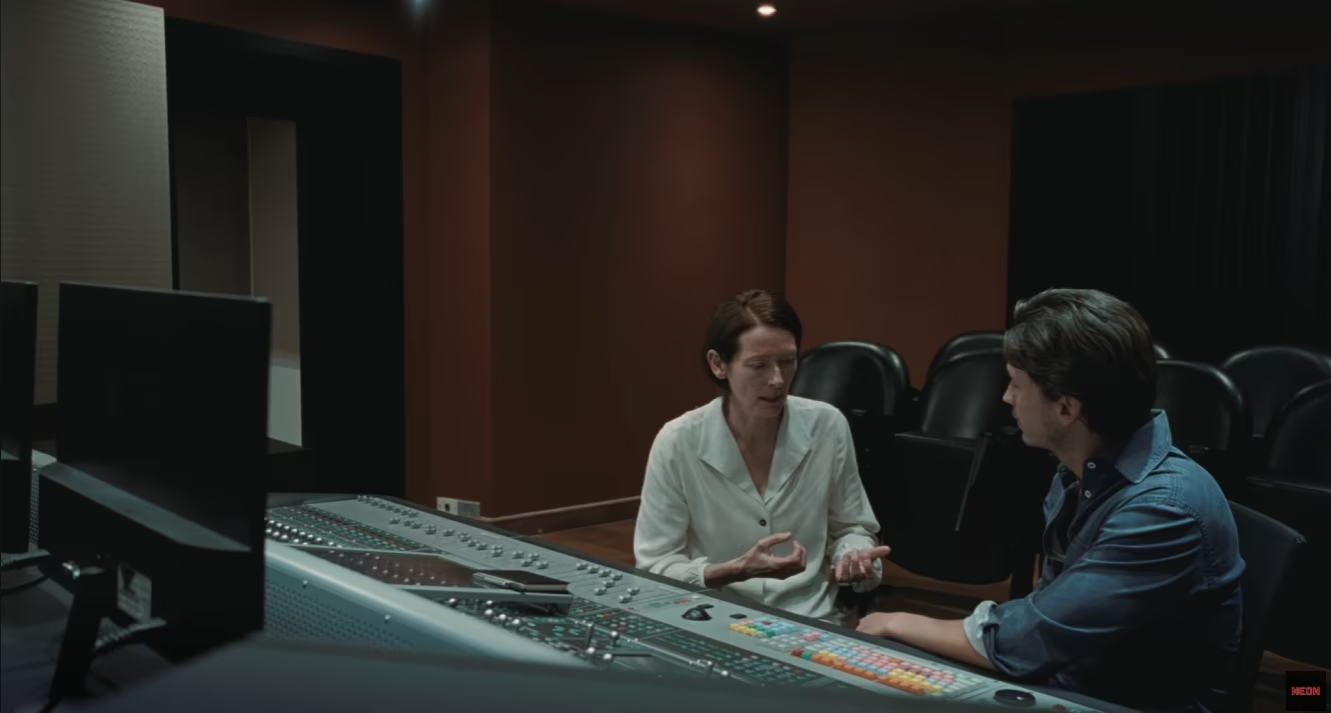
Desperate for clarity, Jessica enlists the help of a young, patient sound engineer, Hernán Bedoya (Juan Pablo Urrego). In one of the film’s most captivating and meticulously crafted sequences, the two sit in a sterile recording studio attempting to recreate the sound. Jessica fumbles for adjectives, utilizing what Juan describes as “perfect for poetry” broken Spanish to describe the noise as being “like a big concrete ball that falls into a metal well which is surrounded by seawater”. Using a massive cinematic sound library—featuring bluntly named audio files like “stomach punch in hoodie”—Hernán manipulates frequencies, adding earthier tones, tweaking the bass, and altering the decay until the synthetic noise perfectly aligns with the devastating phantom sound in Jessica’s mind. However, when Jessica returns to the university studio days later to find Hernán, she is met with blank stares; the staff claims no one by that name has ever worked there.
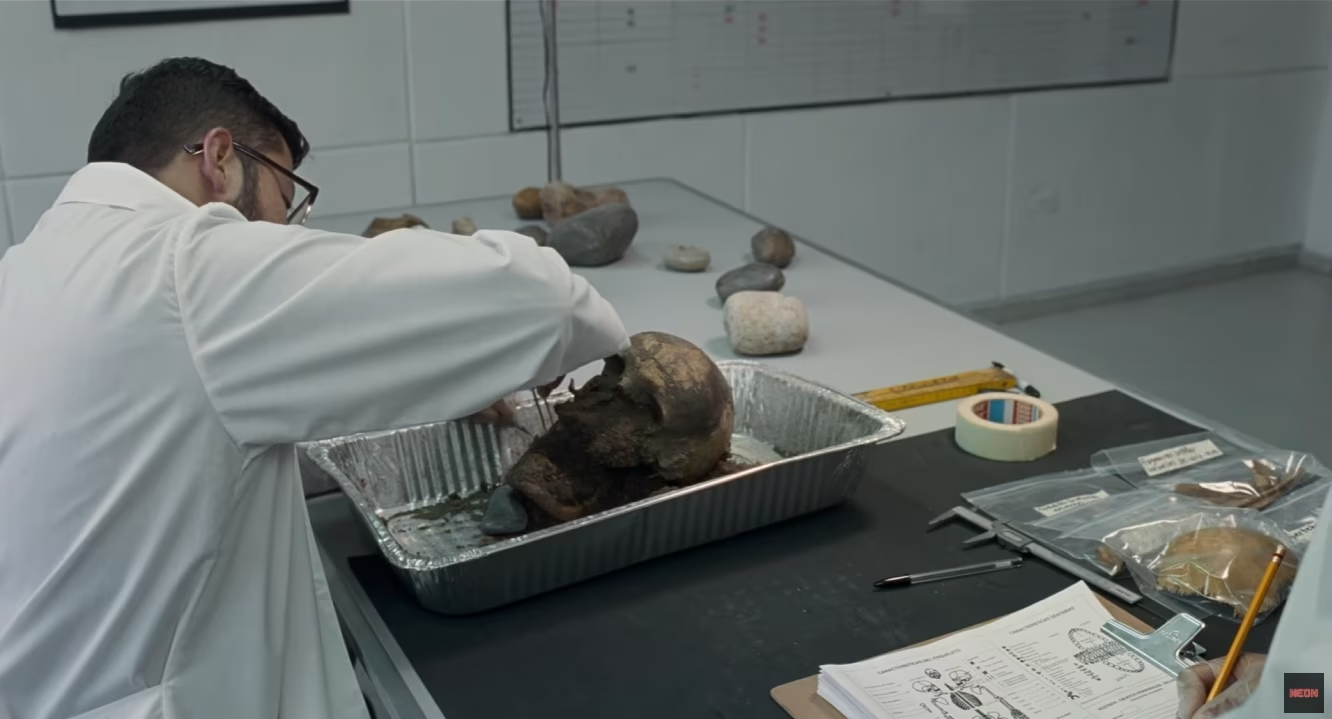
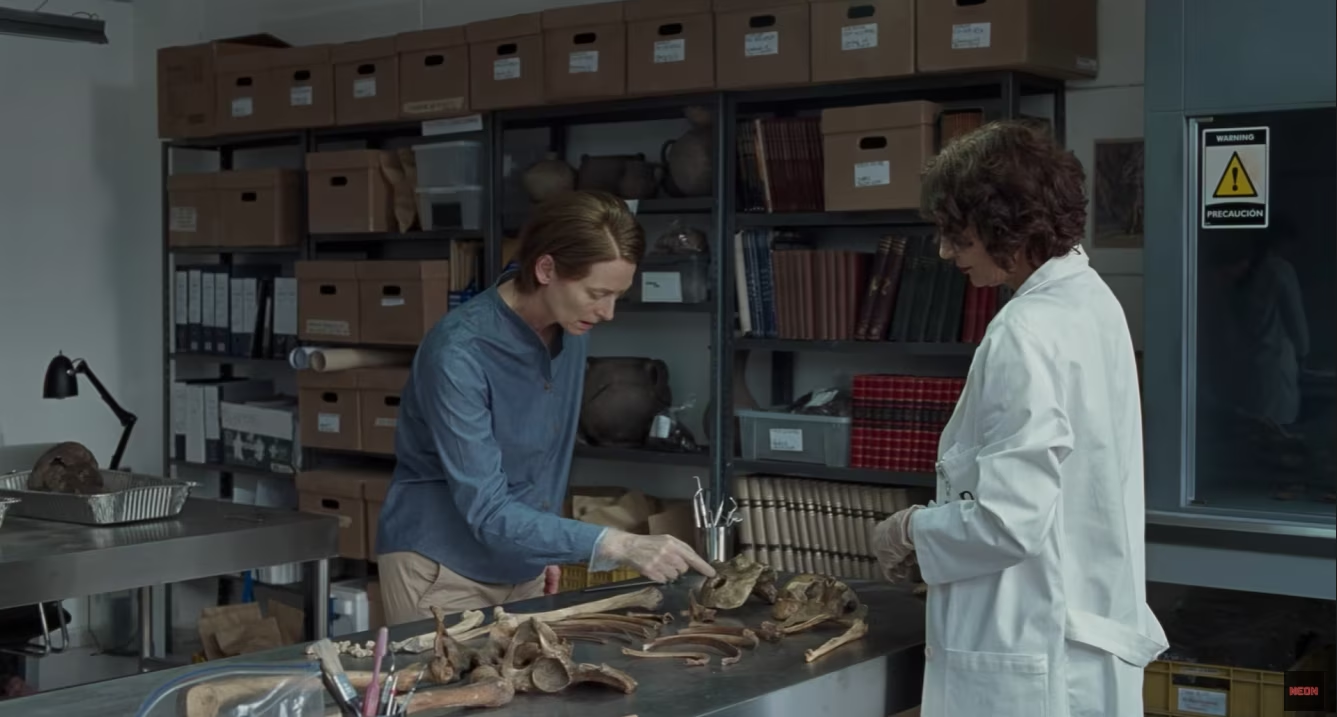
Parallel to this auditory quest, Jessica befriends a French archaeologist, Agnes Cerkinsky (Jeanne Balibar), who is analyzing human remains unearthed during the construction of the La Linea tunnel—a massive, real-world infrastructure project cutting through the Andes mountains. Agnes shows Jessica a 6,000-year-old skull pierced with a perfect, circular hole. This physical evidence of ancient trepanation—a primitive surgical procedure ostensibly performed to release evil spirits or relieve extreme cranial pressure—serves as a potent historical mirror to Jessica’s own mental burden and her unspoken desire to drill through her psychological distress to find peace.

The Rural Descent: Pijao and the Weight of Time
The second half of the film transitions from the strict, concrete geometry of the city into the verdant, unpredictable ecosystem of the Colombian jungle near Pijao. Here, the rational, scientific approach of Bogotá gives way to an intuitive, animistic reality.
Wandering aimlessly by a rushing river, Jessica encounters an older man expertly scaling fish. He introduces himself as Hernán (Elkin Díaz). This older Hernán is an anomaly; he never leaves his small, isolated village, claiming that travel, television, and new experiences overwhelm his fragile system. He suffers from a form of hyperthymesia, an infallible memory that forces him to recall every minute detail of his existence—a condition explicitly reminiscent of Jorge Luis Borges’s literary character “Funes the Memorious”. For this Hernán, memory is not a past tense phenomenon; it is a relentless, inescapable, eternal present.
Invited into his sparse, memory-crammed home, Jessica and Hernán share a moment of profound metaphysical communion. In a sequence that actively challenges the boundaries of traditional cinema pacing, Hernán demonstrates his ability to “stop” time by entering a death-like sleep, remaining perfectly still with his eyes open, unblinking, while Jessica watches over him. Upon waking, the two physically connect, grasping hands. In this gesture, the cinematic language shifts into pure psychic transference. Jessica becomes a human antenna, receiving a torrential download of Hernán’s memories—and by extension, the deeply traumatic memories of the land itself. She hears the muffled voices of the past, the violence of history, and the hidden stories of the earth, experiencing a life that is not her own. The culmination of this connection leaves Jessica weeping, not for her own pain, but for the immense, collective sorrow she has just absorbed.
Critical Review: The Aesthetics of Sonic Trauma and Hammock Cinema
To critically review Memoria is to evaluate a work of profound structural audacity. The film operates on a vibrational frequency rather than a narrative one. Critic Evan Morgan posited the concept of “hammock cinema” to describe Weerasethakul’s work: films that appear to reject storytelling actually rely on a tightly woven narrative structure, upon which the more readily apparent free-floating atmosphere and extended shots are given elegance and order. The cinematography by Sayombhu Mukdeeprom relies heavily on static, protracted long takes that force the viewer’s eye to wander the frame, finding microscopic details in the mundane, turning the act of watching into an active meditation.
However, the true star of Memoria is its groundbreaking sound design, orchestrated by Akritchalerm Kalayanamitr, Richard Hocks, and Javier Umpierrez. The soundscape is an intricate tapestry of ambient noise—humming refrigerators, backfiring bus engines, rustling foliage, and howling monkeys. The recurring “boom” acts almost like the kaisaku stick in Zen meditation, a jarring auditory strike designed to snap the drifting, sleepy mind back into acute awareness, keeping the audience engaged through the glacial pacing. Weerasethakul weaponizes silence and ambient noise to create an environment where the audience, like Jessica, becomes hyper-sensitive to every auditory shift.
Thematically, the film weaves Colombia’s history of paramilitary violence and societal trauma into its deep subtext. The pedestrian who dives to the ground in sheer terror at the sound of a backfiring bus is a visceral reminder of a population conditioned by decades of conflict. By declining to present this violence explicitly, Weerasethakul suggests that trauma is not always visible; often, it is trapped in the earth, in the architecture, and in the sound waves that echo eternally through time.
3. Memoria Ending Explained: Global Streaming Platforms and Exhibition
The distribution strategy for Memoria was initially as unconventional and challenging as the film itself. Upon acquiring the rights, its North American distributor, NEON, announced a radical release model: the film would play “in front of only one solitary audience at any given time,” embarking on a perpetual, never-ending roadshow from city to city, one theater a week, indefinitely. The distributor stated emphatically that it would never be released on DVD, Blu-ray, or digital streaming platforms, ensuring that the film remained a strictly communal, theatrical experience. This bold strategy aimed to preserve the integrity of the film’s complex, highly calibrated sound mix, which was specifically engineered for advanced cinematic acoustic environments, arguing that watching it on a laptop or standard television would destroy the artistic intent.
However, the global distribution landscape has varied outside of North America, and the film eventually found its way to digital platforms in specific international regions, accommodating audiences who could not participate in the exclusive roadshow model. Furthermore, curated arthouse cinemas continue to host special screenings globally. Below is a comprehensive breakdown of the film’s availability:
| Platform / Venue | Availability Type | Regional Limitations & Details | Format Quality |
|---|---|---|---|
| MUBI | Subscription Streaming | Exclusive streaming rights in Germany, India, Brazil, Argentina, Mexico, Chile, Turkey, etc. (Not available in the US/UK via MUBI due to theatrical exclusivity). | HD Cinematic Audio |
| Apple TV / iTunes | VOD (Rent/Buy) | Available in select markets including Australia, USA, and New Zealand. | HD / SD |
| Amazon Prime Video | VOD (Rent/Buy) | Available for rental in specific international markets; availability fluctuates based on regional licensing. | HD / SD |
| Rakuten TV | VOD (Rent/Buy) | Select European markets offering rental and purchase options. | HD / SD |
| Google Play Movies | VOD (Rent/Buy) | Select international markets across Europe and Asia. | HD / SD |
| Kanopy | Library Streaming | Available through participating public libraries and universities globally, allowing free access with a library card. | HD |
| Zawya / Cairo Screenings | Theatrical Screenings | Independent theaters in the Middle East and Egypt occasionally feature the film in festival or curated arthouse contexts, preserving the theatrical intent. | Theatrical DCP |
Note: The availability of the film is highly subject to shifting regional licensing agreements. Viewers in North America may still need to rely on the traveling roadshow or specialized physical screenings for the optimal experience.
4. Memoria Ending Explained: An Exhaustive Deep Dive into the Climax
To address the keyword “Memoria ending explained” is to confront the film’s breathtaking, polarizing climax directly—a sequence that bridges the gap between the deeply terrestrial and the inexplicably cosmic. It is a moment that recontextualizes the entire 140 minutes that preceded it.
After her intense psychic communion with Hernán, wherein she absorbs the collective memories of the region, Jessica walks away from his rural home, appearing visibly altered but calmer. The camera cuts away from her to an exterior wide shot of the verdant, dense Colombian jungle canopy. Suddenly, the source of the booming noise is revealed in all its magnificent absurdity. A large, organic-looking spaceship, resembling an armored whale or a prehistoric biological construct, emerges silently from the trees. The craft swivels in the air, lifts upward, and then violently ignites its engines. The exhaust from the ship produces the exact concussive, metallic boom that has plagued Jessica throughout the film—the concrete ball hitting the metal well. As the ship rockets into the sky, it leaves behind a dissipating ring of exhaust, acting almost like a portal, and the sound slowly fades into the atmosphere. Back on the ground, Hernán sits on his porch, casually listening to a radio broadcast about the archaeological discovery of ancient human remains, while Jessica stares out of an open window, finally experiencing a state of tranquil relief.
The Spaceship: A Cosmic Organism
The introduction of a literal spaceship in the final act of a meditative, slow-paced arthouse drama is a jarring juxtaposition, yet it feels entirely earned within Weerasethakul’s meticulously crafted universe. The director has long been fascinated by science fiction, extraterrestrial life, and the works of authors like Arthur C. Clarke, Isaac Asimov, and Ray Bradbury.
However, the spaceship in Memoria is not a conventional sci-fi trope representing a hostile invasion, nor is it a traditional first contact narrative. Instead, it serves as a metaphorical and literal manifestation of the “Wholly Other”—a transcendental force that operates completely outside human logic. The ship represents a grand, cosmic perspective on time. Just as the earth holds the bones of a 6,000-year-old girl subjected to trepanation, the universe holds entities that operate on scales of time and space far beyond human comprehension. The sound of the ship’s engine is described earlier as a “rumble from the core of the earth,” deliberately blurring the line between extraterrestrial technology and the primal, geological groan of the planet itself.
The Concept of the Human Antenna and the Living Archive
The ending fundamentally reframes Jessica’s character and her suffering. She is not suffering from a simple psychiatric ailment, nor is she spiraling into madness; rather, she is functioning as an “antenna”. As a foreigner detached from her own cultural grounding, grieving an unspoken loss, and struggling with a new language, she operates as a blank slate, an empty vessel highly capable of picking up on the invisible frequencies of the world around her.
Conversely, the older Hernán describes himself as a “hard disk,” a living repository of localized memory that cannot be erased. When Jessica physically touches his arm, she connects the antenna to the hard drive, allowing the accumulated data of the region—the trauma, the history, the lives lived and lost, and perhaps even the presence of the alien craft—to flow directly through her.
When the spaceship departs, the noise finally ceases. Jessica’s affliction ends because the physical source of the transmission has left the earth, or, more philosophically, because she has finally understood and processed the true nature of the signal. The gentle rain that falls during the end credits signifies a deep cleansing, a cathartic release of the immense tension that had built up in her mind and in the very soil of the landscape.
A Warning or an Epiphany?
The ending can be interpreted as a profound epiphany regarding humanity’s cosmic connection, a reminder of our minuscule place in the universe. It suggests that the past is never truly dead; it is merely vibrating at a frequency we normally cannot hear without the right equipment. Weerasethakul uses the spaceship to ask the audience to reconsider their relationship with their environment. Have we become so alienated from nature, from our history, and from each other that the natural phenomena of the earth seem alien to us? The spaceship, taking off from the dense jungle rather than a futuristic launchpad, implies that the extraordinary is inherently woven into the tapestry of the mundane.
5. Memoria Ending Explained: Comprehensive FAQ Addressing Audience Queries
The enigmatic, fiercely uncompromising nature of Memoria has generated a multitude of questions from audiences seeking to decode its narrative logic, symbolic language, and subtle character interactions. Below is a comprehensive, exhaustive breakdown answering the most pressing inquiries surrounding the film.
What exactly is the booming sound in the context of the story?
On a literal, narrative level within the film’s climax, the sound is the sonic boom of the alien spacecraft’s engine igniting as it departs from the Colombian jungle. On a metaphorical and thematic level, the sound represents the suppressed trauma, the buried memories, and the violence of the earth—a historical echo demanding to be acknowledged. The sound functions as a psychological trigger, disrupting the illusion of a peaceful present by forcibly injecting the weight of the past into Jessica’s consciousness. Medically and biographically, the premise is based directly on the director’s own experience with “Exploding Head Syndrome,” a real parasomnia characterized by the perception of a loud noise during the transition between waking and sleep.
Are the young Hernán (the sound engineer) and the older Hernán (the fish scaler) the same person?
The film offers no explicit, dialogue-driven confirmation, but vast thematic evidence suggests a metaphysical continuity between the two men, despite the physical impossibility of them existing simultaneously. They share the same name, and both possess an acute, almost supernatural relationship with sound, memory, and recording. The younger Hernán manipulates sound digitally, attempting to synthesize memory through technology; the older Hernán internalizes memory physically, living as a biological archive. When the younger Hernán vanishes from the Bogotá studio as if he never existed, it implies a shift in reality, a collapse of timelines, or that he was a manifestation designed to lead Jessica to the jungle. Weerasethakul’s cinema frequently features shape-shifting and reincarnated souls (as seen prominently in Uncle Boonmee and Tropical Malady), suggesting the two Hernáns are different physical manifestations of the same spiritual entity, acting as guides for Jessica.
Who are the “Invisible People” mentioned by Karen in the hospital?
During a critical conversation in the hospital, Jessica’s sister Karen discusses a tribe of “invisible people” living deep in the Amazon who allegedly cast powerful spells to keep outsiders away, linking this phenomenon to her own mysterious respiratory illness. This subplot serves as a potent metaphor for the marginalized, forgotten, and often brutalized indigenous populations of South America, whose rich histories and current traumas remain invisible to modern, urbanized society. Jessica’s unique ability to hear the booming sound aligns her with these unseen forces; she becomes a conduit for the invisible, granting auditory presence to that which has been visually and historically erased.
Is Jessica actually dead, dreaming, or an alien herself?
While audience interpretations vary wildly, the narrative architecture does not strictly support the theory that Jessica is literally an extraterrestrial or a ghost. Instead, she is an expatriate in a state of deep psychological, linguistic, and sensory dislocation. The film’s opening shot of her waking up heavily suggests the possibility that the entire film operates within a dream logic—a liminal space between consciousness and sleep. As an outsider isolated by language and geography, she is highly susceptible to the lingering energies of the land. She is a living human being, but her profound alienation strips her of her earthly defenses, making her function like an antenna, picking up frequencies that local inhabitants have learned to tune out or suppress for survival.
What is the thematic significance of the 6,000-year-old skull?
The skull, excavated by Agnes from the La Linea tunnel project, features a trepanation hole—an ancient surgical practice of drilling directly into the cranium. In the context of the film, it serves as a visceral, physical representation of Jessica’s internal struggle. Just as ancient peoples drilled holes to release malevolent spirits or alleviate immense pressure, Jessica is desperately searching for a way to release the booming sound trapped inside her own head. The skull also reinforces the overarching theme of “acoustic archaeology,” demonstrating that human intervention, violence, and primitive attempts at healing leave permanent, physical marks on the world, waiting to be unearthed millennia later to tell their story.
Why does Jessica ask about a dog that was never hit by a car?
In a restaurant scene with her sister, Jessica asks about a stray dog that was hit by a car, a story she vividly remembers Karen telling her. Karen’s complete ignorance of this event suggests several unsettling theories. Either Jessica is experiencing the terrifying onset of madness, she is peering into an alternate timeline, or, most likely within the film’s animistic logic, she has already begun absorbing memories belonging to someone else entirely. The film treats memories as fluid, independent entities that can detach from their original hosts and float through the ether, infecting vulnerable, open minds like a virus.
Why does the camera linger for so long on seemingly empty spaces or sleeping characters?
Weerasethakul’s signature “slow cinema” aesthetic is deeply intentional and vital to the film’s impact. By holding a static shot of a sleeping man (Hernán) for an uncomfortable duration, the director forces the audience to transition from passive viewing to active, scrutinizing observation. It induces a meditative, hypnotic state, fundamentally altering the audience’s perception of time. This technique challenges the frantic, cut-heavy pacing of modern media, demanding immense patience and rewarding the viewer with subtle, beautiful details—the shifting of light, the rustle of leaves, the intricate layers of the sound mix—that would otherwise be entirely missed.
6. Cast and Characters
The performances in Memoria are universally characterized by a profound, disciplined restraint. The actors eschew traditional theatricality and melodrama in favor of a quiet, internalized intensity, allowing the heavy atmosphere of the film to take precedence over spoken dialogue.
| Actor Name | Character Name | Role and Narrative Significance |
|---|---|---|
| Tilda Swinton | Jessica Holland | A Scottish botanist residing in Colombia. As the central protagonist, Swinton employs an anti-method acting approach, stripping her performance of excess. Jessica acts as an “antenna” for the suppressed sonic and historical memories of the earth, drifting through the narrative in a somnambulant state. |
| Elkin Díaz | Older Hernán Bedoya | A solitary, stoic fish scaler residing in the rural town of Pijao who suffers from hyperthymesia. He functions as the biological “hard drive,” storing the immense burden of collective memory without being crushed by it. |
| Juan Pablo Urrego | Younger Hernán Bedoya | A brilliant, patient sound engineer in Bogotá who helps Jessica perfectly synthesize the sound haunting her, before inexplicably vanishing from reality, acting as an auditory guide. |
| Jeanne Balibar | Agnes Cerkinsky | A French archaeologist studying ancient human remains at the La Linea tunnel excavation. Her character provides a scientific and historical anchor to Jessica’s otherwise purely psychological quest. |
| Agnes Brekke | Karen Holland | Jessica’s sister, hospitalized in Bogotá with a mysterious illness potentially linked to the spells of the “invisible people” of the Amazon, demonstrating the fragility of the human body and memory. |
| Daniel Giménez Cacho | Juan Ospina | Karen’s husband and a local poet, who provides a grounded, slightly skeptical counterpoint to the film’s metaphysical drift, while appreciating the poetry in Jessica’s struggle. |
| Constanza Gutierrez | Dr. Constanza | A physician who refuses to prescribe Jessica heavy sleeping pills (Xanax), advising her instead to rely on Jesus and an orthopaedic pillow. This interaction highlights the comedic clash between modern medicine and spiritual/psychological ailments. |
| Jerónimo Barón | Mateo Ospina | The young son of Karen and Juan, representing the innocent continuation of the family line amidst the chaos of memory. |
7. Memoria Ending Explained: Secrets, Theories, and Cinematic Nuances
To fully appreciate Memoria, one must look far beyond the immediate narrative and delve into the esoteric theories, historical parallels, and hidden secrets that Weerasethakul has meticulously woven into the subtext of the film.
The Jacques Tourneur Connection
The name of Tilda Swinton’s character, Jessica Holland, is not a coincidence. It is a direct, deliberate homage to the character played by Christine Gordon in Jacques Tourneur’s classic 1943 horror film, I Walked with a Zombie. In Tourneur’s film, Jessica Holland is a woman tragically trapped in a comatose, zombie-like state on a Caribbean island, caught helplessly between the realms of the living and the dead. Weerasethakul explicitly envisioned Memoria as a scenario in which this comatose character suddenly wakes up in modern-day Bogotá, drawn inexorably by a trauma she cannot remember. This intertextual secret reinforces the somnambulant, ghost-like quality of Swinton’s performance, as she wanders the film like a displaced spirit seeking rest.
The Specter of Hernán Cortés and Historical Amnesia
The recurring name “Hernán” carries immense, bloody historical weight in Latin America. Hernán Cortés was the infamous Spanish conquistador responsible for the fall of the Aztec Empire, initiating centuries of violent colonization, bloodshed, and cultural erasure across the Americas. By naming both the young sound engineer and the old guardian of memories “Hernán,” the film subtly invokes the violent origins of the modern South American geopolitical landscape. The older Hernán’s absolute inability to forget acts as a poetic counterbalance to the historical amnesia often imposed by conquering forces. He holds the memories of the victims, ensuring the land remembers what the official history books might omit. Furthermore, Medellín, Spain, is the actual birthplace of Hernán Cortés, drawing a parallel to the Colombian city where Jessica normally resides.
The La Linea Tunnel and Penetrating the Earth
The film’s geographical midpoint centers around the construction of the La Linea tunnel, a massive, real-world engineering project that bores straight through the Colombian Andes. Weerasethakul was deeply fascinated by this project, viewing it as a violent act of penetrating the earth’s flesh. The severe geological and engineering challenges that have continuously plagued the tunnel’s construction serve as a metaphor for the difficulty of navigating Colombia’s complex, scarred political history. The tunnel is a literal intersection where the relentless push for modern progress violently collides with the ancient, buried past, represented perfectly by the 6,000-year-old skull found at the site.
Acoustic Archaeology and the Exploding Head Syndrome
The deeply autobiographical genesis of the film stems directly from Weerasethakul’s own diagnosis with Exploding Head Syndrome. While traveling extensively through Colombia, the director was repeatedly awoken by terrifying imaginary explosions. Rather than viewing this purely as a medical nuisance to be medicated away, he embraced it as a sensory anomaly, eventually missing the sound when it mysteriously ceased. This personal affliction evolved into the philosophical concept of “acoustic archaeology”—the idea that sound waves from past events do not disappear but become trapped in the environment, echoing eternally in the architecture and the soil. Jessica acts as a human microphone, a highly sensitive instrument capable of detecting these residual frequencies that everyone else ignores.
Deleted Scenes and The Philosophy of the Editing Room
Through the publication of the Memoria production book (meticulously edited by Giovanni Marchini Camia), secrets regarding the film’s rigorous editing process were revealed. Weerasethakul is notorious for “killing his darlings” in the editing suite. The original script contained much more explicit backstory for Jessica, including the major revelation that she was a recently bereaved widow. By excising this explicit grief, the director stripped away conventional psychological motivations, leaving Jessica as a pure, unburdened vessel for the audience to inhabit. Other deleted sequences included surreal dream scenes shot through a hole in the ground and raw footage of pig births on set. The removal of these scenes emphasizes Weerasethakul’s ultimate dedication to minimalism, demanding that the audience rely on feeling, sound, and atmosphere rather than narrative exposition.
Memoria is not a puzzle meant to be cleanly solved; it is a sonic environment meant to be fully inhabited. By concluding the film with the revelation of a primordial spacecraft and a torrent of transferred memories, the director shatters the boundaries of conventional narrative realism, ushering the audience into a realm of profound metaphysical contemplation. The booming sound is the sound of time itself—an auditory scar left by violence, evolution, and the cosmic ballet of the universe. For the viewer willing to surrender to its rhythms, the film acts as the ultimate exercise in empathy and acoustic sensitivity, proving that cinema remains an art form capable of rewiring the human soul.
read also : Disclosure Day Ending Explained: The Definitive Breakdown of Spielberg’s 2026 Sci-Fi Masterpiece