Scary Movie 2026 Ending Explained, The comedy landscape has experienced a dramatic and highly publicized drought over the past decade, with theatrical spoof films practically vanishing from the global box office. However, on June 5, 2026, Paramount Pictures released the sixth installment of the legendary parody franchise, officially titled simply Scary Movie (though colloquially and widely referred to as Scary Movie 6). Directed by Michael Tiddes and produced under a first-look deal with Miramax, this release marks a monumental cinematic event for fans of early-2000s comedy: the long-awaited, highly anticipated return of the Wayans family. Decades after a highly publicized and incredibly bitter departure from the intellectual property they created, Marlon, Shawn, and Keenen Ivory Wayans returned to reclaim their legacy, writing and producing the film alongside Craig Wayans and Rick Alvarez.
The release of Scary Movie 2026 operates not merely as a spoof of contemporary horror but as a sharp, aggressive, and deeply meta-textual critique of Hollywood’s current obsession with “legacy sequels” or “requels”. Over the past five years, the horror landscape has been entirely dominated by revivals of franchises like Scream, Halloween, and The Exorcist, where aging legacy characters are forced to return simply to pass the torch to a younger, often less charismatic generation. Scary Movie takes this exact trope, weaponizes it, and ultimately burns it to the ground in a shocking finale that has left audiences and critics deeply divided.
This exhaustive research report dissects every conceivable element of the 2026 release. It explores the intricate and bloody ending, analyzes the highly divisive critical reception, breaks down the massive ensemble cast, evaluates the competitor landscape, and examines the extensive catalog of hidden Easter eggs, parodies, and secrets embedded within the narrative.
The Hollywood Context: Why the Wayans Reclaimed Their Throne
To truly comprehend the sheer vitriol and meta-humor layered into Scary Movie 2026, one must first examine the complicated behind-the-scenes history of the franchise itself. The original Scary Movie (2000) was a cultural juggernaut. Created by Keenen Ivory, Shawn, and Marlon Wayans as a direct parody of the slasher resurgence triggered by Wes Craven’s Scream and I Know What You Did Last Summer, the film shattered records for R-rated comedies, establishing a specific brand of crass, unapologetic, and highly topical humor.
Following the release of Scary Movie 2 (2001), the Wayans family was unceremoniously ousted from the franchise by the studio executives at Miramax, which was then run by Bob and Harvey Weinstein. The studio reportedly lowballed the creators’ contracts during negotiations, effectively forcing the family to walk away from the multibillion-dollar intellectual property they had built from scratch. Miramax retained the rights and proceeded to produce Scary Movie 3, 4, and 5 utilizing different directors, writers, and comedians. While the third installment (directed by David Zucker) found some commercial success, the franchise experienced a steep decline in critical and cultural relevance, culminating in the critically reviled Scary Movie 5 in 2013. By the end of the 2010s, the franchise was considered culturally dead, entirely disconnected from its original voice.
Twenty-five years later, the cinematic landscape shifted. The Wayans struck a deal with Paramount Pictures and Miramax to return, armed with an estimated $30 million budget to resurrect the series. This historical grievance fuels the central narrative of the 2026 film. The anger regarding stolen intellectual property, replaced creators, and the corporate dilution of a comedy brand is explicitly woven into the dialogue and the shocking twist ending. The film operates on two distinct levels: a surface-level parody of modern horror, and a deep, meta-narrative about the Wayans family demanding respect and ownership of their art.
Competitor Analysis: The State of the Spoof Genre in 2026
The release of Scary Movie provides a fascinating case study in market analysis for the modern comedy genre. For years, spoof comedies were a favorite among Hollywood moviegoers, but the genre gradually vanished. Why did the spoof movie die, and how does the 2026 release attempt to navigate this resurrected market?
The death of the spoof genre can be directly attributed to the severe oversaturation of lazy imitators in the late 2000s and early 2010s. Filmmakers like Jason Friedberg and Aaron Seltzer (the minds behind Date Movie, Epic Movie, and Meet the Spartans) stripped the genre of actual joke-writing and narrative structure. They replaced setup and punchline dynamics with mere pop-culture recognition. A character would walk on screen dressed as a superhero, fall over, and the scene would end. Audiences quickly grew tired of the formula, and studios pivoted toward character-driven comedies or superhero blockbusters.
The 2026 Scary Movie attempts to course-correct this historical decline by hiring a massive ensemble of genuinely talented comedic actors and targeting a modern pop-culture landscape that is an absolute goldmine for parody. Hollywood in 2026 is packed with horror franchises, legacy sequels, influencer culture, AI fears, and viral internet trends, providing ample material. Furthermore, the film faced stiff competition at the summer box office, releasing alongside the Amazon big-budget adventure Masters of the Universe and the viral-hit horror adaptations Backrooms and Obsession. Despite harsh critical reviews, early box office tracking indicated that Scary Movie would likely outperform Masters of the Universe, proving that there is a massive, underserved demographic desperate for unapologetic, R-rated theatrical comedies.
However, some critics argue that the film still occasionally falls into the Friedberg and Seltzer trap. While it successfully parodies the structure of the modern Scream requels, certain scenes involving movies like The Substance or M3GAN rely purely on the audience pointing at the screen and recognizing the reference, rather than executing a clever subversion of the source material. When compared to recent comedy reboots, such as the critically acclaimed The Naked Gun revival in 2025, Scary Movie 2026 struggles to maintain a consistent batting average. Critics noted that while The Naked Gun fired jokes at a rapid pace with a high success rate, Scary Movie operates on pure volume, hoping that if it throws enough jokes at the wall, a few are bound to stick.
Comprehensive Cast & Character Deconstruction
The 2026 production serves as a massive, unprecedented reunion, bringing back actors who have not shared the screen in over two decades. Simultaneously, it introduces a younger cast meant to satirize the “Gen Z” protagonists of modern horror films. The dynamic between the legacy characters and the “new blood” forms the thematic core of the movie.
The Legacy “Core Four” Characters
| Actor | Character | 2026 Character Evolution & Parody Target |
|---|---|---|
| Anna Faris | Cindy Campbell | The ultimate parody of the “Final Girl.” In the 2026 iteration, Cindy has transformed into a paranoid, doomsday prepper living in an isolated, heavily booby-trapped house. This is a direct parody of Jamie Lee Curtis’s portrayal of Laurie Strode in the 2018 Halloween reboot. Cindy is estranged from her daughters and completely detached from society until Ghostface resurfaces. Later, she adopts a John Wick persona, fighting killers with rubber dildos. |
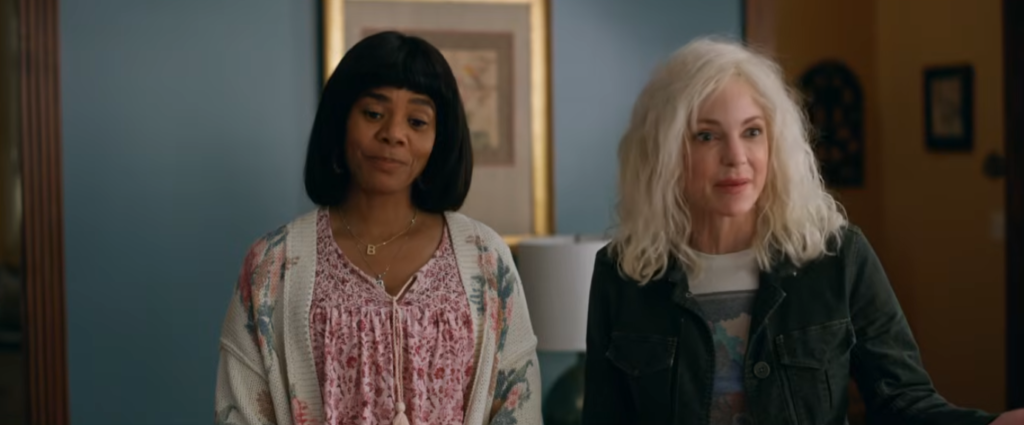
| Regina Hall | Brenda Meeks | Cindy’s best friend returns, though she is now styled aggressively to resemble Octavia Spencer in the horror film Ma. Brenda remains loud, inappropriate, and entirely unbothered by the supernatural violence occurring around her, completely disregarding the trauma of the younger generation. |
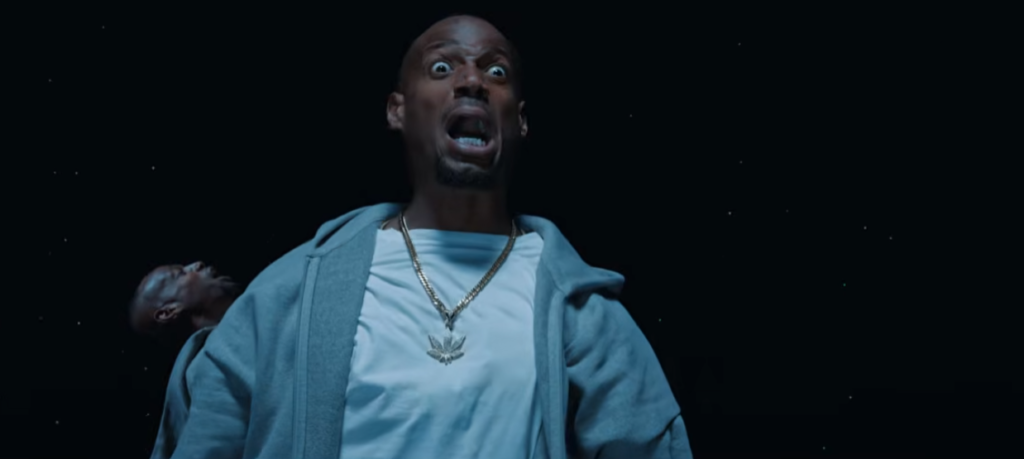
| Marlon Wayans | Shorty Meeks | Brenda’s perpetually intoxicated brother has somehow become a millionaire streamer and cryptocurrency enthusiast, hosting a “Halloweenathon”. Despite his immense wealth, Shorty remains exactly as he was in 2000, functioning as the vehicle for the film’s modern internet-culture jokes and streaming parodies. |
| Shawn Wayans | Ray Wilkins | Brenda’s partner, Ray, is still engaging in the exact same denial regarding his sexuality that defined his character in the first two films. His storyline features a heavy parody of the film Sinners, where he attempts to “pray the gay away” in front of a church congregation, only for the scene to devolve into a massive twerking dance routine. |
The “New Blood” Replacements
The film deliberately introduces a younger cast that mirrors the characters from the 2022 Scream reboot, allowing the Wayans to mock the current trend of replacing beloved characters with younger, often less charismatic actors.
| Actor | Character | Requel Parody Counterpart |
|---|---|---|
| Olivia Rose Keegan | Sara Campbell | Cindy’s eldest estranged daughter. The character is written as a direct parody of Melissa Barrera’s Sam Carpenter from Scream (2022). Keegan brilliantly delivers a hyper-accurate, breathy impression of a young Anna Faris, capturing the exact comedic cadence Faris utilized in the year 2000. |
| Savannah Lee Nassif | Tuesday Campbell | Cindy’s younger daughter. She is named “Tuesday” in a blatant, lazy-on-purpose parody of Jenna Ortega’s iconic character Wednesday. Her brutal attack in the opening act perfectly mirrors Ortega’s opening scene in the fifth Scream film. |
| Cameron Scott Roberts | Jack | Sara’s highly suspicious boyfriend, explicitly designed to look identical to Jack Quaid’s villainous character from Scream (2022). |
| Sydney Park & Gregg Wayans | Dei & Brad Meeks | Brenda’s twin children, serving as direct parodies of the Meeks-Martin twins (Mindy and Chad) from the modern Scream requels. They represent the overly analytical, meta-aware generation of modern horror survivors. |
| Ruby Snowber | Val | Brad’s girlfriend, who operates as the secondary required killer in the classic slasher setup. |
Returning Supporting Cast, Cameos, and Missed Opportunities
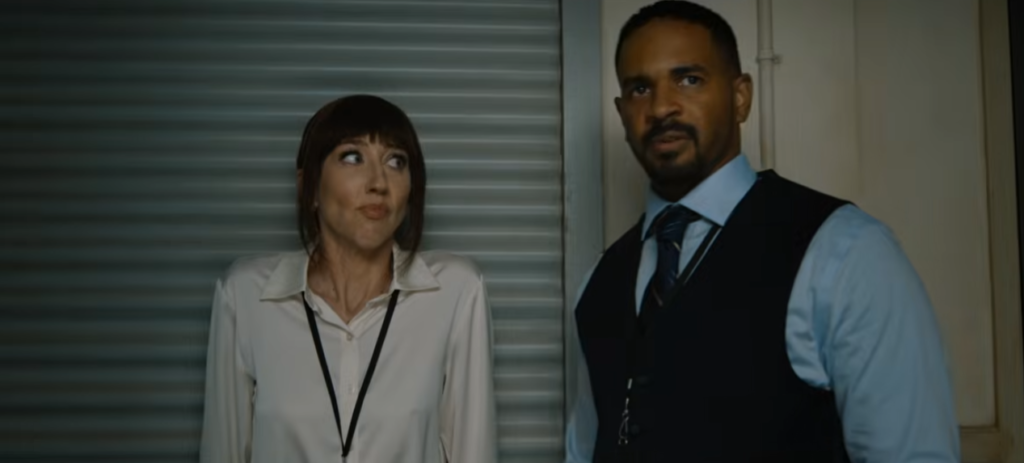
The film is densely packed with cameos from previous installments and modern pop culture figures, though some appearances are arguably wasted. Dave Sheridan makes a triumphant return as Doofy Gilmore, the parody of David Arquette’s Dewey. Doofy has been pardoned for his crimes on January 6th, and remains deeply entrenched in juvenile, scatological humor. He actively fights Ghostface using his unwashed, feces-covered hands, recycling a classic joke from the original film that continues to divide audiences. Cheri Oteri also returns as Gail Hailstorm, the ruthless, opportunistic news reporter who is now desperate for relevance in the era of fake news.
Lochlyn Munro returns briefly as Greg Phillippe, the former high school jock who is now a law enforcement agent grappling with his transgender son, Jess (played by Benny Zielke). Chris Elliott reprises his role as the creepy caretaker with the deformed hand from Scary Movie 2, though his highly promoted return is shockingly relegated to a brief background gag and the post-credits sequence. Additional cameos include Kim Wayans playing a hospital nurse who refuses to fight Ghostface because she is on her union-mandated break, and Damon Wayans Jr. appearing as Agent Underwood.
Noticeably absent from the massive reunion is Shannon Elizabeth, who famously played Buffy Gilmore in the original film. When questioned about her absence, Marlon Wayans confirmed that there was no personal animosity, but rather that the script simply featured too many returning characters to give everyone adequate screen time. The exclusion sparked minor backlash among hardcore fans, especially considering the film made room for internet personalities like Twitch streamer Kai Cenat, who makes a cameo only to be abruptly beheaded by Ghostface.
Plot Synopsis and Thematic Breakdown
The central narrative framework of Scary Movie 2026 lifts heavily from the fifth and sixth Scream films, utilizing their structure as a clothesline on which to hang a relentless barrage of disconnected pop-culture parodies. The formula is intentionally derivative: a masked killer returns to a sleepy town, targeting the offspring of the original survivors, forcing the original heroes out of retirement to pass the torch.
The film opens with a high-energy parody of the Scream 6 alleyway scene. Singer and actress Teyana Taylor sits in a bar waiting for a Tinder date, only to be lured into a dark alley by Ghostface. Instead of running and screaming, Taylor brutally attacks Ghostface, bragging about her chiseled abs and bludgeoning the killer with a Golden Globe award—a sharp, meta-textual nod to her recent real-life Oscar snubs. This sets the tone immediately: the victims in this universe are entirely desensitized to horror tropes.
The plot then shifts to Tuesday Campbell being attacked in her home. This inciting incident draws her pill-popping sister Sara and her heavily suspicious boyfriend Jack back to town. They seek out their estranged mother, Cindy, who is hiding in her booby-trapped fortress, complete with spike pits that she occasionally falls into herself. Soon, Brenda, Shorty, and Ray are inevitably pulled back into the fray to protect the younger generation.
As the narrative progresses, it frequently abandons the core plot to indulge in absurd tangents. For example, when Shorty is attacked by Ghostface, he is hypnotized and sent into “The Sunken Place,” a direct parody of Jordan Peele’s Get Out. However, instead of a terrifying psychological void, Shorty lands in a “K-Pop Hole,” where he encounters and has intimate relations with K-Pop demon hunters in a bizarre, animated musical sequence. Similarly, Brenda accidentally gives trick-or-treating children marijuana edibles from Shorty’s stash. The film then painstakingly recreates the haunting, atmospheric opening of the horror film Weapons, showing the high children running down the street with their arms out to a folk-rock song.
The younger cast members are systematically stalked by Ghostface through various locations, including a subway system populated by other horror icons like Jason Voorhees, Leatherface, and M3GAN. The chaos inevitably leads to a massive climax at an isolated house party, mirroring the structure of every traditional slasher film, setting the stage for the ultimate subversion of the genre.
Scary Movie 2026 Ending Explained: A Meta-Rebellion
The ending of Scary Movie 2026 is where the Wayans completely abandon traditional narrative structure and comedic spoofing in favor of a brutal, aggressive, and highly meta-textual statement about the modern film industry. The finale operates on three distinct layers of parody and commentary, resulting in a triple-twist that redefines the legacy of the franchise.
Layer One: The Traditional Requel Twist
As the survivors gather in the final act to confront the killer, the film executes a classic “killer reveal.” Sara’s boyfriend Jack and Brenda’s son’s girlfriend Val pull off their Ghostface masks, revealing themselves as the masterminds behind the murders. This directly copies the twist of Scream (2022), where the romantic partners of the protagonists are revealed to be toxic, obsessed fans trying to reboot the franchise. However, mid-monologue, before Jack and Val can fully explain their convoluted motives, they are suddenly and brutally murdered by an entirely different group of Ghostface killers.
Layer Two: The Usurpers Punished
The secondary group of Ghostface killers removes their masks to reveal the ultimate twist: the killers are Shawn Wayans, Marlon Wayans, Shaquille O’Neal, and Anthony Anderson. The meta-joke becomes immediately apparent to long-time fans of the series. Shaquille O’Neal and Anthony Anderson prominently starred in Scary Movie 3 and Scary Movie 4—the specific films produced after the Wayans were fired by Miramax.
Shawn and Marlon confront Shaq and Anthony, demanding to know why they agreed to participate in sequels that stole the Wayans’ intellectual property and diluted their brand. After a hilarious, tense exchange where Marlon mocks Shaq’s famously unintelligible podcasting voice, the Wayans brutally stab Shaq and Anthony to death. This act serves as a metaphorical execution of the “usurpers” of their franchise, allowing the Wayans to visually reclaim their stolen property on screen.
Layer Three: Burning Down the Torch-Passing Trope
With the rival actors dead, only the “Core Four” (Cindy, Brenda, Shorty, and Ray) and the surviving new-generation teens remain. A brief moment of peace seems to settle over the group. The veterans discuss how “requels” work, noting that a Halloween movie cannot function without Jamie Lee Curtis, and a Scream movie is absolute garbage without Neve Campbell. They agree to a truce.
However, the ungrateful teenage characters immediately interrupt, disrespecting the legacy cast. They suggest that Cindy and Brenda should step aside so the young cast can take over the franchise moving forward, mockingly calling them “decrepit seniors” and “the oldies”.
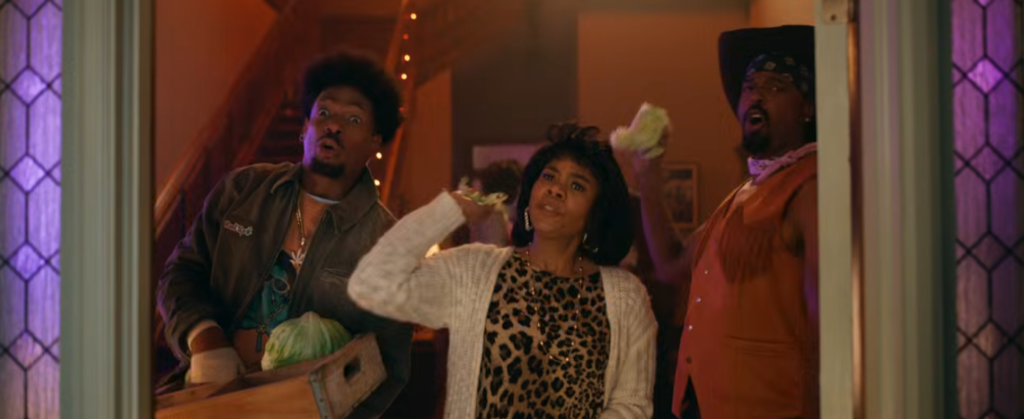
This insult triggers the final, shocking, and deeply dark twist. The original four characters—the heroes of the film—look at each other, realizing they absolutely despise the younger generation. Rather than peacefully passing the torch as Hollywood tradition dictates, Cindy, Brenda, Shorty, and Ray lock the teenagers inside the wooden house. They pour gasoline over the entire property and burn the young cast alive.
The film concludes with an epic, slow-motion shot of Shorty, Ray, Cindy, and Brenda walking away from the massive inferno, staring directly into the camera and flipping the middle finger.
Thematic Meaning of the Brutal Finale
The ending is a massive, undisguised middle finger to Hollywood studio executives and modern cinematic trends. The Wayans are making a definitive, aggressive statement: legacy characters and original creators should not be forced to act as stepping stones for younger, cheaper, and less charismatic actors. By literally burning the “new generation” to ashes, the Wayans reclaim complete ownership of their franchise. The twist ensures that if a Scary Movie 7 happens, it will solely feature the original cast, violently refusing to succumb to the modern Hollywood machine’s demand for younger demographics and legacy passing.
Post-Credits Scenes and Hidden Easter Eggs
Modern theatrical releases demand post-credits scenes, and Scary Movie delivers two highly absurd stingers that abandon the main plot entirely.
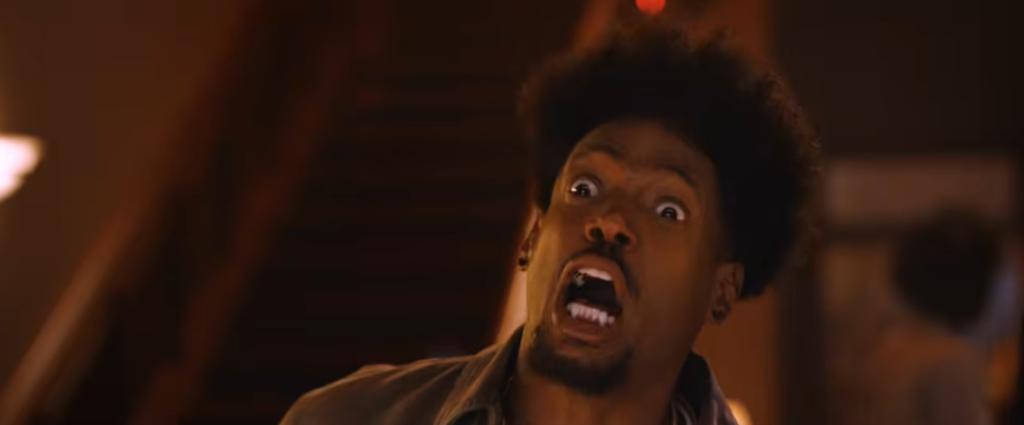
The first is a mid-credits scene featuring a fake movie trailer for a film titled Bros Feratu, a direct parody of Robert Eggers’ highly acclaimed gothic horror film Nosferatu. The scene features a Black vampire hovering over a sleeping white woman with a visible erection, prompting a group of Black women in the background to loudly complain about the vampire’s dating preferences. The scene is completely disconnected from the main plot but serves as a final, absurdist sketch that some critics felt was too random, while others found it to be a highlight of the film’s willingness to go anywhere for a joke.
The second post-credits scene features the return of Chris Elliott’s creepy caretaker character from Scary Movie 2, engaging in a grotesque physical comedy bit involving his deformed, small hand and one of the younger Wayans nephews. It functions merely as a crude nod to hardcore fans of the earlier films.
The Master Index of Parodies
A spoof film lives and dies by its pop-culture references. The 13-year hiatus provided the writers with a massive backlog of cinema to mock. The film crams an overwhelming number of visual gags, dialogue references, and direct scene recreations into its 96-minute runtime.
| Horror Film/Trend | Execution in Scary Movie 2026 |
|---|---|
| Scream (2022) & Scream VI | Forms the entire structural spine of the movie. The Ghostface attacks, the alleyway opening, the bodega attacks, and the bodega subway sequences are all heavily featured. |
| Get Out (2017) | Ghostface hypnotizes Shorty, sending him into “The Sunken Place.” However, Shorty lands in a “K-Pop Hole,” triggering an animated musical sequence. |
| Terrifier (Franchise) | A faux Art the Clown dresses as a mall Santa, handing out wrapped gifts to children that turn out to be severed body parts. |
| The Substance (2024) | Cheri Oteri’s character is injected with a neon fluid called “The Stuff.” Instead of birthing a younger version of herself, her back splits open to birth a dossier of the Jeffrey Epstein flight logs, followed by the emergence of one of the Wayans in their White Chicks makeup. |
| Weapons (2026) | Brenda accidentally gives trick-or-treating children marijuana edibles. The film recreates the haunting opening of Weapons, showing the high children running down the street with their arms out to a folk-rock song. |
| Longlegs (2024) | Nicolas Cage’s bizarre, prosthetic-heavy serial killer is parodied throughout the background sequences, though the character rarely interacts with the main cast. |
| Final Destination | Cindy’s daughter works at a Final Destination theme park, where extreme, Rube Goldberg-esque fatal accidents occur continuously in the background of normal conversations. |
| Michael (2026 Biopic) | Keanan Thompson appears as an actor attempting to play Michael Jackson. He attempts to moonwalk, falls over, and is berated by Jermaine Jackson for lacking talent and having a terrible hairline. |
| Smile (2022) | Characters are repeatedly told to “stop fucking smiling” during serious moments. |
| John Wick | During the climax, Cindy abandons horror tropes and goes into “Wick mode,” executing a dozen Ghostface killers with long brunette hair and tactical rubber dildos. |
Critical Reception vs. Audience Divide: The Cancel Culture Debate
Upon its release on June 5, 2026, Scary Movie was met with a harsh, highly polarized critical reception, debuting with a 31-32% score on Rotten Tomatoes based on over 58 professional reviews, and a dismal score of 37 on Metacritic. The immense divide between professional critics and general audiences highlights a massive shift in comedic sensibilities and cultural acceptable norms.
Why the Critics Panned the Film
Professional reviewers largely condemned the film for its complete lack of narrative cohesion and its aggressive, unapologetic mean streak. Critics noted that the film operates less like a cohesive movie and more like a disjointed Saturday Night Live sketch assembled for the TikTok generation.
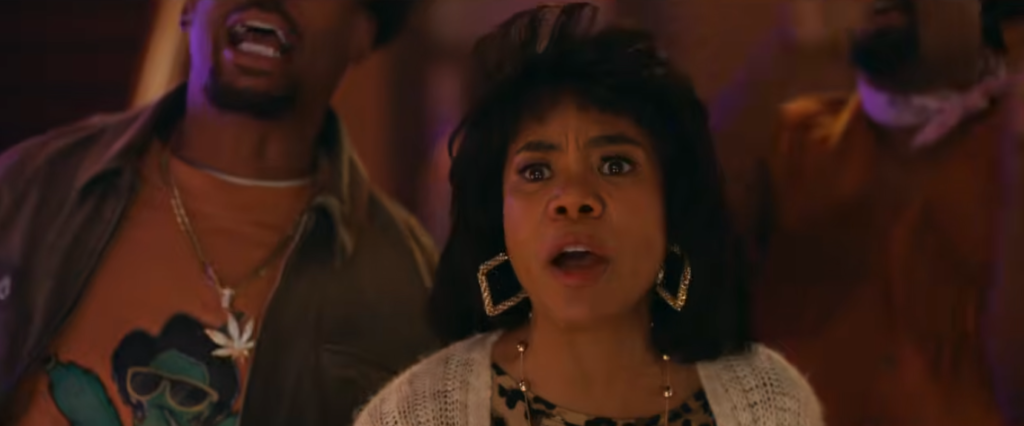
However, the primary source of critical outrage stemmed from the film’s “anti-woke” humor. The Wayans deliberately targeted highly sensitive social issues, leading to accusations of transphobia, homophobia, and political insensitivity. For example, a deeply controversial scene on a subway features Ghostface stabbing a non-binary character; when bystanders attempt to help the victim, the victim aggressively corrects their pronoun usage, prompting the bystanders to join Ghostface in stabbing the victim to death. Another scene features a transgender teenager calling for help from the pool boy and gardener, only to look outside and see ICE agents deporting the workers.
Critics vehemently labeled these jokes as “punching down” at marginalized communities, calling the humor regressive and dangerously outdated. Reviewers argued that early Scary Movie entries punched up at Hollywood institutions and untouchable celebrities, whereas the 2026 film targets vulnerable groups with lazy, boomer-tier internet humor that lacks genuine satirical bite.
The Audience and Creator Perspective
Conversely, the Wayans family aggressively defended the film’s tone, arguing that the backlash proves their exact point. Shawn and Kim Wayans explicitly stated on the red carpet that the core purpose of the 2026 reboot was to “cancel cancel culture”. They argued that the world has become overly toxic, politically polarized, and stressed, and that true comedy requires an environment where absolutely no subject is off-limits and no group is safe from mockery.
For fans of the original early-2000s era, the film delivers exactly what was promised on the poster. It is crass, cruel, juvenile, and completely devoid of moral messaging. Audiences looking for high-brow, emotionally resonant satire were fundamentally misunderstanding the assignment; Scary Movie has always been about gross-out gags, blunt force trauma, bodily fluids, and ridiculous celebrity cameos. Reviewers who defended the film noted that criticizing a Scary Movie for being offensive is akin to criticizing a horror movie for having too much blood—it is a foundational feature of the brand, not a bug. The film’s robust audience verification scores (hovering near 70%) indicate that for moviegoers seeking an escape from overly sanitized modern entertainment, the Wayans’ specific brand of chaos is still highly effective.
Frequently Asked Questions (People Also Ask)
To provide a comprehensive overview of the film and address the most heavily searched queries surrounding the 2026 release, the following section tackles the most prominent questions from audiences and search engines.
Who is the real killer in Scary Movie 2026?
The film features a layered, multi-tier twist regarding the identity of Ghostface. Initially, the killers are revealed to be Sara’s boyfriend Jack and Brenda’s son’s girlfriend Val, mimicking the toxic fan teenage killers of Scream (2022). However, before they can act, they are immediately killed by a second group of Ghostfaces: Shawn Wayans, Marlon Wayans, Shaquille O’Neal, and Anthony Anderson. Ultimately, the true “villains” of the film are the original protagonists themselves (Cindy, Brenda, Ray, and Shorty), who systematically murder the entire new generation of teens in a fiery climax to prevent their beloved franchise from being taken over by younger actors.
Why wasn’t Shannon Elizabeth in Scary Movie 6?
Fans of the original 2000 film were highly disappointed by the notable absence of Shannon Elizabeth, who played the fan-favorite character Buffy Gilmore (a parody of Sarah Michelle Gellar). Marlon Wayans addressed the controversy directly on social media, stating that there was no personal animosity between the creators and the actress, but the script simply featured “toooooo many people coming back”. With a massive ensemble cast required to spoof an entire decade of horror, the writers could not find narrative space for Buffy. Wayans did, however, hint that she could return in a future installment if the franchise continues.
Is Scary Movie 2026 a reboot, a sequel, or a requel?
The film is technically a “legacy sequel” or “requel.” It acts as the sixth official film in the franchise but completely ignores the continuity of Scary Movie 3, 4, and 5—the films made without the Wayans’ involvement. It acknowledges the passage of 26 years since the events of the original films and directly mocks the concept of rebooting a franchise with younger actors while keeping the legacy cast around as mentors.
Does Scary Movie 6 have a post-credits scene?
Yes, the film features two additional sequences that play during the credits. The mid-credits scene is a fake trailer for Bros Feratu, a spoof of the gothic horror film Nosferatu, featuring a culturally specific take on a vampire’s dating habits. The post-credits scene features the highly anticipated return of Chris Elliott’s creepy caretaker character from Scary Movie 2, engaging in a physical comedy bit with his deformed hand.
What is the runtime of Scary Movie 2026?
Scary Movie 2026 has an official runtime of 96 minutes (1 hour and 36 minutes), keeping it in line with the fast-paced, brief runtimes typical of the spoof comedy genre.
Why is the Rotten Tomatoes score so low for Scary Movie 2026?
The film debuted with a Rotten Tomatoes score of 31%. Critics heavily penalized the film for its disjointed, sketch-comedy structure and its reliance on mean-spirited humor aimed at the LGBTQ+ community, non-binary individuals, and other marginalized groups. However, fans of the franchise argue that the low score is indicative of a cultural divide between professional critics and general audiences, as the film was specifically engineered to be offensive and challenge modern sensitivities.
Just as Widow’s Bay leaves us questioning everything, other series have delivered equally stunning twists; explore our full breakdown of the [Masters of the Universe Ending Explained: Shocking Cast & Hidden Facts] for more hidden details
You can explore the brilliant comedic audiobooks and original stories that inspire today’s biggest stand-up comedians. Start listening to thousands of hilarious, premium audiobooks for FREE today with an Audible Premium Plus trial.
Start your FREE Audible Trial and listen to the funniest stories right here.
(Disclosure: As an Amazon Associate, memoria.film may earn a commission from qualifying purchases or free trial sign-ups through this link, at no additional cost to you. This helps support our cinematic archive.)