Backrooms Ending Explained, A24’s theatrical adaptation of Backrooms (2026), directed by twenty-year-old visionary Kane Parsons and written by Will Soodik, represents a monumental shift in modern psychological horror. Rather than relying on cheap jump scares or standard monster-in-the-house tropes, the film utilizes the infinite, decaying yellow corridors of the internet’s most famous creepypasta to build a claustrophobic masterclass in existential dread.
The film replaces the amorphous horror of the web series with a deeply tragic and highly structured metaphorical narrative. At its core, the Backrooms are not just a glitch in reality—they are a non-Euclidean physical manifestation of unresolved human trauma, dementia, and our toxic cycles of complacency.
The Spatial Anomaly: The Non-Euclidean Metrics of Reality Glitching
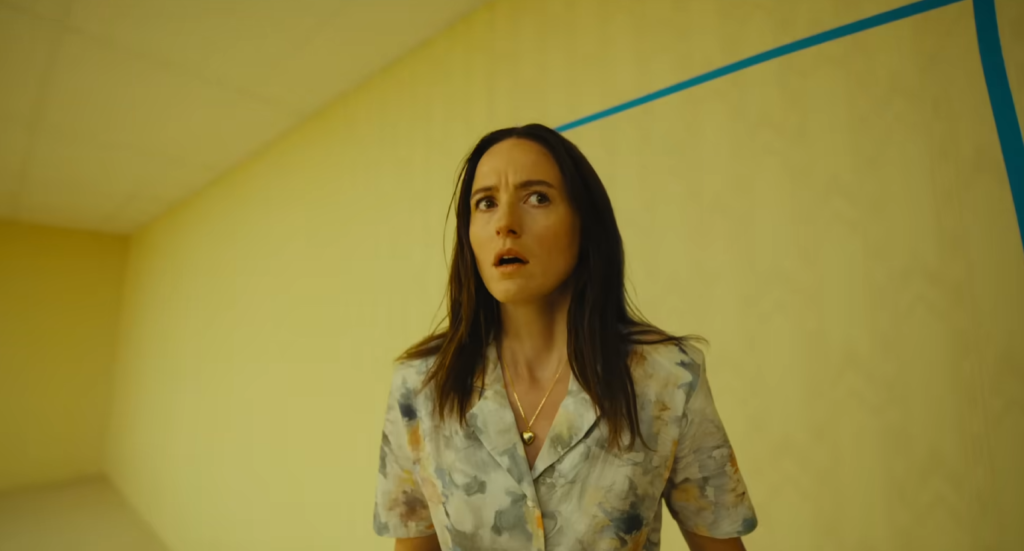
To understand the tragedy of Backrooms, we must first address how the physical space functions. Unlike the real world, the spatial layout of the yellow labyrinth actively rejects Euclidean geometry.
Under standard physical metrics, the distance $d$ between two coordinates in flat $\mathbb{R}^3$ space is defined by the classical formula:
$$d(P, Q) = \sqrt{(x_2 – x_1)^2 + (y_2 – y_1)^2 + (z_2 – z_1)^2}$$
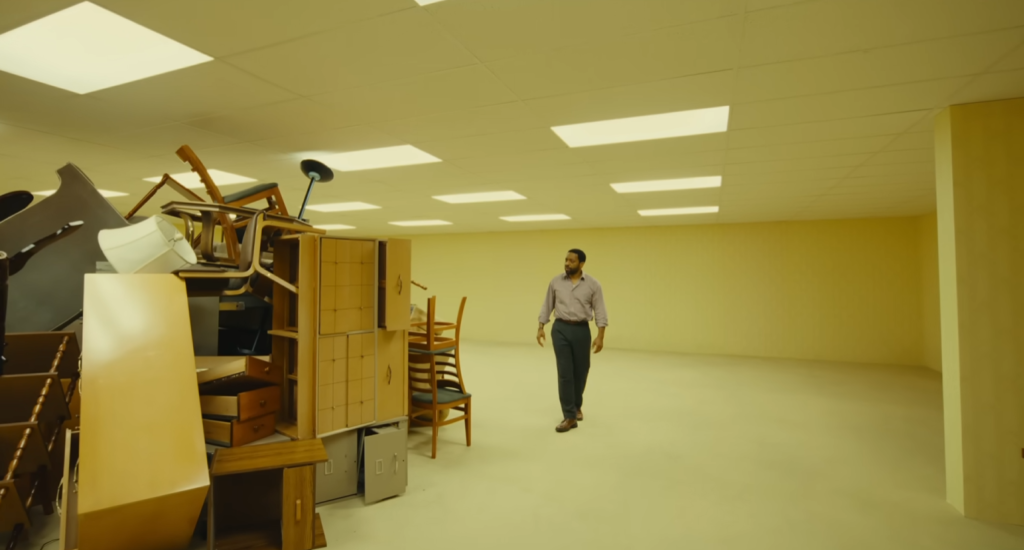
Within the Backrooms, however, this metric breaks down entirely. The spatial manifold is governed by an unstable metric tensor $g_{\mu\nu}$, where spatial coordinates fold in on themselves. Corridors expand infinitely, empty furniture showrooms morph into childhood memories, and human beings “no-clip” through structural seams where reality’s collision detection simply fails. This spatial distortion mirrors the psychological deterioration of those trapped within it, serving as an echo chamber for their deepest regrets.
Clark’s Internal Trap: The Ottoman Empire and the Complacency of Decay
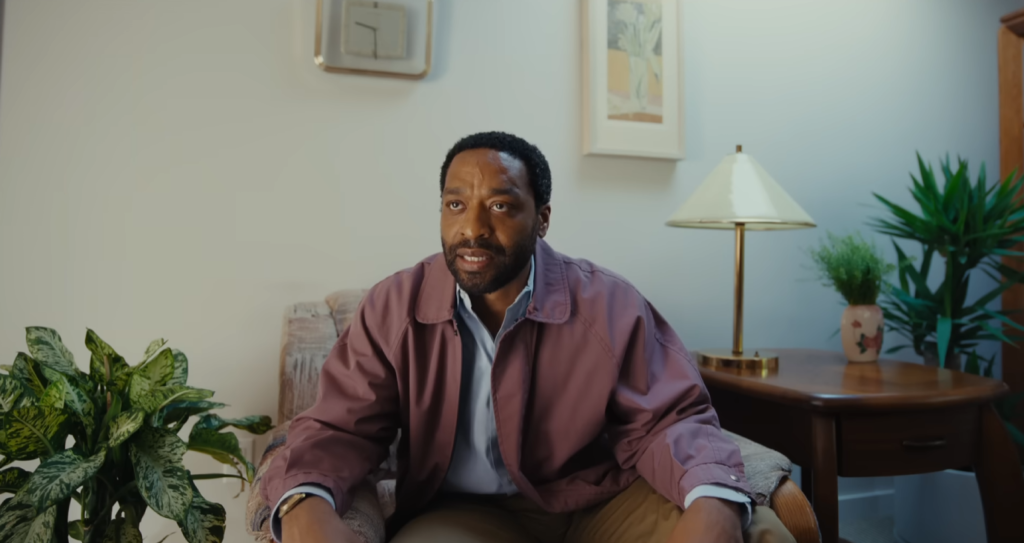
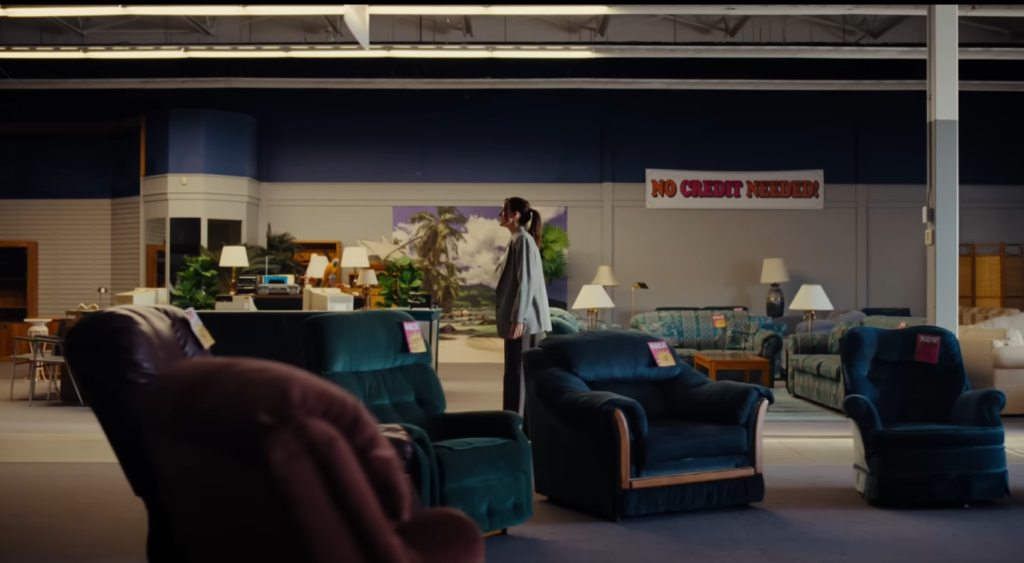
Chiwetel Ejiofor delivers a harrowing performance as Clark, the bankrupt, alcoholic owner of a discount furniture store called “The Ottoman Empire”. Struggling to cope with a bitter divorce and a crumbling life, Clark discovers a “null zone” portal in his store’s basement.
Instead of running from the horror of the yellow maze, Clark becomes obsessed with it. He begins mapping the corridors, eventually moving his entire life inside the Backrooms. Clark’s obsession is rooted in a profound midlife crisis. He views the Backrooms as a blank slate—an endless loop where he can escape the responsibilities and failures of his real-world marriage.
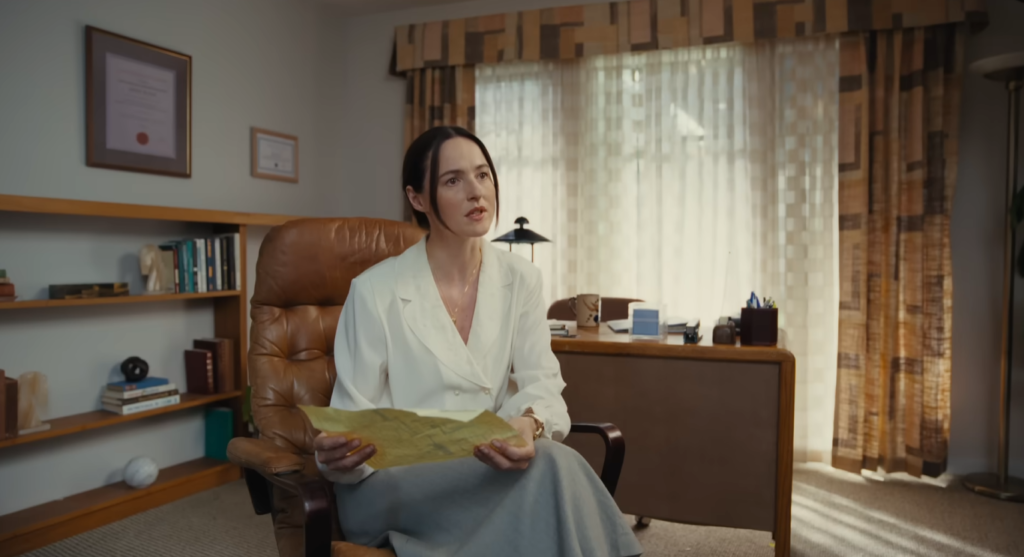
Clark’s fatal flaw is his absolute refusal to change. In his final, terrifying dinner party scene with his therapist Dr. Mary Kline (Renate Reinsve), Clark forces her to re-enact a therapy role-play surrounded by distorted, frozen human entities known as “Still Lifes”. He proudly declares that he does not need to change, and that he has found a space where he can simply exist in his complacency.
Who is “Captain Clark”? The Monster as Manifestation of Self-Loathing
The true horror of the climax is the revelation of “Captain Clark,” a mutated, towering pirate mascot monster that stalks the yellow halls. This creature is not an alien inhabitant; it is a physical manifestation of Clark’s internal darkness and repressed rage. Dressed in the mascot costume of Clark’s despised furniture store, the monster represents the toxic weight of his professional failures and toxic masculinity.
When Captain Clark enters the dinner party room, the real Clark attempts to embrace the entity, believing they are one and the same. He assures his copy, “It’s okay, we don’t need to change,” desperately clinging to his self-destructive behavior.
However, because the Backrooms operate as a brutal feedback loop of self-loathing, the monster spares no mercy. Captain Clark violently attacks and devours the real Clark. Clark is literally and metaphorically consumed by his own unexamined dark side—content to die rather than undergo the painful process of psychological growth and accountability.
Dr. Mary Kline’s Escape: Childhood Trauma and the Fragment of Cement
Renate Reinsve’s Dr. Mary Kline serves as the emotional anchor of the film. As Clark’s pragmatic therapist, Mary is secretly running from her own childhood trauma involving an agoraphobic, mentally ill mother and the traumatic demolition of her childhood home.
When Mary enters the Backrooms to rescue Clark, she finds herself chased by the mutated Captain Clark monster. Her escape sequence takes her through environments that mimic her childhood neighborhood, demonstrating that the Backrooms are digging into her subconscious as well.
In a pivotal moment of self-defense, Mary subdues the monster using a physical fragment of driveway cement that she has kept from her demolished childhood home. This is a deeply symbolic act. By weaponizing a physical piece of her past, Mary confronts her trauma directly. Unlike Clark, who ran from his past to live in a yellow loop, Mary uses the painful memory of her demolished childhood to break the cycle and physically escape the beast.
The Ending Explained: The Interrogation and the Haunting Still Life Copy
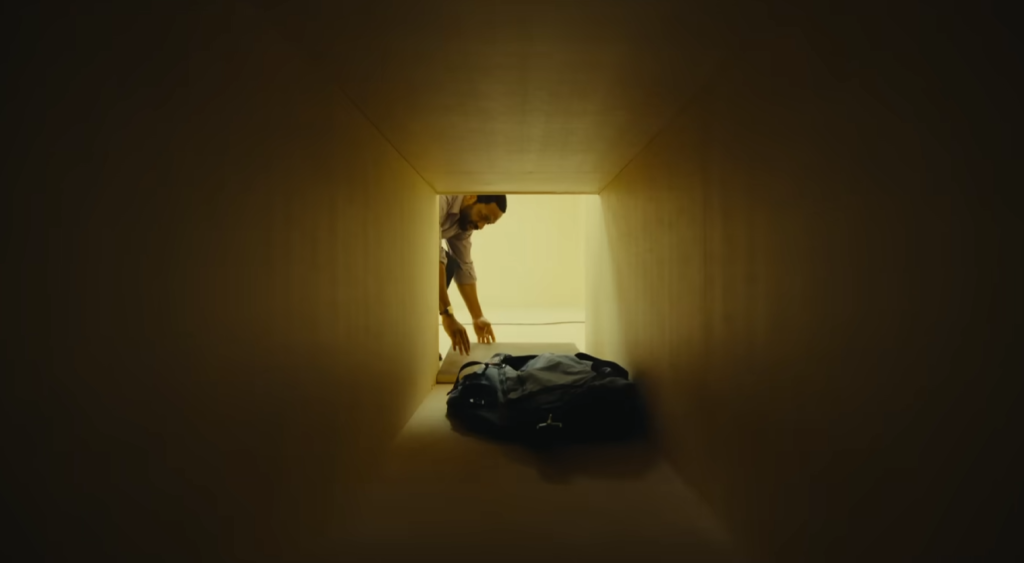
After crawling through a narrow escape hatch, Mary is immediately taken into custody by the clandestine ASYNC Research Institute, led by the detached, bureaucratic bureaucrat Phil (Mark Duplass).
During her isolation and interrogation, Phil reveals a terrifying global crisis: “null zones” are opening up all over the world, swallowing critical infrastructure, and ASYNC is desperately trying to map and utilize the space. When a traumatized Mary asks if she will ever be allowed to leave the facility, Phil coldly replies, “That’s not up to me.”
This interaction highlights the ultimate tragedy of Mary’s journey. While she successfully defended herself against her personal demons (Captain Clark), she has fallen straight into the hands of a cold, capitalistic machine. The corporate exploitation of the Backrooms mirrors the demolition of her childhood home: both represent cold, systemic structures erasing human memory and emotion for profit.
The film’s final, haunting shot features a slow pan across the empty yellow corridors of the Backrooms. In the center of a barren room sits a static, slightly distorted “Still Life” clone of Mary, rocking silently in a chair.
This ending leaves us with two chilling truths:
- The Backrooms Leave a Permanent Mark: Even if Mary’s physical body resides in an ASYNC isolation chamber, her passage through the liminal space has left an indelible imprint. The dimension has “remembered” and duplicated her trauma, trapping a copy of her forever in her own psychological cage.
- The Endless Loop: Mary remains trapped in her behavioral patterns. She sits in an ASYNC room looking out of a window pane, while her copy sits in a yellow room doing the exact same thing—destined to repeat her isolation forever.
The Sound of Decay: Dementia and “The Caretaker” Metaphor
One of the most brilliant thematic choices in Backrooms is the inclusion of the track “B1 – All That Follows Is True” from Everywhere at the End of Time by the ambient project The Caretaker.
The Caretaker’s album famously documents the cognitive stages of Alzheimer’s disease and dementia through decaying, repeating ballroom jazz loops. By utilizing this music, Kane Parsons draws a direct parallel between the physical structure of the Backrooms and the cognitive decline of the human mind.
The repeating yellow walls, the hallways that lead to dead ends, and the mangled anatomy of the “Still Life” entities represent the human brain trying to render memories of the real world but failing. Just as a dementia patient struggles to recall the face of a loved one—resulting in a distorted, unrecognizable memory—the Backrooms try to render bedrooms, kitchens, and neighborhoods, but end up creating an uncanny, terrifying loop.
Ultimately, Backrooms is a masterclass in liminal horror because it reminds us that the most terrifying monster is not something hiding in the dark, but the endless, empty loops of our own unresolved minds.
If you’re still reeling from that mind-bending finale, you won’t believe the hidden clues you missed. Uncover the full truth in our exclusive breakdown: [Widow’s Bay Ending Explained: Shocking Apple TV Cast, Hidden Secrets & Theories]
You can explore the brilliant comedic audiobooks and original stories that inspire today’s biggest stand-up comedians. Start listening to thousands of hilarious, premium audiobooks for FREE today with an Audible Premium Plus trial.
Start your FREE Audible Trial and listen to the funniest stories right here.
(Disclosure: As an Amazon Associate, memoria.film may earn a commission from qualifying purchases or free trial sign-ups through this link, at no additional cost to you. This helps support our cinematic archive.)