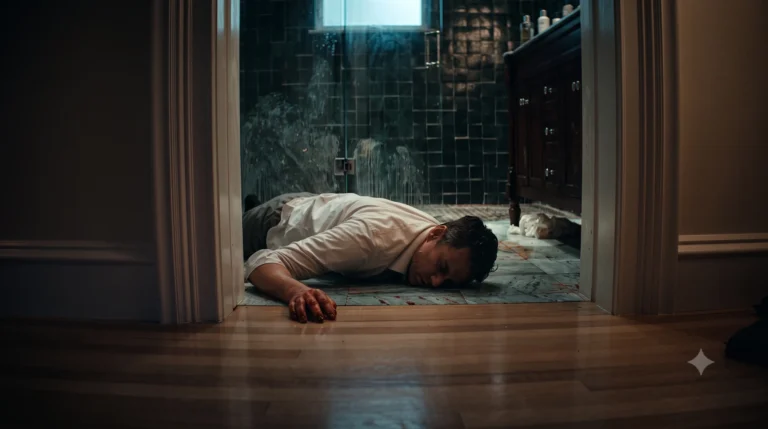
The East Palace ending explained & Spoilers Alert !
Are you seriously planning to ruin your weekend sleep schedule binge-watching Netflix’s latest 2026 drop, The East Palace?
Look. The 8-episode historical thriller is basically what happens if you throw The Conjuring and Stranger Things into a blender, and then add brutal Mortal Kombat sword fights. It is a highly ambitious, visually chaotic ride. But while the action sequences will literally flip the camera upside down to keep your eyes glued to the screen, you need to prepare for some noticeably cheap CGI and a mystery that becomes laughably predictable by the second half.
The Drowned Prince and the Reluctant Exorcist
Episode 1 does not waste time. The Crown Prince staggers through a shallow pond, coughing up blood before dropping dead in the water.
The Queen Mother immediately blames a 30-year-old ancient curse. King Yeongjong, playing the classic arrogant monarch, completely dismisses her and refuses to believe in superstitions.
Huge mistake.
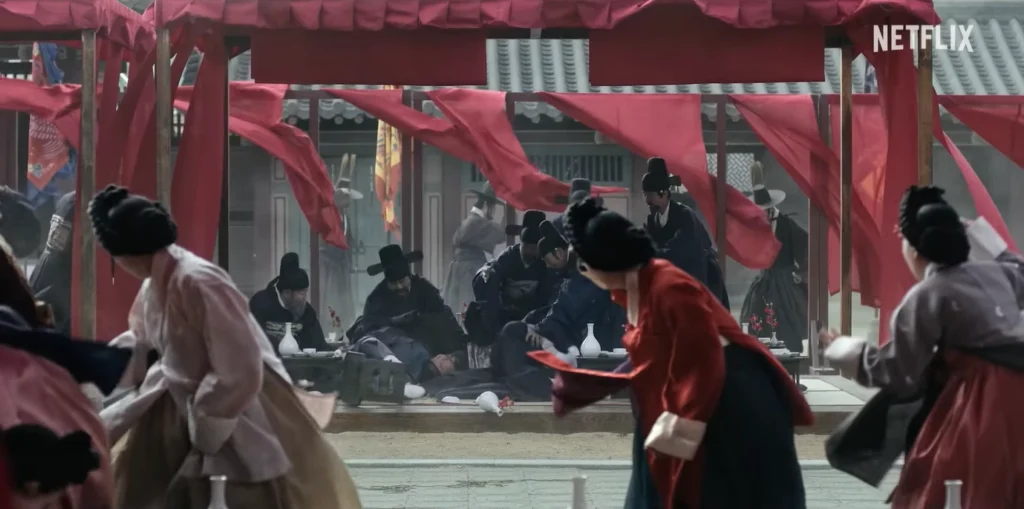
Almost immediately, water supernaturally floods the palace halls. A spirit paralyzes the King in his tracks, promising to eradicate his entire royal bloodline. Right on cue, the youngest prince gets possessed, goes violently insane, and tries to stab himself with a sword.
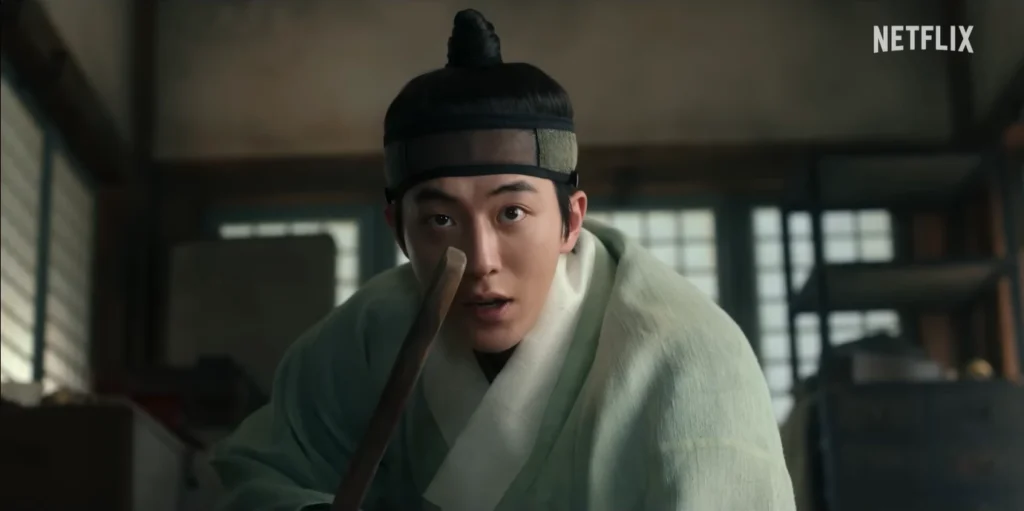
Enter Gu-cheon. He is not your standard noble hero. He is a cynical exorcist sleeping in a temple just to avoid the ghosts that constantly bother him when he is awake. His backstory is deeply traumatic. Years ago, his shaman mother jumped off a riverside cliff into deep water, drowning herself, but Gu-cheon miraculously survived underwater for 15 minutes. Now, he sees the invisible world: Gime (dark energy born from human hatred and greed) and Wangi (wandering spirits anchored by heavy regrets).
The Blood-Red Spirit Realm
The King gives Gu-cheon a brutal ultimatum: Save the prince, or get executed.
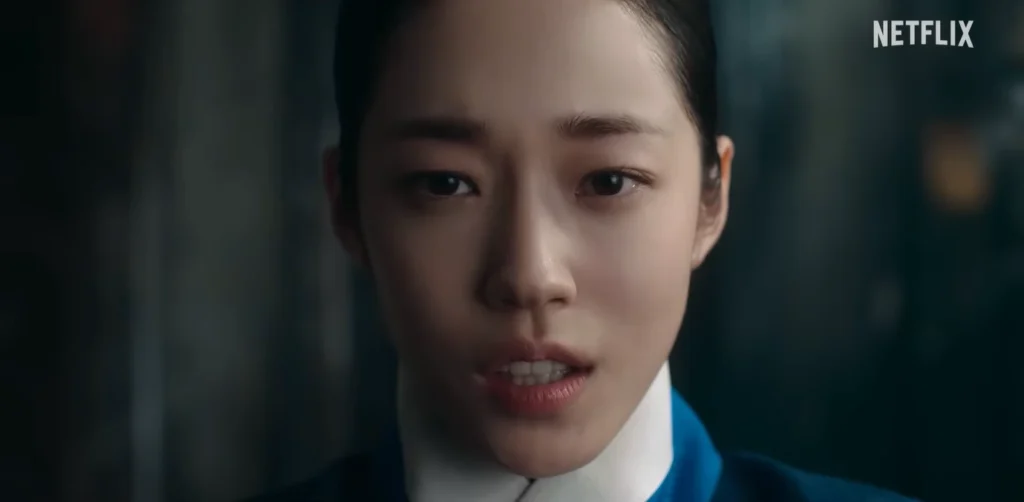
To keep an eye on him, the King assigns Saeng-gang (Se Gang) to assist him. She appears to be a simple court lady, but she is secretly the King’s illegitimate daughter, hidden from the rest of the kingdom.
When the prince’s condition rapidly deteriorates—foaming at the mouth while a shaman literally coughs up blood trying to save him—Gu-cheon does something completely unhinged. He doesn’t perform a standard ritual in the bedroom. He goes to the cursed pond, ties a rope around a tree, loops the other end tightly around his own neck, and intentionally drowns himself to cross into the spirit realm.
The visual transition here is fantastic.
The spirit world’s sky is blood red, swarming with crows. Gu-cheon finds a massive ghost physically draining the prince’s spiritual body and slashes its neck with his sword. Back in the real world, Saeng-gang follows Gu-cheon’s secret instructions. She cuts her own hand and smears the blood on herself, using the scent of fresh blood to distract the monster and buy Gu-cheon time.
It is a kinetic, intensely gory sequence. But the ghost drops a massive hint before vanishing: It knows Gu-cheon cannot truly defeat it.
Is the pond spirit actually killing the royal family? Nope. It is just basic, greedy human murder running a highly successful supernatural PR campaign.
Sitting in the dark, watching the mid-series episodes drop this twist, I literally spilled my drink. I thought the writers were just dragging out a standard exorcism plot… or actually, I severely underestimated how deliciously evil Joseon dynasty politics could get.
The World’s Most Toxic Grandmother
For thirty years, everyone in the palace believed a murdered court lady was picking off the princes one by one. The former Queen falsely accused this pregnant court lady of having an affair with a royal guard. Before her execution, she swore a bloody oath to return and wipe out the royal bloodline.
A perfect ghost story.
Gu-cheon goes through hell and actually defeats the pond spirit. Case closed, right? But Saeng-gang keeps hearing whispers from the dead, chanting that the real culprit is still breathing. Then, Prince Yeongan drops dead.
The ghost didn’t kill him.
The biggest twist of The East Palace lands with a sickening thud. The mastermind is Saeng-gang’s sweet, protective grandmother. Decades ago, she used the court lady’s execution as a brilliant smoke screen to secretly poison every single prince standing in her son’s way to the throne. She even recruited Saeng-gang’s mother to help, and then brutally murdered her to ensure zero loose ends.
Absolutely psychotic behavior.
The Crown Prince Gets an Ak-gwi Upgrade
The generational trauma does not stop there.
The current Crown Prince inherited his father’s ability to hear the dead. He listens to the spirits and uncovers his family’s blood-soaked path to the throne. So what does this supposedly noble prince do? He decides to copy his grandmother’s playbook and starts poisoning his own brothers.
King Yeongjong finds out. He refuses to let history repeat itself.
He executes his own son.
The Crown Prince doesn’t just die. He dies suffocating on pure, unadulterated hatred, transforming into an Ak-gwi—a monstrous entity entirely stripped of its humanity, existing only to destroy.
We’ve seen a million K-dramas in 2026 use the “vengeful ghost” trope, but an undead royal raising an army of angry plague victims to annihilate the palace? That is a massive escalation. King Yeongjong had previously sacrificed a whole village of plague victims to save the kingdom, and now those abandoned souls are marching on the East Palace.
The Primordial Bargain
Look. You cannot just stab an Ak-gwi and walk away.
The lore drops a terrifying rule: completely erasing another soul saddles the killer with overwhelming karmic debt. If you destroy an Ak-gwi, you are condemned to become one yourself.
Gu-cheon doesn’t even flinch. He knows he is not walking out of this alive.
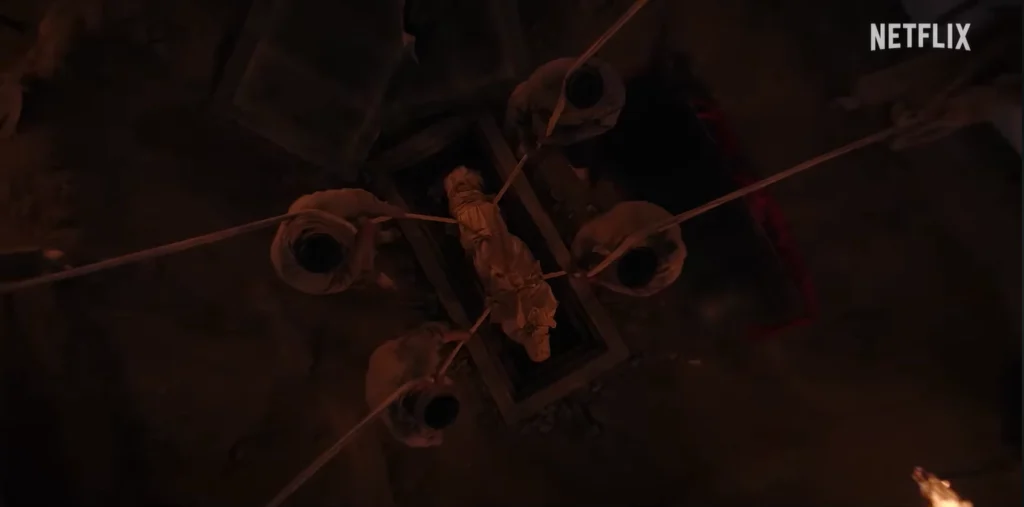
To get enough raw, unfiltered power to match the Crown Prince, Gu-cheon seeks out Mother Gwi-mae. She isn’t a typical villain; she is an ancient, neutral force of supernatural balance. She doesn’t offer him a magical power-up out of the goodness of her heart. It is a strict, fatal transaction. Gu-cheon willingly trades his own future—and his soul—just to buy Saeng-gang enough time to survive.
He attacks the Crown Prince, utterly obliterating his soul.
And then, his physical body drops dead.
A King Who Actually Apologizes? Unheard Of
You would expect the final battle against a mutated, undead Crown Prince to end with a massive CGI explosion.
Actually, the writers pulled off something incredibly rare for 2026 television. The plague spirits aren’t defeated by raw physical force. They are defeated by basic accountability.
Throughout the series, King Yeongjong hid behind his throne, refusing to confront the fact that he sacrificed an entire village of innocent people to a plague. But during the appeasement rite, he completely drops the royal ego. He doesn’t beg for forgiveness or make cheap excuses. He stands in front of the furious spirits, admits his crimes were unforgivable, and tells them they have every right to kill him.
That single moment of terrifying honesty shatters the curse. Once the victims finally receive the acknowledgment they were denied in life, they let go of their resentment.
Without their stolen anger to fuel him, the Ak-gwi Crown Prince loses his supernatural armor. Unresolved guilt created the monsters; sincere accountability kills them.
The Riverside Therapy Session
Let’s go back to Gu-cheon’s lifeless body.
He lies completely motionless for three agonizing days. Saeng-gang tries everything to revive him, but it is entirely useless. I was sitting there at 3 AM, genuinely believing the showrunners had the guts to permanently kill off their lead.
But wait.
The tiny, adorable spirit known as Ggeomeoksali is still lingering right next to Gu-cheon’s body. Because this specific creature only follows the living, Saeng-gang cracks the code. Gu-cheon’s physical body isn’t dead; his soul has just wandered off.
He is spiritually paralyzed at the exact riverside cliff where his mother drowned years ago. He spent his entire life weighed down by the toxic belief that he was supposed to die with her.
Saeng-gang tracks him down and violently rejects his martyr complex. She rings a bell to guide him back, becoming the only person in his life to demand he choose his own future instead of sacrificing himself for a corrupt kingdom. He hears the bell. He chooses the living.
The Invisible Leash
Historically, if a commoner knows the King committed mass murder and the royal family is built on poisoned corpses, they get a swift execution.
But King Yeongjong actually shows character growth. He chooses trust over fear and lets Gu-cheon and Saeng-gang walk out of the East Palace alive. They abandon their suffocating royal and exorcist identities to finally live on their own terms.
A heartwarming, peaceful resolution.
Absolute bait and switch.
Just before the screen fades to black, a final supernatural scream tears through the audio. The camera pans down to Gu-cheon walking away. Attached to his hand is a heavy, spiritual chain stretching endlessly back into the Realm of Gwi.
He survived the palace. He got the girl. But part of his soul is permanently tethered to the demonic underworld he bargained with.
You don’t just walk away from hell. It keeps you on a leash.
read more : Widow’s Bay Ending Explained: Shocking Apple TV Cast, Hidden Secrets & Theories